
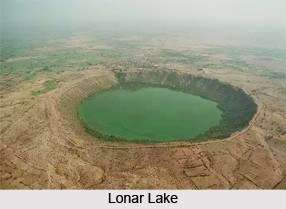
 Lonar Lake is a saline soda lake in India. It is not only one and only in India, but it is the world"s hyper-velocity impact crater.
Lonar Lake
Lonar Lake is one and only world’s hyper-velocity impact crater in basaltic rock, located in Maharashtra, now the tourist attraction for both the serene nature and the temple of Yadava Dynasty in the early medieval India.
Introduction
Lonar Lake is a saline soda lake in India. It is not only one and only in India, but it is the world"s hyper-velocity impact crater.Location of Lonar Lake
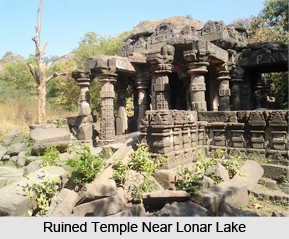
Lonar Lake located at Lonar in Buldhana district of Maharashtra. Near Lonar Lake, there are many temples constructed in the medieval era especially in Yadava Dynasty.
Creation of Lonar Lake
Lonar Lake was created by a meteor impact during the Pleistocene Epoch and it is the only known hyper velocity impact crater in basaltic rock anywhere on earth.
Lonar Lake in Historical Texts
Ain-i-Akbari which was written about 1600 CE states that the Western Ghats Mountain Range in India produce all the requisites for making glass and soap. And here are saltpetre works which yield a considerable revenue to the state, from the duties collected. On these mountains is a spring of salt water, but the water from the centre and the edges is perfectly fresh.
Geological Explanation on Lonar Lake
 Lonar Lake lies within the only known extraterrestrial impact crater found within the great Deccan Traps basaltic formation of India. The lake was initially believed to be of volcanic origin, but now it is recognized as an impact crater created by the hypervelocity impact of either a comet or an asteroid. The presence of plagioclase that has been either converted into maskelynite or contains planar deformation features has confirmed the impact origin of this crater. It is argued that only shock metamorphism caused by hypervelocity impact can transform plagioclase into maskelynite. The presence of shatter cones, impact deformation of basalt layers comprising its rim, shocked brecciate inside the crater, and non-volcanic blanket surrounding the crater are further proof of the impact origin of Lonar crater. The crater of Lonar Lake has an oval shape. The meteorite impact came from the east, at an angle of 35 to 40 degrees.
Geography of Lonar Lake
Lonar Lake lies in a basalt impact structure, is both saline and alkaline in nature. Geologists, ecologists, archaeologists, naturalists and astronomers have published studies of various aspects of this crater lake ecosystem.
Extension of Lonar Lake : Lonar Lake has a mean diameter of 1.2 kilometres (3,900 ft) and is about 137 metres (449 ft) below the crater rim. The meteor crater rim is about 1.8 kilometres (5,900 ft) in diameter. The circular depression of Lonar Lake bears a saline water lake in its central portion. The crater`s age is usually estimated to be 52,000 to 60,000 years (Pleistocene), although a study published in 2010 gives an age of 570,000 to 4,70,000 years.
Extension of Lonar Lake : Lonar Lake has a mean diameter of 1.2 kilometres (3,900 ft) and is about 137 metres (449 ft) below the crater rim. The meteor crater rim is about 1.8 kilometres (5,900 ft) in diameter. The circular depression of Lonar Lake bears a saline water lake in its central portion. The crater`s age is usually estimated to be 52,000 to 60,000 years (Pleistocene), although a study published in 2010 gives an age of 570,000 to 4,70,000 years.
Natural Beauty of Lonar Lake
Lonar Lake has the beautiful natural landscape. There are the series of low hills surrounding the basin which has an oval shape (almost round) with circumference at top of about 8 km (five miles). The sides of Lonar Lake rise abruptly at an angle of about 75 degree. At the base, the lake has a circumference of about 4.8 km (three miles). The slopes are covered with tree-savannah, housing teak, Wrightia tinctoria, Butea monosperma, and Helicteres isora. Shrub-savannah with Acacia nilotica and Ziziphus spp. covers the crater wall. Along the lake shore, non-native Prosopis juliflora is spreading. The north-eastern alluvial terrace, along the dhara river fan, is used for agriculture. Millet, maize, lady`s finger, banana and papaya are the main cultivated crops.
Water of Lonar Lake
The water of Lonar Lake contains various salts or sodas, and during dry weather when evaporation reduces the water level, large quantities of soda are collected. Two small streams, named Purna River and Penganga River, drain into the lake, and a well of sweet water is located on the southern side, close to the water`s edge.
Temples near Lonar Lake
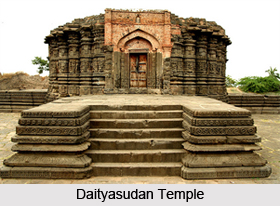 Daityasudan Temple : Daityasudan Temple is one of the most exquisitely built temples in Lonar Lake region. This temple is now in ruins. This temple is on the rim of the Bowl of Main crater. One needs to go inside the narrow lanes of the Lonar to visit this master piece. There are many erotic sculptures around this temple of Datiyasundan, which are also depicted in Khajuraho of Madhya Pradesh. Daityasudan Temple is a Vishnu temple with Goddess Durga, Lord Saurya and Nrusimha on three remaining sides of Daitya Sudan Temple. The east is the entrance; this temple has a base of seven layers of stone platforms. Later it was demolished by the invasion of last Mughal ruler of India, Aurangzeb.
Lonardhar Temple : Lonardhar Temple is Lord Vishnu temple built on the 1 foot wide water stream which falls into a "Kund" constantly throughout the year. The stream was caused by impact of the main meteor. It"s still not clear how the water stream is sourced from by this natural water stream. The rim is at higher altitude than surrounding areas thereby making it another mystery.
Kamalaja Temple : Kamalaja Temple is the temple in Lonar region. This temple is located at the southern most portion of the Lonar Lake. Kamalaja Temple is dedicated to Goddess Kamalaja. Every year there is a festival held by the devotees and the people from the far off places used to visit this temple.
Motha Maruti : Motha Maruti is a 9 feet long Hanuman Temple located in the Lonar region and it is located in front of the Lonar Lake. It is believed to be part of the splinter fell from the universe as the meteor impact during the Pleistocene Epoch.
Tourism on Lonar Lake
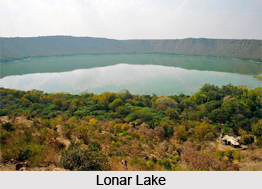 Lonar Lake has its own ecological system. As sun sets, the entire lake appears differently. The lake water of Lonar sweeps across the shore like sea water, the birds, wolves, peacock and other creatures start making their presence felt.
The best time to visit Lonar Lake is the Sun rise and Sun set. Lonar Lake has remarkable presence of splinters of glass confirming the impact which caused the enormous temperature rise thereby turning the sand into glass.
Chemical Reaction of Lonar Lake : Due to the tourist extravaganza in the time of Maha Shivaratri and the nearby inorganically agriculture, the chemical characteristics misbalanced with outer neutral (pH 7) and an inner alkaline (pH 11) mixing each with its own flora and fauna.
Flora and Fauna near Lonar Lake : Lonar Lake is a haven for a wide range of plant and animal life. The resident and migratory birds such as Black-Winged Stilts, Brahminy Ducks, Grebes, Shelducks (European Migrants), Shovellers, Teals, Herons, Red-Wattled Lapwings, Rollers or Blue Jays, Baya Weavers, Parakeet Hoopoes, Larks, Tailorbirds, Magpies, Robins and Swallows are found on the lake. Among reptiles, the monitor lizard is reported to be prominent. The lake is also home to thousands of peafowls, chinkara and gazelles.
Recently updated articles in Geography of India
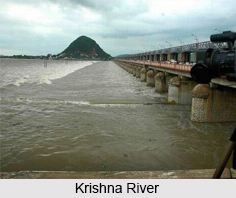
Krishnaveni River
The Krishnaveni River, presently known as the Krishna River, is one of India’s major rivers. Originating in the Western Ghats of Maharashtra, it flows...

Wakal River
The Wakal River is an important tributary of the Sabarmati River, originating in Rajasthan’s Aravalli Range and flowing through Rajasthan and Gujarat....
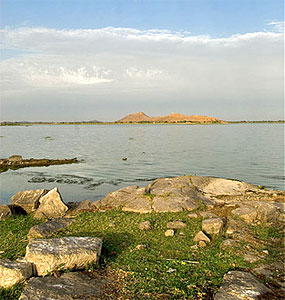
Pahuj River
Pahuj River is an important tributary of the Sindh River that flows through the Indian states of Madhya Pradesh and Uttar Pradesh. Originating in the...
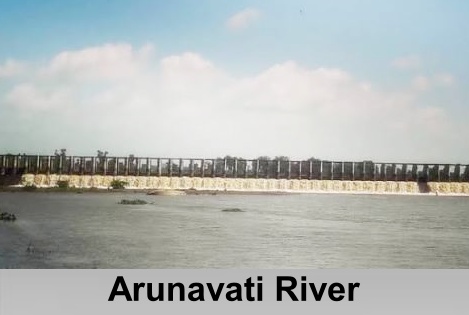
Arunavati River
Arunavati River is a seasonal right-bank tributary of the Tapi River, flowing through parts of Madhya Pradesh and Maharashtra. Originating in the Satp...
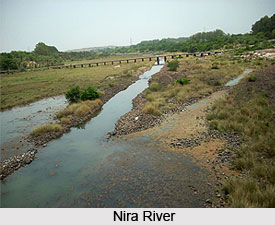
Nira River
Nira River is an important tributary of the Bhima River flowing through Maharashtra. Originating in the Western Ghats, it traverses Pune, Satara, and...
Related articles in Geography of India
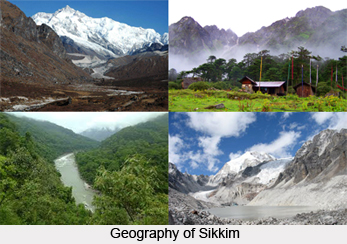
Geography of Sikkim
Geography of Sikkim is characterised by a vast array of magnificent hillock that extends from one corner of the state to the other.
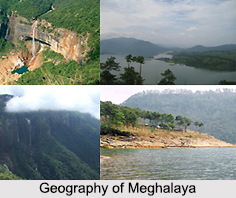
Geography of Meghalaya
The suitable climate, highland plateaus, rivers and the flora and fauna together forms the geography of Meghalaya.
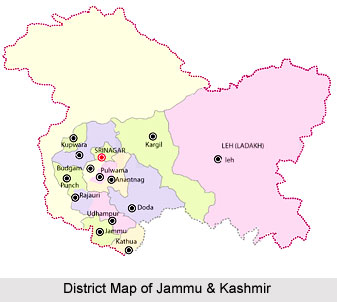
Geography of Jammu & Kashmir
Jammu and Kashmir is encompassed by valleys. Some of the dominant valleys of the state are Kashmir Valley, Tawi Valley, Chenab Valley, Poonch Valley,...
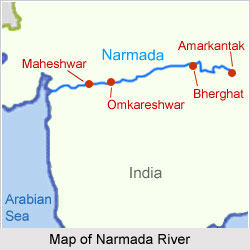
Narmada River
Narmada River is regarded as the 5th longest river of India and the life line of Madhya Pradesh. Narmada River basin spreads over an area of about 98,...
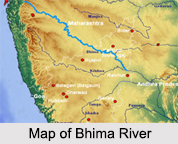
Bhima River
The Bhima River is the largest tributary of the Krishna River and is significant in the western and southern Indian states.