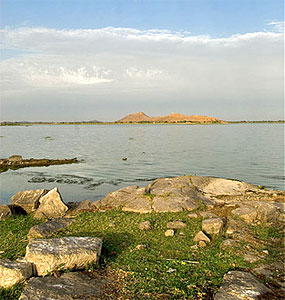
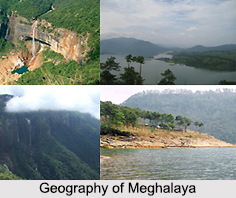
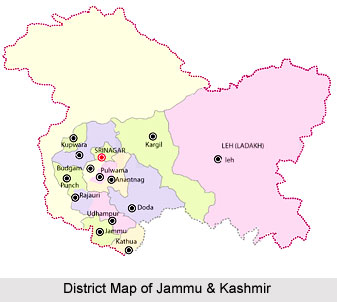
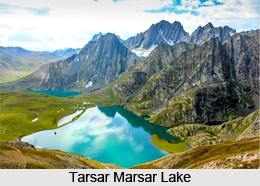
 Tarsar Lake is an almond-shaped, oligotrophic alpine lake situated in the Kashmir Valley, specifically in Aru, Anantnag district, Jammu and Kashmir, India. The lake is separated by a mountain forming another lake of the same nature known as "Marsar Lake", which is in the vicinity of Dachigam National Park. Together these two lakes are referred to as the "Twin Sisters".
Marsar Lake is a beautiful alpine water body full of scenic natural beauty. The lake is located at a distance of about 5 km from Nagberan village. Marsar Lake along with Tarsar Lake forms a challenging trekking trail that adds another feature to the adventure of Jammu and Kashmir tourism.
Geography of Tarsar Marsar Lake
Tarsar Lake is dominated by the peaks of the Kolahoi mountain massif some 20 km to the east. Nestled at an elevation of 3795 meters, the lake is eye-catching and measures 2 km in length and around 0.8 km in width. The lake is separated by a mountain with a minimum peak elevation of 4,000 metres (13,000 ft) from another lake known as "Marsar Lake.
The Tarsar Lake is drained by an outlet stream which falls into the Lidder River at Lidderwat, 15 km to the east. The Marsar Lake on the other hand drains out and flows in the opposite direction of the Tarsar Lake.
Flora and Fauna of Tarsar Marsar Lake
During the winter, the Tarsar Lake freezes and is covered by heavy snow. It has floating ice even in the summer. The basin of the lake is surrounded by a sheet of alpine flowers. The Geum, Blue Poppy, Potentilla and Gentian are relatively common. Hedysarum flowers are found in late spring throughout the area around the lake.
During summer there are breeding colonies of migratory birds, including Bar-Headed Goose, Lammergeyers, High-Flying Choughs, Himalayan Golden Eagles, Cinnamon Sparrows and Black Bulbuls. The basin of Tarsar and the adjoining Dachigam National Park constitute one of the most important habitats of the Kashmir Stag, Ibex, Musk Deer, Snow Leopard and Himalayan Brown Bear, and in the higher reaches, the Golden Marmot.
How to Reach Tarsar Marsar Lake
Tarsar Lake is one of the beautiful tourist places to visit in Pahalgam. Tarsar Marsar Lake is accessible only during the summer. In winter, the treks are closed because of the heavy snowfall. It can be reached from Srinagar, via a 102 km motorable road which leads through Anantnag and Pahalgam to the Aru trekking camp. Due to the steepness of the trek, it is preferable to approach the lake by the Aru-Lidderwat trek and return via the Sumbal-Sindh Valley trek. Another accessible route to Tarsar and Marsar is a place called Nagberan via Tral.