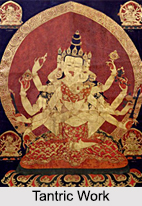
 Tantric Literature and its practices have influenced all the religions of India. There is still a considerable number of works in manuscripts in different collections of India. Tantra consists of a large number of sects and subjects having characteristically varying rituals and practices. Tantras are works that primarily focus on ritual and meditative practices, so the term tantric also envelops the practices associated with these scriptures, which were traditionally disseminated by the tantric practitioners, along with the texts. The ritual mainly advocated by Tantric literature is a system of worship in which, by internal and external ritual acts, the worshiper intends to establish his or her identity with the deity worshiped.
Tantric Literature falls under "Agamas" that concentrate on a particular aspect of the almighty and enjoyment is necessary for salvation. Tantric Literature begins with creation of the world and ends with the end of the world or the beginning.
Names of Various Tantric Literatures
Some of the important Tantric texts are "Guhyasamaya", "Manjusir Moolakalpa", "Rudrayamala" and "Brahmayamala", which were written by Buddhist monks. The major works on the Agama Shastra of Kashmir are "Mdlinivijaya", "Svacchanda", "Vijhdnabhairava", "Ucchusmabhairava", "Anandabhairava", "Mrgendra", "Mdtanga", "Netra", "Naisvasa", "Svayambhuva" and "Rudrayamala".
The main works of the Pratyabhijna literature are "Sivadrishti" of Somananda, "Pratyabhijhdkarika" of Utpala, "Malinivijayottaravartika", "Pratyabhijnavimarsini", "Tantra Loka", "Tantrasara" and "Paramdrthasdra" of Abhinavagupta, "Pratyabhijndhadaya" of Ksemaraja, disciple of Abhinava. The chief works of the Samhita class are "Ahirbudhnya", "Isvara", "Pauskara", "Parama", "Sdttvata", "Brihadbrahma", "Janmadrthasdra" and "Jayakhya".
The "Saundarya Lahari" is a popular Tantric work which is attributed to Shankaracharya. The "Varaha Tantra" has 54 Tantras. There are many digests, commentaries, lexicons, for instance "Tantrasara" of the Bengali Krishnananda, "Tantrabhidhdna" and "Mantrakosa".
Among the Buddhist Tantras the common ones are "Arya Manjusrilmulakalpa", "Hevajra Tantra", "Prajnopaya-viniscaya-siddhi" of Anangavajra.
Many texts have been composed and preserved by tantric communities, the majority of which have not been edited, studied or translated. Tantric literature was often ignored by past generations of scholars, some of whom deemed tantric literature as unworthy of study. The study of these texts is an ongoing effort, which, as it proceeds, should deepen ones understanding of the history of tantric traditions.