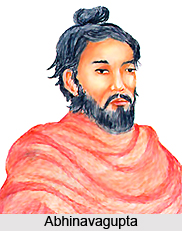
 Abhinavagupta (975 -1025 AD) is an ancient philosopher in India, who lived in the state of Kashmir during the end of the tenth and the beginning of eleventh centuries. He was a learned person with knowledge in both the Shaiva philosophy and Sanskrit literature. He is a Kashmiri theologian and aesthetician. He belonged to the Tantric Trika ritual cult.
His philosophical works include commentaries on Utpaladev`a Ishvarapratyabhijna-karikas and the Malinivijayottara Tantra. He believed that other doctrinal systems are not to be treated as adversaries instead they should be considered as aspects of the self-expression of the supreme conscious reality. Abhinavagupta put forward a theory of absolute idealism. According to this theory the world derives from a single universal, autonomous and dynamic consciousness that expresses itself in an infinite variety of subjects, objects and acts of awareness. The seeker after release from rebirth is supposed to meditate upon the nature of consciousness, oscillating between the illumination of objects and reflective awareness. Abhinavagupta believed that the independence of mind is impossible. He has an argument against Buddhism too. He believes that the atman, the permanent background to experience, persists as a stable unity that synthesizes mental states. There would be only momentary, self-contained, unrelated mental episodes without such a principle. According to him ideas represent physical objects. Consciousness can only represent what is itself conscious.
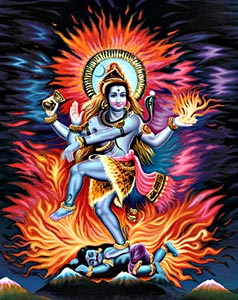
Abhinavagupta took the way of direct communication for spreading his knowledge about the Shaiva philosophy and he took help of a number of teachers and saints of his contemporary time. This brought him the nickname, `Sankaracharya of Kashmir`. Abhinavagupta also became successful in possessing all the eight yogic powers that are explained in the Hindu Shastras and apart from that he also had a vast knowledge about the `Six Signs` that make someone in the category of god. This was the main reason why some of his descendants and the other people did consider him as the `Shiva incarnate`.
Abhinavagupta gave a new and his own definition of Karma and said that karma actually deals with space and time and according to him actually there is no space. He was successful in making one thing clear and that is the state of God`s consciousness. Abhinavagupta has also written some wonderful books to spread his philosophy and those books have also become well famous among the masses. Some of his most popular and famous works include the likes of `Bhairavastotra`, `Vastika` and also the `Kramastotra`.