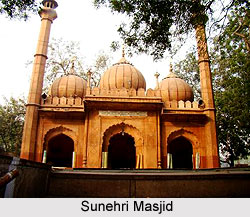
 Sunehri Masjid is one of those monuments Old Delhi that remained unharmed after the first war of Indian Independence in 1857. Sunehri Masjid is located near the Red Fort, in the city of Delhi. The mosque is also known as the "Golden Mosque". The mosque`s original form has been altered as additions have been constructed to provide lodgings to the devotees. The mosque is also affected under danger of infringement. Sunehri Masjid was repaired by Bahadur Shah Zafar.
Legends of Sunehri Masjid
According to the legends, Qudsiya Begum was a consort of Mughal emperor Muhammad Shah and mother of his descendant Ahmad Shah Bahadur. She was also a superintendent and it is said that she even served as de facto regent (kind of government) of India from 1748 to 1754. It was she who had ordered the construction of the mosque.
Qudsiya Begum is said to have been an influential woman who reigned with great power and authority after the death of her husband. She had a fondness for art and architecture throughout her life. Begum was also credited for the construction of an elaborate garden area called Qudsiya Bagh. It is said that the construction of the mosque took four years, from 1847 to 1851, and was built for Nawab Bahadur Javed Khan who was a leading nobleman for the period of the sovereignty of the Ahmad Shah Bahadur and administrator of the harem. However, then Mughal Emperor Bahadur Shah Zafar ordered the dome to be replaced with strong red limestones.
The most important thing about this mosque is that Nadir Shah, the Persian ruler who defeated Mughal ruler Muhammad Shah watched the "katl-i-am" or general massacre of people of Delhi from top of this mosque. It is said that in one day around 30,000 people were done to death.
Architecture of Sunehri Masjid
Sunehri Masjid is an elegant building that has been built on the south-western corner of Delhi Gate. The mosque is adorned with three large domes that were originally coated with copper. The mosque houses with a main prayer hall and twin minarets that have been intricately carved. The domes of the mosque had copper gilt plates. These plates were repaired and reinstated by Bahadur Shah II in 1852 by sandstone facing. An inscription can be seen on the central arch of the mosque. It enlightens the people about the builder of the mosque and date of construction.
Visiting Information of Sunehri Masjid
Sunehri Masjid of Old Delhi can be reached through the metro as the nearest metro station to the Masjid is Kashmiri Gate, while the nearest Railway Station is Old Delhi Railway Station.