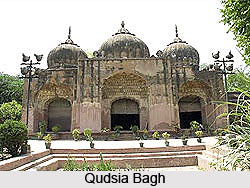
 Qudsia Bagh is an 18th-century garden complex and palace located in Old Delhi. Qudsia Bagh is located on the main Shamnath Road, north of Inter State Bus Terminal (ISBT), and near Kashmiri Gate. The garden dates back to the mid of 18th century. Laid by Nawab Qudsia Begum in 1748, the dancing girl who later became wife of Emperor Muhammad Shah Rangeela, the garden once housed a palace, waterfall, a mosque, a summer lodge and a beautiful flower and fruit garden. This huge garden with a palace and a private mosque extended up to the banks of the Yamuna River.
Legend of Qudsia Bagh
Qudsia Bagh dates back to the mid-18th century. The place gives an impression of a magnificent pleasure park. Qudsia Bagh was built by Qudsia Begum, the wife of Mohammed Shah and the mother of Ahmad Shah Bahadur. She was a dancing girl and was called Udham Bai before she married the emperor and got the title of Qudsia Begum. She built this garden fortress exclusively for herself in the same year that her husband died. Begum also proved to be a great Mughal lady of the first half of the eighteenth century.
Interiors of Qudsia Bagh
The garden was built in the traditional Persian Charbagh (four gardens) style, and was originally divided into four parts by the flowing water bodies and walkways. Earlier there were a palace, waterfall, a mosque, a summer lodge and a beautiful flower and fruit garden with the Qudsia Bagh. There was also a raised pavilion to sit and admire the garden and the 4 parts had various flower beds and fruit trees. Qudsia Masjid served as a personal mosque of the Emperor and his wife. The architectural plan of the mosque is very simple way. It is surmounted by 3 domes and has three arched openings. It was later repaired and renovated in 1833-34 by Bahadur Shah II.
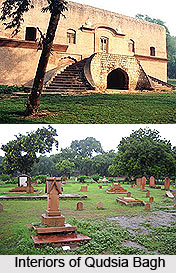
According to history, Qudsia Palace was built like a fort. It was surrounded by high walls. During the Great Revolt of 1857, this garden was used by the British troops as their camp and most of the walls and gateways were destroyed. Once the war was over, a capable gardener was appointed by a British official to take care of the garden. Recently the gateway and the mosque have been repaired and renovated to restore the beauty and charm of the garden. After the war, the British appointed the able gardener Smith to look after the garden. The gateway and the mosque were recently restored and efforts have been made to bring the garden back to its original beauty. At present it is a very good place to relax and rest, away from the hustle and bustle of nearby Old Delhi. The gateway is called Hathi or Elephant gate, and even in its ruined state, it looks majestic. The entrance gateway, the Qudsia mosque located about 300 meters to the east and the 2 pavilions carved in red sandstone are still visible. Later British freemasons under took the control of this park. A hall was also erected by them here. Soon a large part of the garden was demolished to construct the Inter State Bus Terminus and the adjoining tourist campground.
Present Scenario of Qudsia Bagh
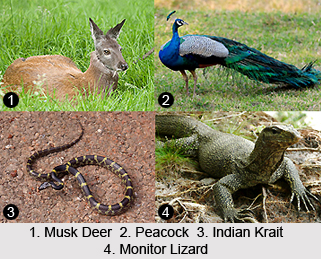
There is a Hindu monument located in the vicinity of Qudsia Bagh that houses the mounted statue of Pratap Singh known for his bravery and fearlessness. Today this garden is well maintained and a lot of birds, particularly peacocks, can be seen there. It is ideal for a peaceful walk, but also to sit back on a bench and admire the traces that history has left behind and imagine its lost grandeur. However, a greater part of the garden was used to construct the Inter State Bus Terminus and the adjacent tourist campsite.