 Rupnagar, situated in Rupnagar district of Punjab state, is an ancient town as well as a major site of Indus Valley Civilization. The town is believed to have named by Rokeshar, a king who reigned here during the 11th century. He named the place after his son Rup Sen. Rupnagar spreads over a high ancient mound over the Shiwalik. It merges with the plains on the left bank of Sutlej River.
Archaeological excavations furnished a sequence of six cultural phases, starting from Harappan civilization to present time, with certain breaks. Archaeological Survey of India, under the guidance of Dr. Y. D. Sharma has made these findings. An archaeological museum has also been established in Rupnagar which hosts various antiquities found along with the photographs of the excavations.
Cultural Phase I
Excavations in Rupnagar at lowest level have revealed Harappan traits. Major findings of this phase include copper implements, imprints of seals on a lump of burnt clay or terracotta, terracotta bangles and beads and typical pottery of Indus Valley Civilization. A steatite seal having Indus script has also been found which was probably used for trade purpose. The earliest houses of this region were formed of river pebbles, which subsequently got replaced by cut slabs of lime. Foundation of the houses was usually built with sun baked bricks. Other common features included water repelling sticky clay as plasters and deep-pitched roofs.
Cultural Phase II
The second cultural phase of Rupnagar belonged to the period of painted grey ware which followed the first phase. Remains of pottery excavated from this phase included copper implements, ivory kohl sticks, bone arrowheads, semi precious stones, terracotta bangles, black painted grey ware.
Cultural Phase III
By 600 BC, a new settlement flourished here which was chronologically designated as cultural phase III. However the grey potteries of phase II still continued. The third cultural phase stretched from 600 BC to 200 BC. Excavations have revealed copper implements, uninscribed cast coins and punch marked coins. A significant finding in this phase was an ivory seal with the inscription of Mauryan Brahmi script associated with 4th and 3rd centuries BCE. A water tank has also been recovered whose upper level have soak wells lined with terracotta rings of Kushana and Sunga periods. The housing complexes of the phases from III to V were made of mud bricks and stones.
Cultural Phase IV
Cultural phase IV of Rupnagar has furnished articles belonging to Gupta, Kushana and Sunga periods. Abundant copper coins belonging to Kushana and Gupta periods have been recovered. Apart from this, a gold coin has also been found which was issued by Chandragupta Kumardevi of the Gupta dynasty. This reign is often stated as the golden age in ancient Indian history. Numerous terracotta figurines have been unearthed along with a set of three silver utensils which were probably used for ritualistic purpose. Its adornment testifies the excellent craftsmanship of Gupta dynasty. The pottery of this phase comprises of red ware, embellished with various motifs.
Cultural Phase V
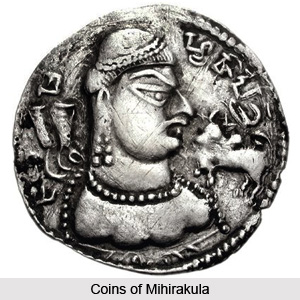
The fifth cultural phase of Rupnagar follows a short break after the fourth phase. This phase begins around early 6th century and continues for three to four centuries. Excavations have revealed coins of Mihirakula and Toramana, ancient empires. The society during this phase was quite prosperous and the spacious brick buildings are the evidences of this fact.
Cultural Phase VI
The sixth cultural phase began after the rising of a new town in Rupnagar around 13th century CE and is continuing and blossoming till the present day.