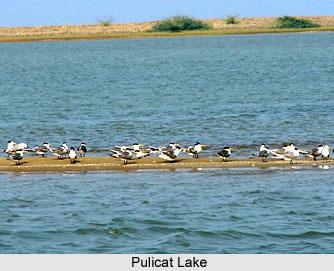
 Nestled on the border of Andhra Pradesh and Tamil Nadu, along the Coromandel Coastline is the Pulicat Lake, with a length of about 60 km. The lake is located on the swampy sandy Andhra plains, and the surrounding area is sparsely settled. Towns along the lake include Dugarajupatnam, Pulicat and Sullurpeta. The long and narrow Sriharikota Island, which separates Pulicat Lake from the Bay of Bengal, is the site of Satish Dhawan Space Centre, India"s satellite-launching facility. Sixteen islands nicely enhance the topographical beauty. Almost thirty lakes are there adjacent to it. A popular story is that Dutch and the British moored their ships on the Karimanal Village, which is located just opposite to the mouth of the Pulicat lake. The famous Coromandel Coast got its name from there.
Hydrology of the Pulicat Lake
The Arani River at the southern tip, the Kalangi River from the northwest and the Buckingham Canal at the west feeds the brackish water lagoon. The lake acts as buffer to retain the accumulated flood water till the flood water is discharged gradually to the sea during the monsoon period. The water quality of the river basin varies widely during the seasons- summer, pre-monsoon, monsoon and post- monsoon; this is because the depth and width of the lake causes a dynamic situation of mixing and circulation of water.
Flora and Fauna in the Pulicat Lake
The lake has a rich diversity of fishes, mostly brackish water fishes like mullets and catfish, along-with few freshwater species. There is also a substantial production of planktons which gets affected due to the salinity variation in the lake during the monsoons. Tonnes of fish and crustaceans like crabs, shrimps are harvested annually.
The Pulicat Lake serves as the third most important spot for migratory birds, because of its wide diversity of aquatic birds there are also two bird sanctuaries in the lagoon, one in Andhra Pradesh and the other in Tamil Nadu. Every year, there are 15,000 flamingos, which throng the lake including Spot-Billed Pelican, pelicans, kingfishers, herons, painted storks, and ducks. Huge sea turtles build their nests on the beautiful banks of the Pulicat Lake.
There is a reported aquatic vegetation of about 59 species. There are patches of residual, dry, evergreen forest and large areas of littoral scrub in woodlands in fishing villages bordering the lagoon.
Much of the Pulicat Lake is sheltered as a wildlife sanctuary and the authorities have taken great initiatives for its protection. However, the proposal plans including petrochemical compound, power plants, and a satellite port on Ennore creek, have aroused concern about the ecological balances of the Pulicat Lake.