 The Indian Subcontinent provides suitable habitats to various species of birds for residing and nesting. Pelicans are no exception in this regard. They belong to the kingdom, Animalia; phylum, Chordata; class, Aves; order, Pelecaniformes; family Pelecanidae; and genus, Pelecanus. These pelicans are described below.
Great White Pelican
 The adult Great White Pelican is a white plumaged bird. A distinctive feature of this pelican is its bill, which is extremely long. Male and female Great White Pelicans differ in terms of physical features. A breeding male has pinkish facial skin, whereas the female has orange facial skin. The male Pelican measures 175 cm in length and its weight ranges from 9,000 to 15,000 grams. The length of its bill ranges from 350 to 450 mm. The female counterpart measures 150 cm in length and its weighs ranges from 5,500 to 9,000 grams. The length of its bill ranges from 280 to 400 mm. If the bird is grey in color and has dark flight feathers, it is then identified as an immature bird. This species depends mainly on fish for survival.
Spot-Billed Pelican
 The dominant color on the body of the Spot-Billed Pelican is white. The bird has grey colored crest and hindneck. A grayish nape crest is formed by the feathers on the hind neck, which are characteristically curly. The color of the pouch ranges from pink to purplish and has large pale spots. The bird is also spotted on the sides of the upper mandible. The color of the tip of the bill or nail appears yellow or orange. The breeding bird has pink orbital patch. Its skin at the base of the beak is dark. This bird uses its bill pouch to catch fish.
Dalmatian Pelican
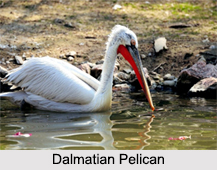
Dalmatian Pelican breeds in the Indian Subcontinent. This bird has chalky upper parts and tail. The breeding adult pelican is recognized as a silvery white bird. The color of the gular pouch differs according to the breeding season. During the breeding season, the bird has orange-red gular pouch, whereas in the non-breeding season, the color of the pouch changes to yellow. The color of the bare skin around the eyes ranges from yellow to purple. The bird has grayish white wings, with black tips. The nape feathers are curly. The legs of the bird are grey in color. The length of a Dalmatian Pelican ranges from 160 to 180 cm and its weight ranges from 10,000 to 13,000 grams. The wingspan ranges from 300 to 350 cm. The length of the bill ranges from 350 to 450 mm. This pelican depends mainly on fish for survival.