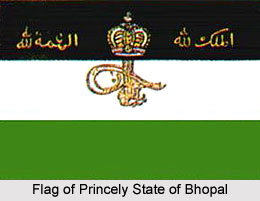
Princely State of Bhopal

Princely State of Bhopal was one of the 19 Gun Salute states of India which was under the indirect control of the British Government of India.

About Princely State of Bhopal

Princely State of BhopalThe Princely State of Bhopal was one of the 19 Gun Salute states of India during the rule of the British Empire in India which was administered by native rulers, also known as Indian princes, under the indirect control of the British Government of India. The princely state existed from the year 1818 to 1947. After India achieved independence, the territory attained the statues of an autonomous country until 1949, after which the state was merged with the Dominion of India as Bhopal. The Princely State of Bhopal covered a total area of 6,921.25 sq miles and comprised of a total population of 785,322 in the year 1941. Bhopal was located in the state of Malwa and included 2,946 villages and 17 towns. It was the leading Muslim princely state in Central India Agency and was ranked 2nd in importance to Hyderabad amongst the Indian Muslim states.

The territory was bounded by the Sironj district of Tonk, Bhilsa and Isagarh districts of Gwalior and Muhammadgarh in the north; by the British district of Saugor in the east; by the British districts of Hoshangabad and Narsinghpur (all in the Central Provinces and Berar) in the south; and the Shajapur district of Gwalior in the west; and by Narsighgarh and Rajgarh in the north-west. It was a part of the Bhopal Agency under the Central India Agency.
History of Princely State of Bhopal

The initial capital of the state was at Islamnagar, which was later moved to the city of Bhopal. The state was established by Dost Mohammad Khan, a Mughal soldier. After the death of the Mughal emperor Aurangzeb, he became a mercenary and annexed various regions to his feudal territory. In the year 1724, the princely state of Bhopal accepted the suzerainty of the Nizam of Hyderabad. Later in 1818, it came under the protection of the British Government of India. During the great revolt of 1857, Sikander Begum, the then ruler of Bhopal, provided support to British East India Company, as per the treaty of 1818. The rebellion in the state of Bhopal and the surrounding areas was repressed by Sikander Begum in its preliminary stages. The state comprised of an army, which was under the direct command of British officers. It was developed under the Anglo Bhopal treaty of 1818 and comprised of 600 cavalry and 400 infantry.

Bhopal State was honoured a one of the Salute States of India with a gun salute of 19 guns. The courts of the state exercised full civil and criminal jurisdiction. The native ruler of the state held the title of Nawab and took charge of the administration of the princely state. Moreover a partially elective Legislative Council was set up in the year 1927. The territory was divided into 3 nizamats for administrative purposes. In 1897, the British rupee became the only recognized legal tender.

After India achieved independence on August 15, 1947, Bhopal was one of the last Indian princely states to sign the Instrument of Accession after the nation attained independence from the dominion of the British Government of India on August 15, 1947. Due to the Indian Independence Act 1947, all the Indian princely states were released from their treaty obligations to the British administration and had to decide whether to merge with the new dominions of India or Pakistan. On 1 June 1949, the princely state Bhopal was taken over by the Union of India. The new Bhopal State was declared a Part C state, governed by a chief commissioner appointed by the Indian President.

Rulers of Princely State of Bhopal

Nawab Dost Mohammad Khan (1723- 1728)
Nawab Yar Mohammad Khan (1728- 1742)
Nawab Faiz Mohammad Khan (1742- 1777)
Nawab Hayat Mohammad Khan (1777- 1807)
Nawab Ghous Mohammad Khan (1807- 1826)
Nawab Wazir Mohammad Khan (1807- 1816)
Nawab Nazar Mohammad Khan, son of Wazir Mohammad Khan (1816- 1819)
Nawab Sultan Qudsia Begum (1819- 1837)
Nawab Jahangir Mohammad Khan (1837- 1844)
Nawab Sikander Jahan Begum (1860- 1868)
Nawab Sultan Shah Jahan Begum (1844- 1860 and 1868- 1901)
Nawab Sultan Kaikhusrau Jahan Begum (1901- 1926)
Nawab Hamidullah Khan (1926- 1949)

Princes/Nawabs of Bhopal State

Princes/Nawabs of Bhopal StateDuring British rule in India (which covers both the British East India Company rule and later the British Raj), the state of Bhopal was ruled by many people. They were Muslims and had served the state under the title of "Nawab". Given below are the rulers of Bhopal.

Faiz Mohammad Khan : Faiz Mohammad Khan was the third Nawab of Bhopal. He was the son of Y Muhammad, the second Nawab of Bhopal and the stepson of Mamola Bai, a very influential Hindu wife of Y Muhammad. Faiz Mohammad ruled from 1742 to 1777. In the event of the advancing Sultan Mohammad Khan and Sadar Khan and their sponsored revolt in Islamnagar, Mamola Bai made the 11-year-old Faiz Muhammad Khan the new Nawab of Bhopal. The stepmother and her son declared Bijjeh Ram as the commander of the Mughal Army consisting of 5000 troops. This army forwarded to Eidgah Hill to battle against Sultan Mohammad Khan. Sultan Mohammad Khan`s forces abandoned him and recognized Faiz Muhammad Khan as the new Nawab.

Hayat Mohammad Khan : Hayat Mohammad Khan ruled Bhopal as a Nawab from 1777 to1807.

Ghous Mohammad Khan : Ghous Mohammad Khan was the Nawab of Bhopal from 1807 to 1826.

Wazir Muhammed Khan : Wazir Muhammed Khan was the Nawab of Bhopal in opposition to Nawab Ghous Muhammed Khan from 1807 to 1816. He has also served as the Diwan of Bhopal and the Commander-in-Chief of the Bhopal Army.

Nazar Muhammed Khan : Nazar Muhammed Khan, the son of Wazir Mohammad Khan was the Nawab of Bhopal from 1816 to 1819.

Munir Muhammed Khan : Munir Muhammed Khan was the Nawab of Bhopal from 1819 to 1827.

Muiz Muhammad Khan Bahadur : Muiz Muhammad Khan Bahadur was the Nawab of Bhopal from 1826 to 1837.

Jahangir Muhammad Khan Bahadur : Jahangir Muhammad Khan Bahadur served Bhopal as a Nawab from 1837 to 1844.

Faudjar Muhammed Khan : Faudjar Muhammed Khan served Bhopal as a Nawab from 1844 to 1847.

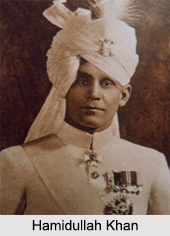
Hamidullah Khan : Hamidullah Khan was the last ruling Nawab of Bhopal. His reign continued from 20th of April, 1926 to 1st of June, 1949. Khan had served as a delegate to the Round Table Conference in London and as a Chancellor of the Chamber of Princes from 1944 to 1947. He was at the Battle of Keren and the Battle of El Alamein, during the Second World War. Post Indian Independence on August 15, 1947. Hamidullah Khan acceded Bhopal to India in 1949 making Bhopal one of the last states to sign the `Instrument of Accession`.

Princesses/ Nawab Begums of Bhopal State

Princesses/ Nawab Begums of Bhopal StateMajority of the rulers of this state were male successors, but the state was also ruled by female successors. The male successors were called the Nawabs whereas the female successors were called Nawab Begums. Given below are the Nawab Begums of Bhopal.
Qudsia Begum : Qudsia Begum served Bhopal from 1819 to 1837 as the first female ruler of the state.

Sultan Sikander Begum : Sultan Sikander Begum, the Nawab Begum of Bhopal ruled from 1860 to 1868.

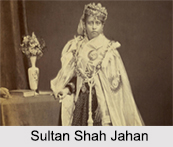
Sultan Shah Jahan : Sultan Shah Jahan, the Nawab Begum of Bhopal ruled from 1844 to1860 and then from 1868 to 1901. As an effective ruler, Shah Jahan is credited with the improvement of tax revenue system, commissioning of the farming of opium to balance the budget deficit, increment of salaries of her soldiers, modernization of the military`s arms, improvement of the efficiency of the police force, construction of a dam and an artificial lake and the undertaking of the first census post two plagues in the state. Princesses/ Nawab Begums of Bhopal StateShe had authored several books in Urdu and initiated the construction of one of the largest mosques in India, the Taj-ul-Masajid in Bhopal. Shah Jahan is also credited with the construction of the Taj Mahal Palace in Bhopal. Her generosity can be comprehended from the donations for the building of a mosque at Woking, Surrey in the UK. To establish the Muhammadan Anglo-Oriental College at Aligarh (which became the Aligarh Muslim University), Shah Jahan made contributions. She had also subsidized the cost of a railway to be constructed between Hoshangabad and Bhopal.
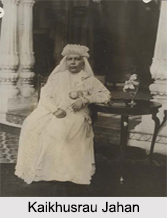
Kaikhusrau Jahan : Kaikhusrau Jahan was the Begum of Bhopal from 1901 to 1926. Kaikhusrau was a progressive ruler which can be comprehended from the fact that she founded several important educational institutions in Bhopal like technical institutes, established free and compulsory primary education in 1918 and increased the number of qualified teachers. She particularly focused upon public instruction, especially female education. She had reformed taxation, the army, police, the judiciary and the jails. She had expanded agriculture and carried out extensive irrigation and public works in the state. She is credited with the establishment of an Executive and Legislative State Council in 1922 and commencement of open elections for the municipalities. She is noted for inoculation and vaccination programs, improvement of water supply and standards of hygiene and sanitation. She has authored books on education, health, etc.

Recently updated articles in History of India

Suhungmung
Suhungmung Thumbnail

Suhungmung

Suhungmung was the fourteenth ruler of the Ahom dynasty who ruled from the period 1497 to 1539 AD. His reign was significant in terms of expansion of...

Princely State of Dadhalia
Princely State of Dadhalia Thumbnail

Princely State of Dadhalia

Princely State of Dadhalia was located in the present state of Gujarat. The state covered a total area of 28 sq miles and comprised of 15 villages. Th...

Princely State of Rupal
Princely State of Rupal Thumbnail

Princely State of Rupal

Princely State of Rupal was a part of the Baroda Agency, a sub division of Western India States Agency. It was under the administrative control of the...

Archaeological Sites of West Bengal
Archaeological Sites of West Bengal Thumbnail

Archaeological Sites of West Bengal

Archaeological sites of West Bengal reveal several aspects of ancient India. Excavations by the Archaeological Survey of India have furnished artefact...

Princely State of Gabat
Princely State of Gabat Thumbnail

Princely State of Gabat

Princely State of Gabat was one of the native states of India during the Brtish period. Thakors were the native rulers of this state. After India gain...