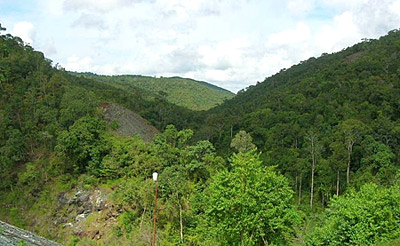
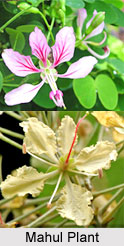
 Mahul is an Indian Medicinal Plant and is a very large and is usually evergreen plant. The Mahul also known as "Camel"s Foot Climber" is a gigantic climber with a stem 80 cm in diameter. It owes its name to its cleft leaves which look like the footprints of a camel. Mahul or Maloo Creeper is the largest creeper in India, and can grow up to 10-30 m long. The woody stem can get as thick as 20 cm. The spreading stout branches are covered with rusty fine hair. The stout tendrils are coiling and occur in pairs. It belongs to the Gulmohur family. Maloo Creeper is found in the Himalayas, from Kashmir to Sikkim, up to altitudes of 1500 m. This plant is found in deciduous forests of India from Gujarat southwards to Maharashtra and northern Andhra Pradesh, commonly on hillsides and in forest valleys.
Characteristic Features of Mahul
The bark of this plant is dark reddish-brown or blackish, inner bark tough, fibrous, bright pink with white or yellowish bands that turn orange-brown on exposure. Large leaves are 10-45 cm, 2-lobed with a broad cut. The white flowers, 2-3 cm across, turn yellow when old. The flowers are borne in rounded clusters. Fruits are flat, woody pod with rusty-velvety hairs, 20-30cm long. The flowers come out between April and June and fruits from December to March in central India.
Different Names of Mahul
Mahul is commonly known as the "Maloo Creeper" and also known as "Chehur" in Bengali, "Camel"s Foot Climber" in English, "Mahul" in Hindi and "Chambuli" in Marathi and Kannada, "Bhorla" in Nepali, "Siyali" in Oriya, "Madapu" in Telugu, "Asmantaka" or "Malanjhana" in Sanskrit. The botanical name of this plant is "Bauhinia Vahlii Wight" and "Arn".
Medicinal Values of Mahul
The medicinal values of Mahul are also considered as one of the most important usages of this plant. The seeds are considered aphrodisiac and tonic. The leaves are demulcent and mucilaginous. An aqueous extract of the root is given orally for the treatment of syphilis among the Gond Tribes of Uttar Pradesh. Among the Munda Tribes in southern Bihar, a fine paste of the root is given with water to treat dysentery.