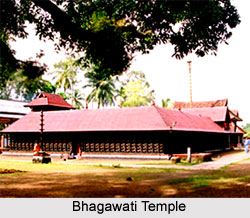
Bhagawati Temple

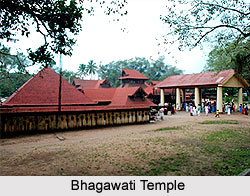
Bhagawati Temple believed to be the abode of Kannagi is located in Kerala. Talappoli and Bharani are the two most important festivals celebrated here. architectural features.

Introduction

Bhagawati Temple, Kodungallur, KeralaIn Kodungallur border is the abode of Goddess Kali because legends believe that Kannagi was the incarnation of Kali. But initially the temple housed Lord Shiva which is evident from its architectural features.

Bhagawati Temple is also referred to as the abode of Kannagi is located in Kodungallur in Kerala. Kannagi is believed to be an incarnation of Goddess Kali. The temple was thus erected in her memory in Kodungallur. Certain features of the structure of the Kodungallur temple point to the fact that, originally, it was a Shiva shrine and that the image of Kali was installed later. The idol of Shiva faces the east direction and the idol of Kali is in the north direction. The temple follows a ritual of first offering pooja and naivedyam to Lord Shiva and then to the Devi.

Legend of Bhagawati Temple

Legends of Bhagawati Temple There are several legends associated with the Chengannur Bhagawati Temple located in Kerala. It was the wedding day of Parvati and Lord Shiva also known as Parameswara at Mount Kailas. All the thirty-three crores of devas and asuras had assembled for the occasion. It looked as though the earth would tilt towards the north because of the undue weight that side. Lord Shiva grew anxious. He summoned sage Agastya and requested him to proceed to the south to maintain the balance. At this Sage Agastya felt sorely disappointed as he would miss the celestial wedding. Parameswara understood his feelings. He assured him that he would see everything through divine sight. Further, He promised that the marriage ceremony of the God with his consort would come to the South and grant him darshan. Accordingly sage Agastya journeyed towards the south and selected a part of the Sahyadri called Sonadri for his meditation. Lord Shiva went there with Parvati and blessed Agastya.

There is yet another legend regarding the origin of the temple. Daksha showed disrespect to Lord Shiva, his son-in-law, by not inviting him to the sacrifice he performed. Sati had attended this ceremony much against the desire of Lord Shiva. Resenting the insult to her and her husband she immolated herself by jumping into the sacrificial fire. The grief stricken Shiva carrying the charred body of Sati wandered here and there in desolation. To relieve him from this situation, Lord Vishnu with the aid of the Sudarsana chakra cut Sati`s body into pieces. Wherever her limbs fell the place acquired Shiva`s chaitanya. It is believed that in Chengannur, the reproductive parts of Sati had fallen.

It is also believed that the image of Bhagawati is that of Kannaki. Her husband, Kovalan, was executed by the Pandya king on a false charge of theft of the queen`s anklet, foisted upon him by the royal goldsmith. In her anger Kannaki plucked off her left breast and hurled it at the city of Madurai which began at once to burn. She thus came to Chenkunnu in Kerala and did penance under a tree. Kovalan appeared before her in a vimana and took her to heaven. Deeming her to be an incarnation of Goddess Kali or Mother Goddess, Senkuttuvan, a Chera king, went north and brought a stone from the Himalaya Mountains to be set up as her image. It was consecrated as "Chengamalavalli" with great pomp and ceremony.

Architecture of Bhagawati Temple

The Bhagawati Temple dates back to the ancient times. To the east of Goddess Kali image there is a small chamber with no doors or windows nor any other opening over ground. It has no entrance and is covered on all sides with granite though there is a roof above. It is, therefore, called the secret chamber. There is however an underground passage from this room eastward which opens to over ground about hundred yards away in the temple courtyard. The mouth of this passage is closed at the ground level and an enclosure has been erected around it. The western wall of the secret chamber, against which a crimson cloth is hung, is held sacred. Lamps are lit and regular rituals are organized here. However only certain privileged persons like the members of the family of the local chief visiting this temple can view this cloth and worship it. This can be done only through the western door of the sanctum of Kali which is opened only on such rare occasions. There are seven images known as Saptamatrukas or Seven Mothers installed in the hall adjoining the sanctum of Kali on its western side. They represent the six Goddesses whom the Gods created to kill Daruka and Chamundi. The images, each with four arms, are in the sitting posture facing north. There are three doors to the hall through which they can be seen.

Deity of Bhagawati Temple

The Bhagawati Temple houses the majestic idol of Goddess Kali which is about six feet high. It is made of wood and has been carved out of the trunk of a jack fruit tree. The idol is in a seated idol. It is fully decked with gold ornaments, a kirita (crown) like the one used by actors in Kathakali and a mask. The goddess has eight arms which carry various weapons and symbols some of which are difficult to identify. All the parts except the hands are covered by golden raiment. She wears ornaments like addhika (necklace) and pavan mala, chain woven of gold discs around her neck. Below the waist of the idol she wears a crimson cloth. The next important deity is Kshetrapala, which literally means the guard of the square. It, therefore, stands outside in the courtyard on the north-east side in the position of guarding the temple. The image in made of stone that is twelve feet high and is a rare feature in the Devi temple.

Festivals of Bhagawati Temple

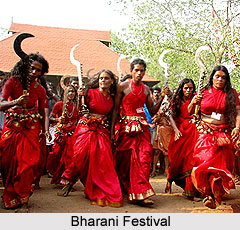
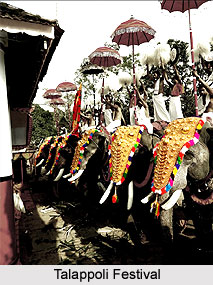
Festivals of Bhagawati Temple, Kodungallur, KeralaBhagawati Temple is an ancient temple located in Kodungallur in Kerala. It is also referred to as the abode of Kannagi. Kannagi is believed to be an incarnation of Goddess Kali. The temple was thus erected in her memory in Kodungallur. The temple celebrates many festivals on a grand scale. Among them Talappoli and Bharani are the two main festivals conducted in the temple of Kannaki every year. The former is a colourful pageant full of merriment, with mainly the local people participating while the Bharani festival is purely devotional and ritualistic, yet attracting pilgrims from all over Kerala.

Talappoli festival starts on Makar Sankranti i.e. the first of Makaram i.e. on December-January and lasts for four days. It is a harvest festival coinciding with Pongal celebrated in Tamil Nadu and certain parts of South India. On the day previous of Makar Sankranti in Kerala and in other places rubbish and other unwanted materials are collected and burnt. Houses and courtyards are cleaned. The temple premises are decorated and a large fair set up. A part of the rice from the freshly harvested paddy is set apart as offering to the Goddess. On Makar Sankranti the people belonging to the community of Kudumis (Konkani-speaking people, their main occupation being making of pappads) from and around Kodungallur gather here in large numbers with their offerings. A big fireworks display takes place which mark the inauguration of the festival. From the next day onwards, for four successive days, there are elephant processions both in the morning and in the evening. The procession starts from a small shrine dedicated to Kurumbayamma supposed to be the original seat of Kodungallur Devi about half a kilometre away. A feature of the procession is an array of the gaily dressed women carrying talam (trays) with coconuts and rice accompanying it. Another is the central elephant carrying a kolam that is a flat plate with a small umbrella instead of thidampu, a miniature of the idol used in profession in other temples. As it reaches the eastern side of the temple reception is held to the Goddess by the Chieftain of Kodungallur and priests of the temple with the cries of `Amma` rending the air.

The Bharani festival is celebrated on the Bharani asterism of the month of Kumbham (February-March) when the temple flag is hoisted. It lasts for seven days after the next Bharani in Meenam (March-April). The temple is widely known more for this festival. It is the one temple in Kerala where non-caste Hindus was allowed entry during the festival long before the Temple Entry legislation became effective in Kerala. The festival begins with the symbolic ceremonial kavu teendal or polluting the temple by a goldsmith of polluting caste going round the temple three times ringing a bell at about 7 in the morning. After a few minutes the eldest family member of the Pilappilly House attached to the temple announces that the temple has been swept clean. Thereafter the Nambudiri priest enters the sanctum and conducts the usual services.
Festivals of Bhagawati Temple, Kodungallur, Kerala The flow of pilgrims from other parts of Kerala commences some days before the Bharani day in Meenam. The sacrifice of cocks is held on Avittam or Chatayam day i.e. six or seven days before Bharani. From these days the temple is regarded as polluted. The heads of cocks are severed by a sharp knife and blood spilt on the two stones in the courtyard. It is on account of this ceremony (which is now stopped) the Bharani festival came to be known as the Cock Festival.

The privilege of commencing the Cock Festival traditionally belonged to a Nair from Kodungallur Bhagawati Veedu (House). On Aswati day previous to Bharani offerings are made to the Goddess. Small packages of turmeric, pepper and other articles with some coins, coconut and a live cock are given to the goddess. On this day the Atikal, a non-Brahmin priest enters the sanctum and performs the service of trichchandanapoti chartal or smearing of the idol with holy sandal powder. This is done with the door of the temple kept closed. Later they are opened for darshan. After this service the Valia or Senior Raja of Kodungallur stands on the platform of the pipal tree in front of the eastern portico and spreads a green umbrella. On Karthika day, i.e. the day after Bharani, the premises of the temple are swept clean. The Nambudiri priests enter the temple and start the usual services after performing purificatory rites. Thousands of pilgrims who gather for the festival disperse after taking prasad like sandal paste mixed with turmeric, and chantu, black paint of burnt rice.

The time for the celebration of the Bharani festival is noteworthy. The months of March, April and May are the hottest months in Kerala which are also crucial for agriculturists. The fields are ploughed several times after the preceding crops are cut in December-January. The farmers look skywards for merciful rains. The Bharani festival which takes place now is obviously to please the Gods for good rains and bountiful crops.

Recently updated articles in Temples of India

Rathnapureeswarar Temple
Rathnapureeswarar Temple Thumbnail

Rathnapureeswarar Temple

Rathnapureeswarar Temple in Tiruvarur district, Tamil Nadu, is a revered Shaivite shrine among the Paadal Petra Sthalams. Dedicated to Lord Shiva, it...

Gayatri Temple, Sirmaur
Gayatri Temple, Sirmaur Thumbnail

Gayatri Temple, Sirmaur

Gayatri Temple is located in Sirmaur district, Himachal Pradesh. Gayatri Temple is a sacred shrine that belongs to the medieval age.

Thousand Pillars Temple
Thousand Pillars Temple Thumbnail

Thousand Pillars Temple

Thousand Pillars Temple, Andhra Pradesh possesses 1000 pillars built by the Kakatiya ruler Rudra Deva during 1163 AD and is adorned with beautiful scu...

Triloknath Temple, Mandi District
Triloknath Temple, Mandi District Thumbnail

Triloknath Temple, Mandi District

Triloknath Temple is built in the Shikhara style of architecture, situated in Mandi, HP.