 Origin of the Concept of Incarnations of Lord Vishnu lies in the Vedas. God has been appearing to people from time to time either to pass on some message or accomplishing some task through the beholder. There is a hymn appearing in the Purusa Sukta which claims that "the one who is not born takes many births". The implication of this statement of the Vedas is that the Supreme Being assumes different manifestations for the good of the world. He is however not subject to normal birth with the physical body. Another hymn in the Rig Veda, which is sung for the purpose of invoking Lord Vishnu in the sacrificial pillar, states that - "He comes down decorated with beautiful garments and surrounded by celestial beings and that He becomes great by taking births". This mantra refers explicitly to the ascent of Lord Vishnu.
There are repeated statements in the Rig Veda which refer to the three strides with which Lord Vishnu pervades the three worlds. These refer to the Trivikrama Avatara of the Vedic period. The Taittiriya Brahmana states that God, who is the father of all, chooses His own children (the human beings) as His parents, signifying the secret of the divine descent for the good of mankind.
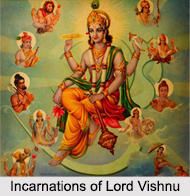
Incarnations of Lord Vishnu
The Satapatha Brahmana narrates the incarnation of Vishnu as a fish (Matsya). The Taittiriya Aranyaka mentions the Avatara of Lord Vishnu as a tortoise (Kurma). The Taittiriya Brahmana gives an episode of Varaha Avatara (incarnation as boar).
Types of Incarnations of Lord Vishnu
The various versions of the Avatara narrated in the Vedas are somewhat different from those found in the Indian Puranas. This variation is due to the fact that there are many numbers of Avataras that have taken place at different epochs in the continuous process of evolution and dissolution of the universe from time immemorial.
The basic theory of Avatara as found in the Vedas has been further elaborated in the Agama treatises and later in the Mahabharata and the Puranas. The philosophical and theological significance of Avatara has been fully explained in the Bhagavad Gita. This has provided the basis for the detailed formulation of the doctrine by the Vaishnava leaders.