 The Devas lost their inherent glory and power, as a repercussion of the curse that befell them . Indra, the king of Devas or Devraja, once invoked the wrath of the headstrong sage, Durvasa, by insulting him. The enraged Durvasa cursed him the loss of power and prestige.
The Devas were intensely vexed by the demons or Asuras. The enemy clan of Asura, grabbed the golden opportunity. They dethroned the weak Indra and his associate Devas. The distressed Devas, then fervently appealed to the Holy Trinity or Trimurti, consisting of Brahma, Vishnu and Shiva. They suggested the Devas to procure, the Elixir of life, contained in the Amrit Kumbh or Pot of Ambrosia, embedded in the milk-ocean. Amrit will bless them with the gift of Immortality.
Vishnu advised them to enter into an alliance with the resister Asuras, as the Samudra-Manthan or the Churning of the ocean, is a mighty task. It would be well worked out under a concerted effort of the Devas or Asuras. The churning should be exexcuted with Mandar Parvat or Mountain, as the churning-rod, and with Vasuki, the divine and mammoth serpent, the King of Snakes, as the churning -rope.
The clever Brihaspati, the Guru or Teacher of the Devas manipulated the demons. Asuras agreed, being allured with the bright prospect of the Ambrosia and abundant opulence, hidden in the sea. After immense toil, the Deva-Asura group uprooted the Mandar Parvat, from its site to carry it to the ocean. But the assignment seemed next to impossible. Vishnu, commanded, his Vahana or Vehicle Garuda, to place it on the ocean.
The churning of the ocean commenced with Mandar and Vasuki. But after sometime, Mandar, with no support at its base, slides down inside the depths of the unfathomable ocean. The Devas and Asuras, finding themselves in dire straits, resorted to the help of Vishnu.
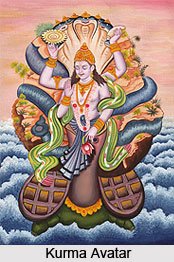
Vishnu evolved in the appearance of a giant Tortoise or the Kurma. The upper right arm of the incarnation holds the `Mace` of Vishnu called Kaumodaki, which literally means ` the thing that inebriates the mind`. The mace thus symbolizes the power of knowledge, because knowledge dazzles and elates the mind. All physical and mental power is derived from knowledge. Knowledge can be the power of time as it can conquer time. Thus the mace is also identified with Goddess Kali, who is the power of time and destroys all that opposes it.
The second right hand of Kurma Avatara holds the lotus, which signifies detachment. Lotus grows in muddy water but neither water nor the dirt can stick the petals of this beautiful flower. Like lotus, Vishnu bestows with life`s pleasures but never gets entrapped by the charms of world.
There is a discus in the upper left hand of the Kurma Avatara. Vishnu`s discuss is called Sudarshana, which literally means beauteous sight. It is the symbol of a sharp instrument, which removes all the obstacles and helps to attain enlightenment.
The other left arm of Kurma holds the conch, which symbolizes for existence. The conch has the form of multiple spirals, which start, from a single point in the form of increasing spheres. It is thus associated with the elementary nature of water. When blown, the conch produces a primeval sound from which the creation developed.Kurma Avatar, dived into the ocean, and lifted Mandar, by placing it on its robust back. The elated Devas and Asuras, resumed churning with renewed zest and vigour.
Thus the Caring Rescuer Vishnu demonstrates in the history of his Kurma Avatar, his Will to solve the problems of his devotees in the best way.
More on Kurma
Kurma Purana