 The Indian Subcontinent provides suitable habitats to various species of reptiles for residing and reproducing. Tortoises are no exception in this regard. Various species of tortoises have been recorded in India. Some of these tortoises are described below.
Indian Star Tortoise
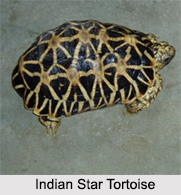
Indian Star Tortoise is native to India and can be recorded in the dry areas and scrub forest of the country. This tortoise has yellow colored shell with black or brown color over it. The top shell or the highly domed carapace has radiating yellow lines that create star like patterns. These star patterns are also present on the bottom shell or plastron. The tortoise has cream or yellow-brown colored head and legs, with dark spots. It develops more stripes with age.
Asian Forest Tortoise
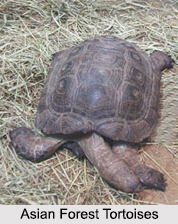
An adult Asian Forest Tortoise is a brown or blackish reptile. It"s head is moderate in size. The upper shell or the carapace is considerably depressed, slightly flared and serrated on the rear sides. Scutes are dark in the middle, turning paler or greyer on the outside. This tortoise has a long, narrow nuchal scute with parallel sides. The plastron is large and its color ranges from pale green to cream with some dark spots on the abdominals. The seam between the humerals is a little longer than the one between the pectorals. The hind lobe is deeply notched. It has two supracaudal shields. The dorsal shields are concentrically striated.
 The axillary shield is very small and the inguinal is large. This tortoise has two large prefrontal shields and a large frontal. The forelimbs anteriorly have very large, bony, pointed, imbricate tubercles, forming four or five longitudinal series. The hind limbs have very large bony tubercles on the plantar surface.
Elongated Tortoise
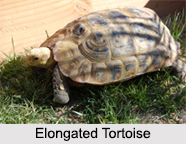
In India, Elongated Tortoise has been recorded in Jalpaiguri, East Bengal and Singhbhum in Bihar. Its beak is feebly hooked. The head and neck are uniformly light yellow in color. The color of the carapace ranges from caramel to yellowish-dark brown. There are dark blotches present on every scute of the tortoise. The plastron is large, truncate anteriorly and deeply notched posteriorly. The vertebral portion of the its body is flat. The anterior and posterior margins are slightly reverted. The nuchal is narrow and elongated. The rear marginal scutes are highly grooved. Both the breeding male and female tortoises assume a pink color around the eyes and nostrils. The male tortoise is narrower than the female tortoise with a shorter tail and more concave plastrons. As compared to the male tortoise, the hind claws of the female tortoise are markedly longer and more curved.