 Langudi Hill in Odisha is a renowned ancient Buddhist archaeological site located in Jajpur District at a distance of nearly 90 km from Bhubaneshwar as well as Mahanadi delta. The hills extend from north till south and lacks proper vegetation, interspersed by Kelua River which flows across the eastern and north-eastern portions of Langudi Hill. A spectacular sight completes with scenic plains and hills welcomes visitors to Langudi Hill. Believed to be amongst the most significant Buddhist sites of India, Langudi Hill has witnessed several excavations by the Archaeological Survey of India or ASI during the 21st century. Such excavations have enabled the discovery of interesting Buddhist stupas, Buddhist monasteries, idols of Lord Buddha and other Buddhist relics.
Buddhist Attractions at Langudi Hill
Langudi Hill possesses various beautiful Buddhist stupas, Buddhist shrines, motifs, monasteries and numerous other Buddhist relics. This part of the country is well-known for its religious structures associated to the different Buddhist sects of `Tantrayana`, `Vajrayana`, `Mahayana` and `Theravada`. Buddhist sculptures present in Lalitgiri, Udaigiri and Ratnagiri are worth beholding.
Rock-Cut Caves at Langudi Hill
Langudi Hills is home to 34 rock-cut stupas which have been unearthed by excavations carried out in northern portions of Langudi Hill. They signify Buddhist art which is practised in India and consist of a rectangular `harmika`, a cylindrical dome and a colossal circular dome. According to an account of the traveller Hieun Tsang in `Pushagiri Mahavihar`, Langudi Hills is home to the nation`s most ancient Ashokan stupa, overlapped with burnt bricks. These caves are a reflection of the development of pre-monastic movement in Odisha, and Dhauli and Karim are the other regions which possess rock-cut caves.
Buddha`s Sculpture at Langudi Hill
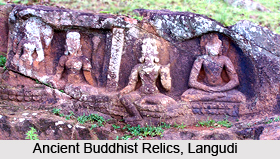
Numerable types of Buddha sculptures are existent in Langudi Hill, of which the `samudra mudra` image of Lord Buddha is the most popular and belongs to the 7th century CE. In this particular sculpture, Lord Buddha is portrayed as displaying a mysterious half-smile on His divine face. This is said to be one of the most unique idols of Lord Buddha. Meditative or `Dhyani Buddhas`, also referred to as the `Bodhisattva Avalokiteshwaras` are the deities of the pantheon of `Vajrayana`.
Sculptures of Goddesses at Langudi Hill
Marvellous rock-cut idols of female Goddesses like `Tara` equipped with two arms, embellished with jewelleries, a pleasant smile and a rounded face, Prajnaparamita who holds a lotus in one of her hands and an idol of a Mahayana deity. All such idols of female deities indicate the significance of women during ancient and medieval ages.
Ruins of Pushpagiri University
The damaged remnants of Pushpagiri University are also present in Langudi Hill which belongs to the 2nd century BC to the 10th century AD. This ancient educational institute is also termed as the `Pushpagiri Mahavihara`. It is believed to have been a renowned spot of Buddhist learning in India, particularly during the ancient times, which prospered during the 11th century. Pushpagiri University sprawls over 3 campuses, spreading over Udaigiri, Lalitgiri and Ratnagiri. Excavations have created awareness about the fact that the premises of this university are larger and older as compared to Nalanda and Vikramashila. The ruins of Pushpagiri University belong to a later date than the time of construction of Nalanda and Takshila.
Visiting Information
Langudi Hill can be reached from Chandikhol and Jaraka, which are present on the National Highway 5, which connects Chennai and Kolkata. Kesinga is the closest railway station to Langudi Hill. The ideal time to pay a visit to Langudi Hill is during the months of February and October.