
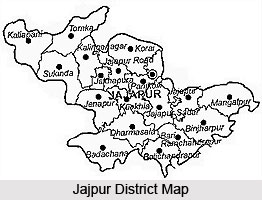
 Jajpur District is popularly known as Biraja Khetra, which translates as `the place sacred to Goddess biraja`, and is located on the banks of the Baitarani River. The district is historically very important and is known from the excavated facts that it was the capital of Orissa during the Kesari Dynasty. Following the investigations of the historians Jajpur is the home of Lord Jagannath and also existed as the section of Kalinga, which intensifies the historical significance of the place.
Jajpur District
Jajpur District in Orissa is regarded as a holy pilgrimage site. It is also known as Biraja Khetra. Panikoili is the district headquarters.
Introduction
Jajpur District is popularly known as Biraja Khetra, which translates as `the place sacred to Goddess biraja`, and is located on the banks of the Baitarani River. The district is historically very important and is known from the excavated facts that it was the capital of Orissa during the Kesari Dynasty. Following the investigations of the historians Jajpur is the home of Lord Jagannath and also existed as the section of Kalinga, which intensifies the historical significance of the place.Location of Jajpur District
Jajpur District is located in between 20 degree 30 minutes to 21 degree 10 minutes north latitude and 85 degree 40 minutes to 86 degree 44 minutes east longitude covering an area of 2887.69 sq kms. Northern boundary of Jajpur District is bounded by river Baitarini and by the districts Keonjhar and Bhadrak, in the south by Cuttack District and in the east by Dhenkanal District and in the west by Kendrapara district.
History of Jajpur District
 History of Jajpur District, Odisha dates back to the 10th century, when this region was under the rule of `Jajati Keshari`, a king of the Somvanshi Dynasty. The name `Jajpur` is believed to be attributed to the name of this royal king. The district is also referred to as the `Biraja Khetra`, which when translated to English implies `the region divine to Goddess Biraja`. It is existent on the banks of Baitarani River. Jajpur District is a historically significant spot and excavations conducted here suggest that Jajpur was the royal capital of Odisha during the reign of the Kesari Dynasty. Historians have claimed that Jajpur is one of the names of Lord Jagannath which used to be present as part of Kalinga.
It is said that King Jajati of Somvanshi had once performed a major `Yajna` known as `Dasaswamedha` at this region. Thereafter, he had brought 10, 000 Brahmins from the northern portion of India, who had settled in the different `Sasanas` in Jajpur. He had made Jajpur as his own capital which was later renamed as `Jajatipura` by his orders. Jajpur is mentioned in various mythological tales of India and also many `Puranas` including `Baitarani Tirtha` and `Viraja`. `Astapithamahatmaya`, `Tantrachintamani`, `Brahmanda Purana`, `Brahma Purana`, `Vayu Purana`, `Chaitanya -Charitamrita` and so on. Jajpur District is quite popular amongst Hindus for being one of the `Shakti Peethas`.
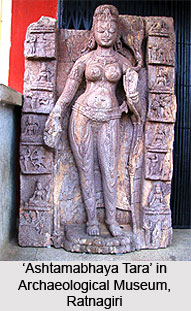
Historical accounts have asserted that Jajpur was an important pilgrimage centre as it possessed numerable stone temples, similar to those existent in Bhubaneshwar. These temples were quite ancient and comprised magnificent architectural features. However, during 736 A.D., Jajpur District became the seat for a brand new political scenario, gradually, with the advent of the Bhaumakaras. For over 400 years, kings of Somvanshi Dynasty and Bhauma Dynasty ruled over vast stretches of Odisha and bore testimony to the traditions and culture of the people who lived during that point of time. Jajpur was declared as the capital during the rule of King Somvanshi. The area around the Archaeological Museum has given birth to several wonderful tourist destinations which are located near Ratnagiri. This museum is amongst the noted site museums belonging to the Archaeological Survey of India or ASI.
Besides being a cradle for Hinduism, Jajpur was also a crucial breeding centre of religions like Jainism and Buddhism. Ancient travelogues penned down by the traveller Hieun Tsang during 639 A.D. indicates the presence of `Puspagiri Vihar` in the regions located close to Jajpur District. Towards the 8th century, the philosophy of `Tantrayan` started developing in Jajpur. A Jagannath Temple had been constructed at Jajpur District, which had a resemblance to the Jagannath Temple at Puri. However, as per some accounts in history it was demolished by the Muslim invaders. Images of `Sapta Matrukas` can be noticed near the Dasaswamedh Ghat, which involve `Maheswari`, `Varahi`, `Chamunda`, `Indrani`, `Vaisnavi`, `Sivaduti` and others. Jajpur saw numerous political conflicts and gory warfare, especially the battle which led to the shifting of imperial power to the Afghans that was fought near Jajpur, particularly at Gohiri Tikira. Ramchandra Bhanja and Mukundadeva Harichandan fought against each other in this battle.
Art and Culture of Jajpur District
 Art and culture of Jajpur District, which is located in Odisha boasts of a long and diverse cultural history which is a beautiful blend of philosophical, spiritual and the creative instincts of the regional inhabitants of this region. This Indian district possesses great cultural heritage which is revealed to in the vibrant forms of numerous types of art-forms. Also referred to as a `heritage district`, Jajpur is amongst the ancient cities belonging to Odisha which is home to some archaeological remnants. `Navigaya` is yet another name for Jajpur District, and it is visited by innumerable travellers for the purpose of offering prayers or `sraddha` on the banks of Baitarani River.
Sculptural Art of Jajpur District : Jajpur District consists of magnificent instances of sculptural art and architectural grandeur. Excavations carried out in part of this district have helped uncover the ruins belonging to a probable pre-historic civilization in the eastern Indian state of Odisha. The archaeological relics have been observed at areas like Baraha Temple, Ratnagiri Temple, Udaigiri Caves, Saptamatruka Temple, Trilochaneswar Mandir and others. Starting from the pre-historic era, these rare sculptures date till the medieval period. A majority of the architecture splendour at Jajpur is manifested through its numerous temples which involve Siddheswar Temple, Biraja Temple, Jagannath Temple and so on.
 Fairs and Festivals of Jajpur District : A large variety of fairs and festivals are observed in Jajpur District, particularly during the month of `Margasira`. The womenfolk offer prayers to Goddess Lakshmi in this festive occasion to invoke the blessings of the deity for a good harvest season. White murals adorn the mud walls and floors of the local homes during this festival. White rice paste is employed to create these drawings. Known as `Chita` or `Jhoti`, their patterns are mystical and are created to establish a connection between the material world and spiritual world.
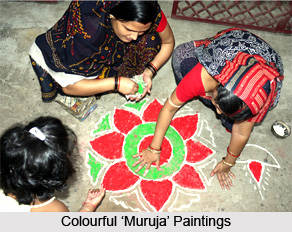
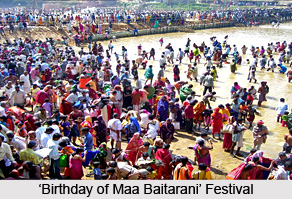
During the sacred month of `Kartika`, the regional women practise penance and paint `muruja` on the floor with the aide of numerous colours Dry leaves are crushed to achieve the green colour while stones are grinded to collect the white hue used for such painting. Yellow colour is attained from marigold flowers and black is collected from burnt coconut shells. This is drawn near the `Tulasi Chaura`, in the style of `Mandala`. The local ladies perform different rituals throughout the year, to pray to their deities for prosperity and harmony. `Chandan Purnima`, Car Festival of Lord Jagannath, Makar Mela, Akshaya Trutia, Birthday of Maa Baitarani and several others are amongst the other festivals celebrated here.
Languages used in Jajpur District
Odiya language is said to be amongst the most ancient languages utilized in this part of the nation. However, Urdu is spoken by only 10 percent of the regional people while different tribal dialects are employed by about 9 to 10 percent of Jajpur`s residents, for communication.
Jajpur District is the hometown of several literary geniuses and painters. The Jhoti, Muruja and Chita are the various streams of painting existent in the Jajpur school of painting. Some of the talented literary personalities belonging to this district include Birupakshya Kar, Manjula Krushna Prasad Basu, Braja Sundar, Abimanyu Samanta Singhar, essayist Baikuntha Nath Rath, dramatist Kamapal Mishra, fiction writer Govind Das, etc. `Ghoda Nacha`, `Daskathia` and `Pala` are some of the most popular elements of the local culture of Jajpur District.
Jajpur District is the hometown of several literary geniuses and painters. The Jhoti, Muruja and Chita are the various streams of painting existent in the Jajpur school of painting. Some of the talented literary personalities belonging to this district include Birupakshya Kar, Manjula Krushna Prasad Basu, Braja Sundar, Abimanyu Samanta Singhar, essayist Baikuntha Nath Rath, dramatist Kamapal Mishra, fiction writer Govind Das, etc. `Ghoda Nacha`, `Daskathia` and `Pala` are some of the most popular elements of the local culture of Jajpur District.
Recently updated articles in States of India
History of Thissur District
Early History of Thissur District explains flourishing of the port cities. Now these port cities are transformed into archaeological sites.
Tippi Orchid Research Centre, Arunachal Pradesh
Tippi Orchid Research Centre in Arunachal Pradesh is renowned for its rich collection of exotic and endangered orchids. Surrounded by lush rainforest...
Tourism in Nashik District
Pilgrimage tourism in Nashik district involves visiting the various places of Hindu and Jain worship located here. Some of the holiest sites for Hind...
Mangadu, Kerala
Mangadu in Kerala’s Kollam district is a significant megalithic site known for its urn burials, cist burials, menhirs, and stone circles. Excavations...
Devaswom
History of Devaswom is not very ancient and can be dated back to late seventeenth century.
Related articles in States of India
East Indian States
East Indian States comprises of Bihar, Jharkhand, West Bengal, Odisha and also the Union Territory of Andaman and Nicobar Islands. It defines the cult...
Purnia District in Bihar
Purnia District is located in Bihar and extends from River Ganga to Nepal. The district has a rich Hindu history and glorious past.
Hooghly district
Hooghly District along the bank of the river Hooghly is one of the principal trading ports of West Bengal.
Geography Of Chittoor District
Geography of Chittoor district is spread along the topography of the land which is divided into two natural divisions; Chittoor has a dry and healthy...
Districts of West Bihar
Districts of West Bihar is comprised of medieval monuments that were built by the different governors of Mughal era.