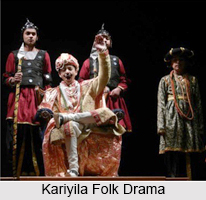
Indian Puppet Theatre in Eastern India is coloured by the length and breadth of the state culture and thrives to be an important occupation for many.
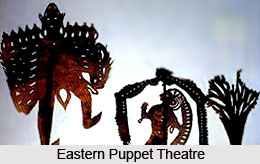
Puppet theatre in
Orissa is quite popular. It is a folk art of the state which is found existing in four different forms. It is interesting to note here that this is a rather old art form as in India puppet theatre preceded the human theatre. The
Sutradhara referred to by Bharata in his
Natyashastra refers to `one who holds the string`, literally the one who introduces the play. By extending the comparison of a string holder in string puppetry to `Sutradhara` in human drama, the ancient dramaturges implied that the Sutradhara plays the same key role in a human drama as the string -holder - puppeteer plays in a puppet drama. There are four kinds of puppetry found in Orissa, namely Shadow puppet, String puppet, Glove puppet and Rod puppet. These are briefly discussed below.
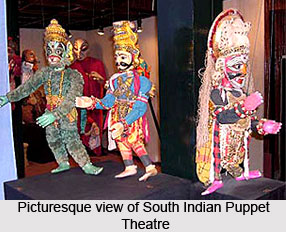
String Puppet : In Orissa this type of puppetry was popular as Gopalila puppet. This is because generally the Lila of
Lord Krishna was played by the string puppet troupes. The strings are manoeuvred by one or more than one puppeteer from above the stage and the puppets seem to move with various postures and gestures when the strings are pulled. The troupes playing string puppets are nowadays found in few places
Ganjam district, Puri district, Balasore district and
Cuttack district.
Glove Puppet : The practice of Glove puppetry is known as Sakhi Kundhei Nata in Orissa. These puppets are worn like gloves on the hands of the puppeteer and through deft movements of fingers and the wrist the puppets are played. The puppeteer sometimes takes an assistant with him who also plays one or two puppets who represent some characters. The puppeteer both dances and sings while playing them. This style is increasingly on the wane and it is limited to two places in
Bhubaneshwar district and Cuttack district.
Rod Puppet : This is known locally as Danda Kandhei. In this form of puppetry, the puppets are embedded to one end of a rod. The hands and legs are flexible. They are manipulated by string. Rod puppets are found today only in one area of
Kendujhar district.
While the traditional players of shadow puppet take their themes only from the Vichitra
Ramayana of Vishwanath Khuntia, the other kind of puppet players use the scripts produced locally or produced by famous folk dramatists like Baisnab
Pani and Balakrishna Mohanty. The songs and music they use are mostly taken from medieval Kavyas including Odissi. They generally use the medieval songs like Chautisha, Koili, Champu and Bhajan. However, they sing them incorrectly or change the style consciously to make it more popular.
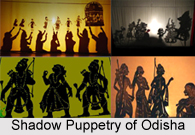
Ravana Chhaya is a rare form of shadow-theatre surviving in
Orissa. Shadow-play, which is also known as shadow-show or shadow-theatre, is different from all other forms of theatre, including puppet plays. On the human and puppet stages a real world of space is created in which actors or figures have direct contact with the audience. The effect of the shadow-play is always indirect although it is a form of puppetry in which flat figures, usually made of leather, are lightly pressed on a translucent screen with a strong source of light behind. The audience sits on the other side of the screen and sees the shadows moving when the figures are manipulated. Thus, spectators and actors separated by the light screen are placed as if in different rooms. The spectator is by himself and his feeling of isolation is heightened by the darkness all around. He does not directly experience the figures and the play; he only sees the image, the projection. The light screen is here most important as it filters and modifies the action. On the inner side of the screen, the actor (the one manipulating the puppets) too is isolated.
Among the four different types of shadow theatre surviving in India,
Ravana Chhaya appears to be the most ancient. This is because the shadows have an unmistakable primitive quality and the performance is the least sophisticated. Besides, it is the only form of shadow-play in which the figures have no jointed limbs. This form of shadow play is mostly seen held in the rural areas. Earlier, the villagers used to believe that the performance of the Ravana Chhaya in the village could avert natural calamities like flood, drought and epidemic. Therefore, inhabitants of different villages used to contribute either in shape of their agricultural produces or money for holding a Ravana Chhaya show in the village at least once a year. Now with advancement of education villagers have started calling such belief as superstition.
Sakhi-kundhei Nata is the traditional string puppetry still extant in Orissa. So far only a few troupes of this fascinating form have been located in remote rural areas. It is not clear why the epithet sakhi is used to designate their puppets. Some surmise that the name arose because the form earlier used to present shows based exclusively on Krishna legends. This feature
Radha`s sakhis or female companions as well. According to another opinion, sakhi is often used as a term of endearment. Since the puppets are cute dolls and acquire a kind of life when manipulated, they were endearingly called sakhi-kundhei.
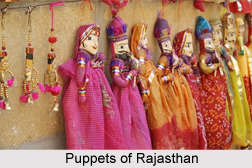
The puppets are made of light wood and, like the
Kathputli of
Rajasthan, have no legs but long flowing skirts. However, they have more joints as the hands and torso are also made of wood. Figures representing major characters have joints at their neck, shoulders, and elbows as well. Five to seven strings attached to the puppet are usually tied to a triangular wooden prop. Orissa
Temple Sculptures and pothi chitras that are drawings in palm-leaf manuscripts have inspired the conception of most puppets. The costumes, music, and style of presentation are somewhat similar to those of the
Yatra operatic in character, where singing dominates over prose dialogue. The puppeteers` prose dialogues are often impromptu. The music admirably blends folk with sophisticated Odissi, the singing style close to that of the traditional Chhanda form.

 India is the abode of puppet theatre from the inception, especially in the 5th Century BC. Puppetry or the puppet theatre is one of the ancient forms of entertainment in India. Although primarily it is used as a form of entertainment; yet its importance in conveying significant meaning cannot be denied. For centuries, Indian puppet theatre in one form or the other flourished in India, particularly in the villages.
 While some says Indian Puppet Theatre did originate in medieval India, other says that it was there throughout, typically as an art form even at the time of the
 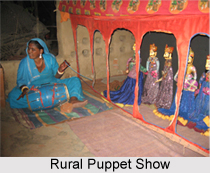 Indian puppet theatre as an artistic visual art is still vibrantly alive in a variety of style. The major types of puppetry that are practiced in different Indian states are: rod, string, shadow and glove puppetry. The puppetry is very popular in the states like
 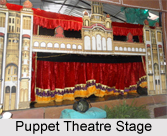 The colour of the puppets also determines the portrayal of character in Indian puppetry. To depict a royal character mainly a light coloured puppet with impressive moustaches is used whereas a gawk eyed and dark coloured puppet usually paints a negative character. The female figures hold their skirts or
 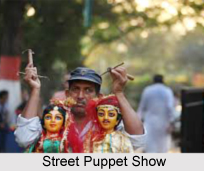 The controlling of the strings are carried over by the male members of the troupe; while the music, singing, dialogue and narrations are provided by the female members of the family.
 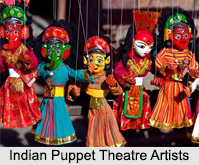 Indian Puppet Theatre Artists have been desperately trying to preserve their dying art form. There is a very few traditional Indian Puppet Theatre Artists still continuing to work on Puppet Theatre. Some of the famous Indian Puppet theatre artists are as follows: