Gondhal Dance
Gondhal is a religious folk dance of Maharashtra. It is performed on special days like when there is a newborn in a family or marriage. Dedicated to goddesses like Renuka and Bhavani, it combines music, storytelling, dance, and devotion.

Share this Article:

Introduction

Gondhal dance is a religious performing art of the state of Maharashtra. Gondhal is also performed as a Marathi folk theatre in the form of worship. This art form is performed exclusively by a group of men as part of rituals after ceremonies like marriage or a new birth. The literal meaning of the word “Gondhal” is “commotion” which is the dramatic narration of mythical stories, praise of heroes or narration of folk legends. All these forms are part of a ritual dedicated to different divinities. Gondhal is an educative, entertaining and important tradition. It is one of those few important folk arts of Maharashtra that has become an inseparable part of the daily life of the people.


Origin of Gondhal Art

Gondhala, as a performing art, is believed to have originated in the region of Karnataka. The term is said to derive from the Sanskrit word “gud,” which evolved into the Marathi word “Gundala” and later transformed into “Gondhala.” From this emerged the name “Gondhalis,” referring to the community of performers associated with the tradition. The origins and functions of this community remain largely obscure, intertwined with mythology and preserved within the cultural memory of the region.

According to legend, the ritualistic dance form known as “gondhal” was created by the warrior sage Parashuram after he defeated and beheaded the demon named Betasur. It is believed that he stitched the demon’s head into a crown and fashioned a musical instrument from it. Accompanied by thunderous rhythms and intense movements, Parshuram performed the dance in devotion to his mother, the Goddess Renuka. This powerful performance came to be known as the gondhal.  Even today, the gondhal continues to be performed as a ritualistic folk dance dedicated to appeasing Goddess Renuka, who is also worshipped as Bhavani or Amba.


History of Gondhal Art

In Maharashtra, the Gondhal performers, known as Gondhalis were not confined to a single caste or community. The tradition included several groups such as Brahmin Gondhalis, Renukrai Gondhalis, Kadamrai Gondhalis, Koombhar Gondhalis, and others, reflecting the widespread cultural acceptance of the practice across different sections of society.

The influence of the gondhal tradition extended beyond Maharashtra when the Marathas established their rule in Thanjavur. They carried the tradition with them, and the presence of a large number of Gondhalis in the region became so significant that an entire street came to be known as “Gondhala.”

Historical accounts suggest that even during the reign of Shivaji Maharaj, long before the era of the Peshwas, the Gondhalis were a highly respected community. They were regularly invited by rulers to perform ritualistic ceremonies and held an esteemed position in society. Their status continued to flourish under the rule of the Peshwas, during which they were honoured with lavish gifts such as bracelets, earrings, bags of money, shawls, and generous offerings of food.

However, with the passage of time, public interest in gondhal performances gradually began to decline, and by 1894 the tradition had already started witnessing a noticeable reduction in patronage and popularity.


Objective of Gondhal

"Gondhal" is performed as a remedy to the suffering caused by age old spiritual defects in the premises and also to terminate distress caused by negative energies, continuing for generations. In order to reduce the suffering of other family members, caused by negative energies, the Goddess is awakened with a loud sound and is invoked to undertake Her mission of destruction. This Marathi folk art is believed to honour Devi Amba Bhavani of Pratapgadh. Bhavani Mata Temple on Pratapgad Fort in Maharashtra is a historic shrine dedicated to Goddess Bhavani, a manifestation of Goddess Shakti or Durga.

Before weddings or sacred thread ceremonies, male and female members of the Gondhali community, popularly known as waghya-murali, were invited to conduct a “jagran-gondhal.” This ritualistic overnight performance combined dance, music, storytelling, and devotional lore, and was believed to protect the family from the evil eye while invoking divine blessings for the auspicious occasion.


Rituals of Gondhal

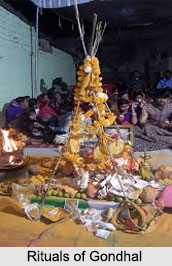
Gondhal takes place in front of the Yajamana’s i.e. host’s house. A wooden board on the ground is covered with a new cloth, on which rice or jowar grains are arranged in a square, in each corner a half coconut, betel nuts, dry dates, turmeric roots, a banana and betel leaves are placed. A pitcher filled with water, betel or mango leaves and whole coconuts are placed at the centre, near the idol of the Goddess. The Goddess is worshipped with flowers. Five stalks of jowar plants or sugar-cane sticks are placed on the board and their heads are tied together in a bunch above the pitcher in such a way that they face each corner of the board. A string of thin wafer-like kadakanya i.e. sweet Puri and karanjya i.e. coconut pie, with a garland are tied to the top of the pitches so that it hangs it. This signifies the presence of the Goddess and her blessings.


The presence of a gondhala performance was considered an essential part of weddings and cradle ceremonies among the Deshastha Brahmins and Maratha communities. During these occasions, the Gondhalis performed songs that often carried a playful and humorous tone, lightly mocking the families of both the bride and groom. Beyond entertainment, the performances also serve an important social function, as many of the songs addressed local issues and reflected the concerns of the community.


Performance of Gondhal

Performance of Gondhal includes devotional singing and dramatic presentation of any part of episode from Indian Puranas. The singers are considered the counterparts of the Caranas, the Bhatas and the Pauranikas, who were also narrators and singers of epics and myths. It comprises a story from the RamayanaMahabharata, or the Puranas with several interpolations. The narration proceeds through dialogues, jokes, songs, dances and prose commentary, without any written script.

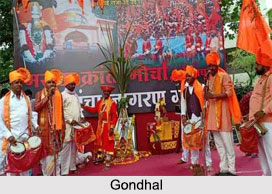
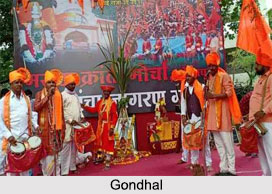
The dance of Gondhali is mostly conventional, in circular, spinning movements, accompanied by mudras with all the fingers. The chief performer in Gondhali, holds a flaming torch. He or she usually has three to six comrades with musical instruments like tal or cymbals, sambaland chaundkedrums, conch, and the stringed tuntune. Many social and mythological songs are also sung with equal interest to accompany the dance performance. 

Gondhal has traditionally been regarded as far more than a form of entertainment. It has long existed as a community-centered ritualistic performance accompanied by a small puja dedicated to the goddess. The performers, dressed in vibrant and brightly coloured attire, adorn themselves heavily with ornaments that enhance the visual intensity of the ritual. The dance is marked by energetic movements, with performers often tossing flaming torches skillfully between their hands. These powerful visual elements create an atmosphere charged with energy and devotion, drawing the gathering toward a shared spiritual experience and fostering a deep sense of collective unity. 

In many ways, the experience of gondhal bears resemblance to the whirling practices associated with Sufism. As the rhythms intensify, men in the audience are often drawn into a trance-like state, spinning repeatedly as though seeking communion with the divine. Women, too, actively participate in the ritual by letting down their hair and rhythmically rotating their necks, symbolically inviting the deity to enter and bless their being.

Costumes for Gondhal

The chief dancer of Gondhali is dressed in a huge, knee-length garment, made using around 25m of cloth, and wears a string of 64 cowrie shells and 64 silk gondas i.e. tassels set alternately. The dancer also wears a kanganidar pagri, that is a tall turban to cover the head. Other dancers usually wear traditional everyday dhotis. Women prefer to wear traditional sarees during the performance.


Share this Article:

More Articles in Indian Drama & Theatre


Gondhal Dance
Gondhal is a religious folk dance of Maharashtra. It is performed on special days like when there is a newborn in a family or marriage. Dedicated to goddesses like Renuka and Bhavani, it combines music, storytelling, dance, and devotion.
Tamasha Folk Dance
Tamasha is a folk art, which includes the love songs, which are traditional lavanis and dance along with the music.
History of Indian Theatre
The history of Indian theater is therefore the saga of changing tradition and the account of changing ritualism.
Indian Dramatist
Indian dramatists maintained Indian drama as a distinct art form.
Sringara Rasa
Sringara Rasa is mentioned in Natyashastra as one of the important rasas. The Sthayi bhava in Sringara rasa is Rati or love.
History of Indian Drama
History of Indian Drama is rich with Vedas and Indian epics and has gradually changed with time and remains unaffected by any foreign influence.
Navarasas - Natyashastra
Nine rasas or navarasas, described in Natyashastra contours the structure of Indian drama.
History of Kannada Theatre
History of Kannada theatre brings forth the richness in the Kannada culture. Theatre of Karnataka has been greatly inspired from various other forms of regional theatre in India.
Powada - Marathi Ballad
Powada is a Marathi ballad describing heroic deeds of valour by great warriors and kings.
Jatra - Bengali Folk Drama
Jatra is a form of folk drama from West Bengal, which includes acting, songs, music and dance by travelling troops
Kuvempu
Kuvempu is a literary acronym of Kuppali Venkatappa Puttappa - a popular Kannada actor-playwright.
Natyashastra
Natyashastra by Bharata muni is the most detail and elaborate of all treatises on dramatic criticism and acting ever written in any language and is regarded as the oldest surviving text on stagecraft in the world.
History of Bengali Theatre
Blessed with its rich heritage the history of Bengali theatre is the saga of the journey of Bengali Theatre
Bhavai - Folk Theatre of Gujarat
Bhavai is a popular folk theatre form of Gujarat that belongs to the tradition of theatre of entertainment.
Theatre In Ancient India
Theatre in ancient India in a systematic manner was introduced by Bharat Muni who prefaced the term "roopaka".
Bidesiya - Folk Theatre Dance
Bidesiya is one of the most popular folk theatre dance forms of Bihar which is said to have originated in the 20th century.
Regional Theatre in India
Regional theatre in India, in different Indian languages and regions, developed as an important element of Indian culture and tradition.
Koodiyattam
Koodiyattam is the oldest existing classical theatre form of the world. It has been recognised by UNESCO as a Human Heritage Art.
Indian Theatre Festivals
Indian theatre festivals help to bridge the gap between the various regions of the country. It also helps to bridge the gap among people and participants!
Kariyila Folk Dance
Kariyila is one of the most appealing and popular folk drama forms of Himachal Pradesh, portraying social satire with the accompaniment of folk dance and music.
Bengali Theatre
Bengali theatre had developed as a prominent form of protest movement during the colonial period. But with time it has made a niche for itself.