
Thanjavur
Thanjavur is one of the political, cultural and religious centres of South India. it is also called as Tanjore.
Introduction
History
Later in 1674, Tanjore was conquered by the Marathas under Venkaji, the half brother of Shivaji the great.
The administration of Tanjavur was given over to British East India Company fully under the treaty of 1799. The raja Serfoji II retained only the capital and a small tract of surrounding country. When ruler died in 1841 without heir, the Thanjavur fort was also annexed by British and became the part of Madras. Till Indian independence Britishers ruled Thanjavur.
History of Thanjavur under Nayakas and Marathas
Ancient history of Thanjavur under Nayakas and Marathas brings to the fore the historical richness of the place. India was colonized by the British for close to two hundred years. Aspects of Indian society, namely, law, education, medicine, literature and art bear varying shades of influence from the colonial masters and their culture. The one art-form which might have offered some resistance during the nineteenth century was probably Indian classical music. That is because music was performed mainly in courts and temples and did not receive any patronage from the colonial and imperialist state. The reconstruction of classical music was an integral part of a self-conscious cultural project that helped frame the contours of a national heritage with all its material and symbolic artefacts. History has not treated music as having played critical role in the development of Indian cultural nationalism. If one traces the history of music in any region, particularly peninsular India by the end of the nineteenth century music, dance and theatre assume great importance in the cultural life of the people.
In the twentieth century, music and musicians move into the larger cultural public sphere to give ticketed entry performances in modern auditoriums. Music gradually evolved into a high art-form that occupied pride of place in the national imagination. It is difficult to identify this change from private sphere to public sphere with a particular ideology, or a religious group and to then assign an ethnic identity. In the case of north India, the credit for this transformation is given to Vishnu Narayan Bathkande and Vishnu Digambar Paluskar. In the fourteenth and fifteenth centuries, the shift from temple to court `would be appropriate to track the change in the pattern of patronage that took place at Tanjore.
Political Influence on Thanjavur
Political Influence on Thanjavur made a clear impact cultural aspect of the place. Political life of the district was fast disintegrating at Tanjore in the time period under reference. The banners of merchant ships of the foreigners from the Western Hemisphere were already fluttering thick in the Indian waters. This signalled the entry of Tanjore into a fresh political hegemony. It was a period of intermittent wars and short-lived successes. Kannadiga and Maratha immigrants poured into the region of Tanjore. The first Maratha colony was planted during Ekoji`s rule and was by Brahmins. Tanjore enjoyed government and benevolent administration under Shaji (AD 1684 to 1712). Sarabhoji I (AD 1712-28) and Tukhoji (AD 1728-36) enjoyed the fruits of the labour of Shaji. Ekoji II (AD 1736-9), Pratapasimha (AD 1739-63) and Tulaja II (AD 1763-87) preceded Amarasimha. The Maratha rule continued up to AD 1799.
The British interference into the politics of Tanjore begins in AD 1749 during the reign of Pratapasimha. The Nawab of the Carnatic looked at Tanjore as an Eldorado and was scheming to invade it. Between AD 1773-6, the Nawab did control Tanjore. The principality was plunged into confusion until the company restored it to the Maratha Raja. Hyder Ali of Mysore invaded Tanjore in 1780. Tyagaraja was in his teens at this time.
When exactly Tyagaraja started composing kritis, we have no means to know. An interpretative imagination perceives spiritual value on significance and renders objects by presenting those parts or qualities in which spiritual value resides. Bitter memories of terrific historical realities undergone find no mention in musical compositions of Tyagaraja. It is understandable since the composer`s mission is to save people from being sucked up in the morass of the historical situation`s particularities. Nevertheless a ravenous inquisitor wearing an historical magnifier can locate the historical aroma in the poppy of devotional literature. Thyagaraja was fully conscious of the blessing that made him native of a region, for he proudly sings of the Tanjore region as `Chola Sima`. The disastrous aftermath of historical happenings between AD 1749 and AD 1780, to which Tyagaraja was an eyewitness, are conceived by the composer as the `dance of Kalipurusha` (Kalipurushudu Natakamunugatta Dalachinadu). In another composition he valourizes soldier imagery. He prays to Lord Rama to bless him to be His faithful servant having the insignia of a horripilate hair as armour, the appellation of Ramabhakta as the metal badge of the livery and Rama nama as the sword.
Tyagaraja`s grandfather and father had much contact with the Thanjavur court. Based on the kritis `Nidhi Chala Sukama`, a tradition had gathered that it is the response to the invitation to perform in the court of Sarabhoji. Whatever be the quantum of truth in the traditional account, the reported incident is thought provoking. About the Nayaka kingship that preceded the Marathas of Tanjore is held as `a tension between inflated claims and the limited scale of kingship`. Maratha court culture assumes Nayaka political symbolism, the king still identified as an Avatara (incarnation).
Geography
Economy
The major industries of Thanjavur are: -
•Thiru Arroran Sugars.
•Arignar Anna Sugars
•Thanjavur Textiles
•Tantex Banitan Factory.
Government
Transport
By Rail- There is a railway junction in Thanjavur, which is well connected with Tiruchi, Chennai and Nagore.
By Road- Thanjavur is well connected with all the major towns in Tamil Nadu. It is also connected with cities like Kochi, Ernakulam and Thiruvananthapuram in Kerala and Bangalore in Karnataka.
Demographics
Culture
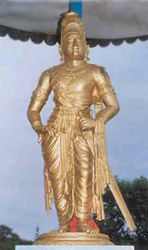 Thanjavur is known for its Carnatic music. It has produced many classical musicians and Bharatnatyam dancers. It has become the second important site for the annual Natyanjali dance festival.
Tiruvaiyaru, close to Thanjavur is the place where the great musician saint Tyagaraja lived. Every year in the Tamil month of Thai, the musicians from all over the country will hold Tyagaraja Aradhana.
Tamil, Marathi and English are the main spoken languages of Thanjavur. Thanjavur is also known for its unique painting style called Tanjore painting. The artist use a combination of canvas background with glass, metals to depict and decorate various scenes from Hindu mythology.
The worship places of Thanjavur are
Temple-Sri Brahadeeswarar Temple, Mariammankoli temple
Church- Schwartz Church, St, Marry`s Church.
Mosque- Dargah near bus stand, and Irwin bridge.
Festivals of Thanjavur
•Saint Tyagaraja Aradhana Music festival in January
• Pongal in January
• Maham Festival in Kumbakonam in February-March.
• Arulmigu Tyagarajaswamy Car festival in March.
• Muthupallakku Thiruvizza in May
• Annai Velannkanni Festival in August-September.
• Raja Chola`s birthday Sathaya Thiruvizza. In October.
• Nagoor Kaundoori Festival in December.
Rituals of Thanjavur
Enta Muddo, in his lyric (in raga Bindumalini), contrasts the superb beauty of the charm of the Lord and the charms of women and wonders why even great men allow themselves to be engaged in the thought of the latter. Performance of yagnas (sacrifices) had attained great popularity during the Maratha rule. `Agnishtoma` the first and foremost of the yagnas was performed by Kuppa Dikshitar in AD 1824; by the father of Rama Vajapai some time before AD 1825; and by Sadasiva Keshava Diksitar in AD 1826. Pasubhanda one of the eighteen yagnas conducted annually/biannually was performed by Kuppa Srowthi in AD 1827; and Varsa Pasu by Nagabhatta Sadasiva Bhatta in AD 1829.
Vajapeya is a yagna that may be performed by Brahmins. Mounting a chariot and holding a white umbrella are among the important rituals connected with the yagna. Sarabhoji II did himself perform it but extended help to the father of Lord Rama Vajpeyi by meeting part of the expenditure. Rama Vajapeyi performed Paundarikam. Many such yagnas like Sarvathomukha, Sodasi, Vaisvadeva, Desappornamasa, Soma Yajna and `Kudali Tusu`, have been performed. The futility of performing these yagnas, is emphasised by Tyagaraja. Those who are given to the performance of sacrifices are devoid of wisdom, are dominical in their mentality and are inclined to be cruel to animals.
Pilgrimages to holy places seem to have received great impetus during Maratha rule. During AD 1801-2, Sarabhoji II visited almost all the important shrines in the Chola country. This is picturesquely described in the work Sarabendra Tbeertavali. Exhaustive information about the pilgrimage to Varanasi is also found in the Modi Records. Tristalli Yatnesa Lavanya, a Maratti work provides information about the centres visited. Utke Govinda Chariar, authored a Lavani describing the pilgrimage to Varanasi. Such marks indicate the assistance rendered by the British East India Company for the successful conduct of the tour.
Education
The famous schools of Thanjavur are-
| KalyanaSundaram Higher Secondary School (Established in 1893) | Sacred Heart |
| Don Bosco matric hig.sec.shool | Shri Venkateswara Matric Hig.sec.shool |
| Kamala subramaniam matric hig.sec.shool | Veeraragava Higher Secondary School |
| Ponnaiyah Ramajayam Public School | Umamaheswara Higher Secondary School |
| Auxilium |
The famous colleges and managements are -
| Rajah Serfoji Government Arts College, Thanjavur. | Marudhupandiar College. |
| Kundhavai Nachiar Government Arts College. | Madha Sami Arul College. |
| Ponnaiah Ramajayam College(PRC). | Adaikala Matha College. |
| Tamilvel Umamaheshwaranar Karanthai Arts College. | Bon Secours College. |
| A.V.V.M Sri Pushpam College | Abi & Abi College of Arts and Science |
| Na. Mu. Venkatasamy Nattar College. | Adikalamatha Institute of Management. |
| Nalli Kuppusamy College | P. R. Institute of Managemnet |
| Bharath College of Science and Management. |
Medical and paramedical Colleges are -
| Thanjavur Medical College. | Arasu Paramedical College. |
| Mannai Narayanasamy College. | Konagarnadu College of Nursing |
The engineering Colleges are-
| P R Engineering College(PREC). | Anjalaiammal Mahalingam Engineering College. |
| Ponnaiyah Ramajayam College Of Engineering and Technology(PRCET). | King`s College of Engineering (KCE). |
| Periyar Maniyammai College of Technology for Women. |
The Polytechnics are-
| Periyar Centenary Polytechnic. | Vandayar Polytechnic. |
| Ponnaiyah Ramajayam Polytechnic college | CCMR Polytechnic. |
Tamil University and Sastra Deemed University are the two famous universities of Thanjavur.
The city also has some research centres, including Paddy Processing Research Centre, Soil and Water Research Centre. There are also two Teachers Training Institutes are present.
Temples in Thanjavur
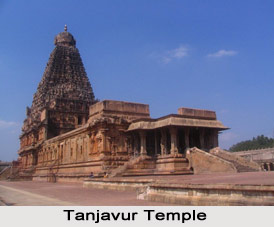 The nearest airport is at Trichy. It is 60 km away from Thanjavur. This pilgrimage center is also accessible from Chidambaram (113 km); Kanniyakumari; Kumbakonam (38 km); Chennai; Madurai (159 km) and Rameswaram.
The Brihadeswara Temple in Thanjavur is one of the finest examples of Dravidian art. It was built by Chola emperor Raja Raja I (985-1013 AD). The construction is unique: the vimanam, known as Dakshina Meru, soars high while the gopuram remains stunted. The 64.8 metre tall, 14 tier and pyramid-shaped vimanam rises from a square base and is topped by a huge monolithic cupola weighing 81.3 tonnes. The most striking thing about the structure is that the shadow of the cupola never falls on the ground.
Brihadeeswara is a gigantic lingam (about 8.7 metres high). There is a massive Nandi at the portals of the temple. It is the second largest monolithic Nandi in the country, next only to the colossal bull at the Lepakshi Veerabhadra temple in Andhra Pradesh.
The divine consort, Brihannayaki, is in a separate shrine. The shrine Lord Subramanya is an exquisite piece of decorative art.
There are excellent sculptures of Lord Shiva in different forms and other gods and goddesses besides several interesting Chola paintings.
Big Temple of Thanjavur
The Big temple of Thanjavur in Tamil Nadu is also known as the Brahadeeswara temple. This temple was built by the Great Rajaraja I the nonpareil of the later Chola dynasty. The temple was built with the marvel of Dravidian art and architecture. One needs several days to go round to enjoy inch by inch of that architectural beauty.
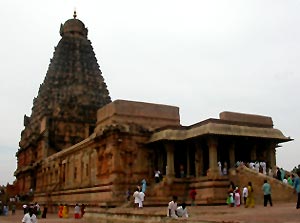 The construction of the Big temple of Thanjavur started in 1003 AD and was completed in 1010 AD. The vimana of this temple is higher than the usual gopuram or portal tower. It is 64.8 m or 208 ft. in height. It rises from a square base and shaped like a pyramid with 14 tiers. There is higher monolithic cupola carved out from 81.3 tonne block of granite on the top of the gopuram. This gopuram can be climbed from the village `Saarappallam` by rolling it along a ramp of earth six km long like the way in which the Egyptian pyramids were built. It is set on a spacious prakara of 240m by 125m.
The Big temple of Thanjavur has a Lingam in the sanctum of 3.70m height. The huge bull (Nandi) in the outer courtyard is monolithic 3.70m high, 6m long and 2.50m wide. It is the handiwork of the Vijayanagar rulers. It is the second largest in India, the first being the one at the Lepakshi temple in Andhra Pradesh.
The dwarapalakas near the doorways of the Big temple of Thanjavur are 5.50m in height. The complex is bordered with various mandapams. One can enter the temple by the three gateways with gopurams. There are lots of inscriptions in the basement, which tell about the various grants and gifts offered to Brahadeeswara by innumerable kings, chieftains and nobles. The establishment of the Big temple had 1000 persons, 400 of them were female dancers. The outer side of the exterior wall is divided into 2 storeys with niches containing the images of Saivaite iconography. The sculptures of the temple represent the Vaishnavaite and Buddhist themes. Again, the outer walls of the temple are decorated with stone images. The inner wall of the sanctum is covered with Chola murals. These were concealed by the superimposition of Vijayanagar Nayak paintings. I
The originals murals of Chola period in this temple walls were brought to light by a special chemical process in 1930. The amazing Chola painting were thus discovered to the world manifesting and this included those of Sundaramurthy Nayanar, Cheraman Perumal, Tiripuranthaga, Rajaraja, Karuvur Thevar and Dakshinamurthi. One can see them dazzle in floodlight inside the inner corridor after taking permission from the archaeological department. One can see 81 dance poses of Bharatha Natyam, the classical dance of the Tamils, which are carved on the outer wall of the upper storey. The inside of the spiralling 14 tiers is quite amazing and the precision of the engineers of the Chola period is outstanding. One wonder of the Big temple of Thanjavur is that the shadow of the cupola never falls in the ground. It is an extraordinary artwork and engineering skills of the Chola architecture.
The Pandayan rulers added the shrine for the Goddess in the 13th century A.D. The Subramania shrine was added by Vijayanagar rulers. Sambaji, the Maratha ruler of Thanjavur renovated the Vinayaka shrine.
Visiting Places in Thanjavur
The Brahadeeswara Temple
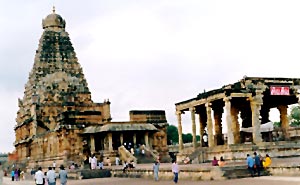 The Big temple of Thanjavur in Tamil Nadu is also known as the Brahadeeswara temple. This temple was built by the Great Rajaraja I the nonpareil of the later Chola dynasty. The temple was built with the marvel of Dravidian art and architecture. One needs several days to go round to enjoy inch by inch of that architectural beauty.
The Big temple of Thanjavur has a Lingam in the sanctum of 3.70m height. The huge bull (Nandi) in the outer courtyard is monolithic 3.70m high, 6m long and 2.50m wide. It is the handiwork of the Vijayanagar rulers. It is the second largest in India, the first being the one at the Lepakshi temple in Andhra Pradesh.
Nidamba Sudini
This is the earliest image of Kali in Potters Street 1.6 km to the east of the Big Temple. Here, the image of the presiding deity is five feet tall wearing a garland of skulls, a snake covering her breasts. Her teeth are protruded and in unbearable wrath trampling the two demons Chandan and Mundan. This image was installed by Vijayalaya Chola to commemorate his victory over the Mutharayas which enabled him to found the later Chola kingdom.
The Palace of Thanjavur
The palace of Thanjavur is not far from the Big temple. The palace with vast labyrinthian buildings, enormous corridors, big halls, watch-towers, moat, fort and courtyards lie in the heart of the city. The Nayaka rulers built the palace around 1550 A.D. and subsequently renovated and enlarged by the Maratha rulers of Thanjavur. Some portion of the palace of Thanjavur is now in ruins but much of it is still in its original beauty. Inside the palace, some government offices are present now. It also contains an art gallery, a library, the hall of music, the audience hall and even today in a portion lives the present legal heirs of the Thanjavur Marathas.
The Rajaraja Chola Art Gallery of Thanjavur
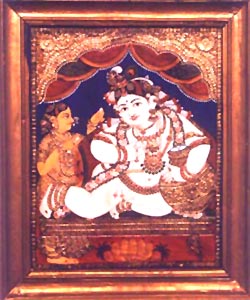 This art gallery can be seen inside the palace. It has a beautiful collection of granite and bronze idols from the 9th to the 12th centuries. The fine pieces of workmanship of Chola art are also present here. Most of them were brought from the temples in and around Thanjavur and preserved here.
The Saraswathi Mahal Library of Thanjavur
This library is situated inside the palace of Thanjavur. The Maratha kings who ruled Thanjavur, established this library in 1700 A.D. There are over 30,000 palm leaf and paper manuscripts in this library. Here, one can see books of both Indian languages and European languages. In one section on the walls are displayed pictures of Chinese torture of prisoners.
Sangeetha Mahal of Thanjavur
This is also situated inside the Thanjavur palace. It is a specimen of sound proof and acoustically perfect music hall. It is tastefully decorated with fine etchings.
Church of Thanjavur
The palace of Thanjavur also contains a church on the eastern side. It is called Schewartz Church and Raja Serfoji built it in 1779 A.D in honour of revered Schewartz of Denmark.
Royal Museum of Thanjavur
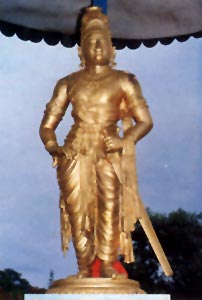 This is another museum in the palace complex. It is very interesting to see. A good collection of manuscripts, weapons, dresses, utensils and musical instruments used by the members of the royal family of Thanjavur can be seen here.
Rajagopala Beerangi in Thanjavur
This big Beerangi (cannon) is situated on the eastern fortification of the fort. It is called Beerangi Medu or Dasmedu.
Sharja Madi of Thanjavur
This is a storeyed building opened for tourists to have a panoramic view of Thanjavur city. It is also seen located in the palace complex. There are beautiful wooden carvings and sculptures inside the Sharja Madi.
Rajarajan Manimandapam
It was built during the 8th World Tamil Conference. A small garden with children`s play materials in it can be seen here.
Rajarajan Museum of Thanjavur
It is situated in the ground floor of the Manimandapam. The State Archaeological Department controls this museum and it contains interesting exhibits, charts, maps etc. on the history of the Chola Empire.
Tolkappiyar Sadukkam of Thanjavur
This Sadukkam (square) was built to commemorate the memory of the ancient grammarian Tolkappiyar during the 8th World Tamil Conference. He was the author of Tolkappiyam, the oldest Tamil grammar available now in full form in print. One can have a panoramic view of Thanjavur from this tower.
 Sivaganga Park of Thanjavur
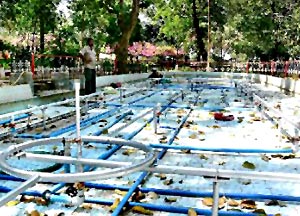
It is a beautifully laid-out park with a tank known for its sweet water and children`s play materials are also kept there.
Tamil University of Thanjavur
It was established in 1981. This University specializes in research and advanced study of the Tamil language. It is 7 km away and located in a vast area with beautiful buildings. It has a very good library with a good collection of English and Tamil books, which is functioning in the University complex.
Recently updated articles in Cities of India
Places of Interest in Deogarh Uttar Pradesh
A place of historical and archaeological significance, Deogarh is a site with few popular places of interest.
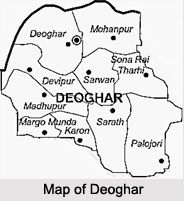
Deoghar in Jharkhand
Deoghar is the divisional headquarters of Santhal Parganas located in Jharkhand and is popular for the famous Baidyanath temple and Shiva Temples.
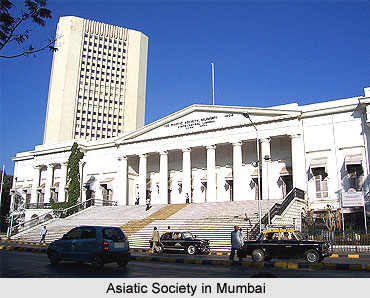
The Asiatic Society of Mumbai
Asiatic Society in Mumbai is the temple of Asian Studies from the time of British rule in India.
Vasco da Gama / Vasco City
Vasco da Gama / Vasco is the biggest city of Goa and is one of the most visited for its perfect amalgamation of business as well as leisure options.
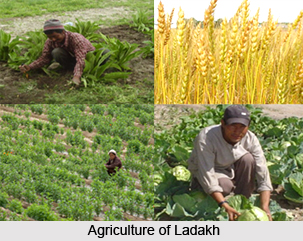
Agriculture of Ladakh
Agriculture in Ladakh is primarily practiced in the short summer season due to its cold desert climate. Farmers grow hardy crops like barley, wheat, p...
Related articles in Cities of India
Holy Cities of North India
Holy Cities of North India are having the rich history of Hinduism and the entire civilization was grown up with the hands of beliefs, rituals and the...
Holy Cities of South India
Holy Cities of South India gives the detailed cultural formation of Dravidians from the early era, which later developed to the world by the Pallavas...
Holy Cities of West India
Holy Cities in West India were established by the rulers of Rajputs and the Satvahana Dynasty and the medieval rulers of Junagadh.
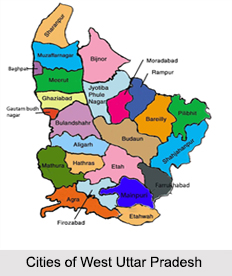
Cities of West Uttar Pradesh
Cities of West Uttar Pradesh include Meerut, Bulandshahr, Ghaziabad, Saharanpur, Muzaffarnagar, Bijnor, Bareilly, Rampur, Agra, Aligarh, Mathura and m...
Port Cities of South India
Port Cities of South India are developed from the early phase of colonial era when the Portuguese and the French traders came to India