
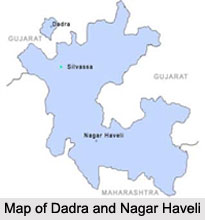
 Dadra and Nagar Haveli is an Indian union territory, located in western part of India. Dadra and Nagar Haveli is crammed between Maharashtra and Gujarat. The capital city of Dadra and Nagar Haveli is Silvassa. Dadra is an enclave lying a few kilometers north of Nagar Haveli in Gujarat. The Daman Ganga River flows through the territory.
Dadra & Nagar Haveli
Dadra and Nagar Haveli is a union territory of western Indian and this place is dotted with a number of tourism destinations which are easily accessible from Gujarat and Maharashtra.
Introduction
Dadra and Nagar Haveli is an Indian union territory, located in western part of India. Dadra and Nagar Haveli is crammed between Maharashtra and Gujarat. The capital city of Dadra and Nagar Haveli is Silvassa. Dadra is an enclave lying a few kilometers north of Nagar Haveli in Gujarat. The Daman Ganga River flows through the territory.History of Dadra and Nagar Haveli
 Dadra and Nagar Haveli, union territory of India, located in the western part of the country and situated between the states of Gujarat to the north and Maharashtra to the south. It lies some 24 km from the Arabian Sea and about 130 km north of Mumbai. The territory consists of two sections - Dadra and Nagar Haveli, which together embrace roughly 70 villages. The capital is Silvassa. Area is 491 square km with population of 342,853 (According to Census 2011).
History of Dadra and Nagar Haveli, which is located between Maharashtra and Gujarat traces the political developments of this Union Territory of India, right since the time it was ruled by the Marathas and also the Portuguese. Prior to being joined with the mainland of India, Dadra and Nagar Haveli witnessed the rule of several dynasties.
Ancient History : The history of Dadra and Nagar Haveli begins with the defeat of the Koli chieftains of the region by the Rajput kings. In the year 1262 a Rajput prince from Rajasthan named Ramsinh established himself as the ruler of Ramnagar, the present-day Dharampur, which consisted of 8 parganas (a group of villages) and assumed the title Maharana. Nagar Haveli was one of the Parganas, and its capital was Silvassa.
In 1360 Rana Dharamshah shifted his capital from Nagar Haveli to Nagar Fatehpur
. With the rise of Maratha power, Shivaji Maharaj viewed Ramnagar as an important locality. He captured the region, but Somshah Rana recaptured it in 1690. After the Treaty of Vasai (6 May 1739), Vasai and the surrounding territories came under the Maratha rule. Soon after, the Marathas captured Ramnagar but reinstated the ruler, Ramdeo, under conditions. Thus the Marathas acquired the rights to collect revenue, known as chauthai from Nagar Haveli and two other Parganas. During the time of Dharamdeo, the son of Ramdeo, due to his change of policies, the Marathas captured Nagar Haveli and the surrounding region.
Medieval History : On the basis of Friendship Treaty executed on 17 December 1779 as compensation towards damage to the Portuguese frigate Santana by Maratha Navy in 1772, the Portuguese were granted the area of Nagar Haveli on 10 June 1783. The treaty allowed the Portuguese to collect revenue from 72 villages in Nagar Haveli. Then, in 1785 the Portuguese purchased Dadra, annexing it to Portuguese India.
In 1818, the Maratha Empire was defeated by the British in the Third Anglo-Maratha War, and the Portuguese ultimately became the effective rulers of Dadra and Nagar Haveli.
Under the Portuguese rule, Dadra and Nagar Haveli were part of the Daman district of the Estado da Ãndia (Portuguese State of India). The two territories formed a single concelho (municipality), named "Nagar Haveli", with its head in Darara until 1885 and, after that, with its head in the town of Silvassa. The local affairs were overseen by an elected camara municipal (municipal council), with the higher level affairs administrated by the district governor of Daman, who was represented in Nagar Haveli by an administrator.
The Nagar Haveli concelho was itself divided in the following freguesias (civil parishes): Silvassa, Noroli, Dadra, Quelalunim, Randá, Darará, Cadoli, Canoel, Carchonde, and Sindonim.
The Portuguese rule lasted until 1954, when Dadra and Nagar Haveli were captured by supporters of the Indian Union. It was the first colony to be detached from the Empire by the occupation of the Indian Union in 1954, after nearly two centuries of Portuguese rule.
Modern History : After India attained Independence in 1947, the residents of Dadra and Nagar Haveli, with the help of volunteers of organisations like the United Front of Goans (UFG), the National Movement Liberation Organisation (NMLO), and the Azad Gomantak Dal, conquered the territories of Dadra and Nagar Haveli from Portuguese India in 1954. As time passed the Indian Independence struggle picked up momentum. On 18 June 1946, Ram Manohar Lohia was arrested in Goa. This was the beginning of the Independence struggle in Goa. He was deported to India. On 15 August 1947, India became independent from British rule, but the Portuguese and other European colonies were not immediately incorporated.
On 18 June 1954, many leaders met at Lavaccha. Lavaccha and Vapi were Indian territories. The order in which these places are lying (from east to west) is Nagar Haveli, Lavaccha, Dadra, Vapi and Daman (on the sea coast). So the Portuguese officers required transit permits through Indian territories of Lavaccha and Vapi to travel between N.H, Dadra, and Daman. On the night of 22 July 1954, 15 volunteers of the United Front of Goans under the leadership of Francis Mascerenhas and Waman Desai sneaked into the territory of Dadra and reached the police station. There are only three personnel at the police station. One was attacked with a knife by one of the volunteers and the other two were overpowered. The Indian tricolour was hoisted and the Indian National Anthem was sung. Dadra was declared "Free territory of Dadra".
On the morning of 2 August 1954, the liberators reached the town of Silvassa to find it free of any Portuguese occupation. The liberation of Dadra and Nagar Haveli was complete. Senhor Luis de Gama, the eldest nationalist hoisted the Indian National Flag and declared the territory of Dadra and Nagar Haveli liberated and the Indian National Anthem was sung.
 In 1961, amidst Indian preparation for the invasion of Goa, Daman, and Diu, K.G. Badlani, an officer of the Indian Administrative Service was, for one day, designated the Prime Minister of Dadra and Nagar Haveli, so that, as Head of State, he could sign an agreement with the Prime Minister of India, Jawaharlal Nehru, and formally merge Dadra and Nagar Haveli with the Republic of India. The Tenth Amendment of the Constitution of India was passed to incorporate Dadra and Nagar Haveli as a union territory, effective 11 August 1961.
On 31 December 1974 a treaty was signed between India and Portugal on recognition of India`s sovereignty over Goa, Daman, Diu, Dadra and Nagar Haveli.
In December 2019, the Parliament of India passed legislation to merge Dadra and Nagar Haveli with the nearby union territory of Daman and Diu to create a single union territory to be known as Dadra and Nagar Haveli and Daman and Diu on 26 January 2020. Dadra and Nagar Haveli will be one of the three districts of the new union territory.
Enclosed by the sea, and the states of Maharashtra and Gujarat is a delightful getaway from the whirlwinds some cities can prove to be. If one wishes to really experience the beauties of nature and meet the people who know how to respect that very same nature, Dadra and Nagar Haveli is the spot for them. Adorned with calm lakes, gardens and a sanctuary to the majestic creatures of the wild. Add to that - the serenity of resplendent churches and temples, it is indeed a splendid destination for all.
Geography of Dadra & Nagar Haveli
Dadra and Nagar Haveli is located on the western side of the foot hills of the Western Ghats Mountain Range in India and about 40 percent of the geographical area is covered with forests. It lies between the parallels of 20 degrees and 20 degrees 25 minutes of latitude north and between the meridian 72 degrees 50 minutes and 73 degrees 15 minutes of longitude. The west, north and south of the territory is surrounded by the Valsad district of Gujarat and towards the south and southeast by Thane District and Nasik district of Maharashtra. The land has a hilly terrain and the soil is rich and fertile. The river Daman-Ganga and its three tributaries intersect the terrain.
Climate of Dadra & Nagar Haveli
 The climate of Dadra & Nagar Haveli is warm and moist during the summer months but less warm during the monsoon months. The southwest monsoon is from June to September. During this time there is profuse rainfall. The rainfall is about 250 to 300cm. The winter months are generally pleasant.
Demographics of Dadra and Nagar Haveli
According to the 2011 census the population is 342853. Dadra and Nagar Haveli is the homeland of various tribes such as Dhodia Tribe, Kokna Tribe and Varli Tribe. The Dhodias and Dublas are mainly confined to the Northern part of Dadra and Nagar Haveli whereas the Koknas and Varlis and found all over. The languages spoken by the people are Hindi, Marathi and Gujarati. The literacy rate is 77.65 percent. The male literacy is 86.46 percent and the female literacy is 65.93 percent.
Administration of Dadra and Nagar Haveli
 Dadra and Nagar Haveli consists of two sections. Dadra consists of three villages and Nagar Haveli consists of 69 villages. The headquarters of the district Dadar and Nagar Haveli is Silvassa.
Economy of Dadra and Nagar Haveli
The agriculture is the main source of economy in Dadra and Nagar Haveli. The region has about 23,627 hectares under cultivation. The main food crops cultivated in Dadra and Nagar Haveli is paddy, ragi, millets, jowar, wheat, tuvar, oilseeds, sugarcane and pulses. Brinjal, tomato, cabbage, and cauliflower are the main vegetables grown here. Forestry is an important economic resource of Dadra and Nagar Haveli. It consists of teak, sadra, khair, mahara and sesame. The forests constitute about 43 percentage of the total geographical area. Dadra and Nagar Haveli is also dependent on manufacturing of spectacle frame, flooring tiles, art silk fabrics, chemicals, detergent powder, electrical fixtures and watches.
People of Dadra and Nagar Haveli
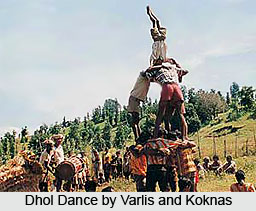 People of Dadra and Nagar Haveli are the regional inhabitants of this Indian Union Territory based between the states of Gujarat and Maharashtra, who follow ancient traditions and customs. Known to be amiable and simple, these people communicate in languages like Hindi, Marathi and Gujarati, while the local `adivasis` converse in individual dialects. Residents of Dadra and Nagar Haveli observe religious and social rituals regularly, and are fond of recreational activities like hunting and fishing, and agriculture is said to be their main occupation. Varli, Dhodia, Kokna, Kathodi, Koli and Dublas are some of the several local tribes who inhabit this Union Territory.
Dhodia Tribe : Dhodia tribe form one of the most significant portions of the population of this part of the nation and constitute about 16.90% of the total populace and are believed to be related to the Bhils. Dhodia is the language spoken by the Dhodias, who feel they are culturally superior to the Bhils. Unlike, Bhils, they do not employ bows and arrows. They are polygamous and purchase their wives even prior to the age when they attain maturity. Dhodias follow many customs which are similar to that of the Hindus, like Raksha Bandhan. They are clad in attractive costumes and jewels made of coloured stones and beads and dwell in thatched huts made of bamboo.
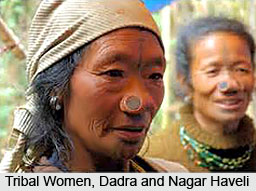
Dubla Tribe : Like Dhodias, the Dubla tribes are also associated to the Bhils and are found in the northern parts of Dadra and Nagar Haveli and communicate with each other with the aide of Dubla language, which is a Bhil language. Generally, they are short and are dark complexioned. They work as servants, casual labourers, landless labourers and other such jobs and are categorised into numerous sub-groups wherein the highest rank is said to be that of the `Talavias`. Dublas are very sociable and love residing in close-knit social clusters. They prefer staying in tiny thatched huts which are composed of mud. A majority of Dublas follow Hinduism. Local men wear `dhotis` and shirts while womenfolk wear knee-length sarees and ornaments.
Kathodi Tribe : The main occupation of the Kathodi tribes is said to be agriculture, but since there is a lack of adequate land holdings in this region, they render service as labourers in the lands belonging to other people. These tribals practise several types of music and dance, and believed to be peace-loving individuals who lead a reserved life. Kathodi tribes reside in the local forests and are engaged in the vocation of making `katha` or `catechew`. They are known to follow their own traditions and cultures.
Kokna Tribe : Koknas form about 16.85% of the population of Dadra and Nagar Haveli and have settled near the foothills of the Western Ghats. Agriculture is one of their important occupations and they cultivate paddy. They are followers of Hinduism and celebrate festivals like Diwali , Kaali Puja, Akhatrij and also worship `Graam Devi`, who is the main presiding deity of the tribal villages of this portion of India. Body art, in the form of tattoos are used by Koknas. Kokna women wear jewelleries and saris and the men wear dhotis which reach till their knees, along with a turban on their heads and a shirt or a waistcoat. Singing and dancing are some of their favourite hobbies. They perform the harvest dance of `Tarpa` during September.
Naika Tribe : Like the Kokna tribes, Naika tribes of this place work as farm labourers in the lands belonging to other people due to the absence of proper landholdings here, even though agriculture is the main occupation of these people. They also make frequent attempts to seek other types of jobs. Handicrafts, folklore, music and dance are integral parts of the Naika tribes of Dadra and Nagar Haveli. They are dependent on the forests for earning their livelihood and are generally shy.
Varli Tribe : The Varli tribes constitute about 62.94% of the total population of this area and represent the members of Scheduled Tribes of India. They are Hindus and are followers of Hinduism, and practise the various rites and rituals of this religion which include Bhawada, Diwali as `Barash`, Kali Puja and offer prayers to the presiding deity or `Graam Devi` of the villages.
Varli men wear turbans on their heads, a loincloth and a waistcoat while the womenfolk are clad in `Lugden`, `Padar` and adorn themselves with white metal jewels as well as silver jewelleries.
Tourism in Dadra and Nagar Haveli
 Tourism in Dadra and Nagar Haveli is enough to impress travellers and nature enthusiasts who have been bitten by wanderlust. This Indian Union Territory, whose capital is the picturesque Silvassa, possesses a vast quantity of tourist destinations which are exquisite places of natural beauty. Dadra and Nagar Haveli is existent between Maharashtra and Gujarat. Some beautiful leisure tourism spots like Tribal Museum of Silvassa and Water Sports Centre at Dudhani are quite interesting. Tourists can also relax at Hirwavan Garden at Pipariya, Kauncha in Silvassa, Khanvel, Mini Zoo and Bal Udyan at Silvassa, Vanganga Lake and Garden at Dadra are only few of the numerable amazing tourist places located in Dadra and Nagar Haveli. Wildlife sanctuaries situated here are the added attractions of this region.
Pilgrimage Tourism in Dadra and Nagar Haveli
Several devotees assemble at the premises of the Lord Shiva temple which is situated at a distance of 2 kms from Khanvel and 18 kms from Silvassa, at Bindrabin. The place is referred to as the Tapovan Tourist Complex and the local Tourism Department has provided some accommodation facilities for the benefit of tourists.
Nature Tourism in Dadra and Nagar Haveli
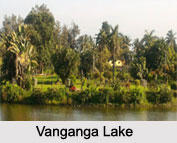
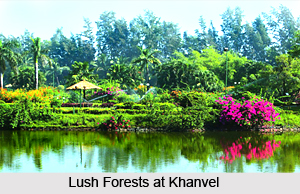
Based at Silvassa, Hirwavan Garden is a famous tourist spot, named after the green Goddess `Hirwa` and contains cascading rivulets, waterfalls, streams and many other kinds of water-bodies, apart from sports meant for children. Based about 4 kms from Silvassa exists the Island Garden, which comprises real thatched huts and wooden bridges and is popular. Kharvel is another marvellous tourist spot, about 20 kms from Silvassa, through which Sakartod River flows by, and is filled with lush forests. Travellers are also fond of Vanganga Lake and Garden at Dadra, particularly its water spread, decorated with fountains, trees and restaurants. Above 40 Hindi films have been shot at this area.
Leisure Tourism in Dadra and Nagar Haveli
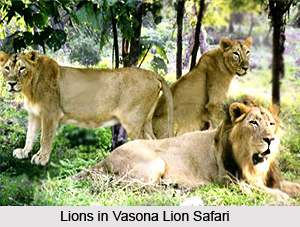
Occupying an area measuring 25 hectares, the Lion Safari Wildlife Park boasts of providing refuge to the Asiatic Lion and specially equipped riders, who are granted rides in uniquely caged vehicles. At Silvassa, one might visit the Mini Zoo and Bal Udyan. Crocodiles, monkeys, various kinds of birds and pythons can be noticed here, which appeal mostly to children. Animal lovers must not miss the wildlife sanctuary at Khanvel, which possesses chital deer, sambhar, birds, blackbucks and other animals. Madhuban Dam, which exists downstream of Damanganga River can also be visited, for it provides recreation facilities like aqua- biking, boating with the aide of bumper boats, canoes, speed boats, passenger boats and so on.
Other Tourist Spots in Dadra and Nagar Haveli
Historians must visit the Tribal Museum at Silvassa, which consists of domestic objects which serve utilitarian purposes, musical instruments, jewelleries worn by the regional tribals, hunting gadgets utilized by them, etc. Photographs of their wedding costumes and their significant occasions are exhibited. One can indulge in water sports, and sailing in `shikaras`, jet skis or speed boats at Dudhani, 20 kms from Khanvel, near Damanganga River. Tourists often visit Luhari, which is based about 14 km from Silvassa, a breathtakingly beautiful region, and also the Lion Safari, Vasona. A riverside park named Vandhara Udyan serves as an ideal picnic spot and holiday getaway.
Recently updated articles in States of India
Bandare Waterfalls, Meghalaya
Bandare Waterfalls in South Garo Hills, Meghalaya, is a secluded natural attraction surrounded by dense subtropical forests and rugged mountain terrai...
History of Thissur District
Early History of Thissur District explains flourishing of the port cities. Now these port cities are transformed into archaeological sites.
Tippi Orchid Research Centre, Arunachal Pradesh
Tippi Orchid Research Centre in Arunachal Pradesh is renowned for its rich collection of exotic and endangered orchids. Surrounded by lush rainforest...
Tourism in Nashik District
Pilgrimage tourism in Nashik district involves visiting the various places of Hindu and Jain worship located here. Some of the holiest sites for Hind...
Mangadu, Kerala
Mangadu in Kerala’s Kollam district is a significant megalithic site known for its urn burials, cist burials, menhirs, and stone circles. Excavations...
Related articles in States of India
East Indian States
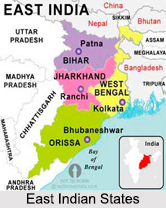
East Indian States comprises of Bihar, Jharkhand, West Bengal, Odisha and also the Union Territory of Andaman and Nicobar Islands. It defines the cult...
Purnia District in Bihar
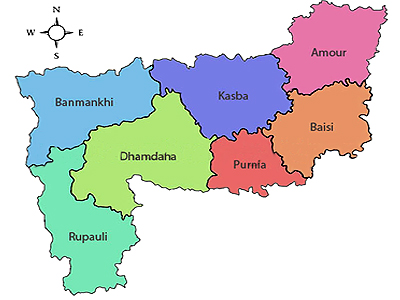
Purnia District is located in Bihar and extends from River Ganga to Nepal. The district has a rich Hindu history and glorious past.
Hooghly district
Hooghly District along the bank of the river Hooghly is one of the principal trading ports of West Bengal.
Geography Of Chittoor District
Geography of Chittoor district is spread along the topography of the land which is divided into two natural divisions; Chittoor has a dry and healthy...
Districts of West Bihar
Districts of West Bihar is comprised of medieval monuments that were built by the different governors of Mughal era.