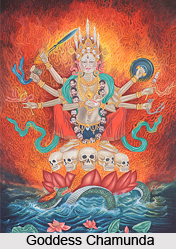
Goddess Chamunda

Devi Chamunda is recognized as one of the chief Yoginis. She is known as the Mysore’s guardian deity or a protector of the whole of Mysore since time immemorial. She is the personal deity of the Mysore royal family in the Mysore Palace.

About Chamunda Devi

Chamunda, GoddessThe name `Chamunda` originated from the name of two monsters Chanda and Munda, who were killed by the Devi. According to an ancient legend the Goddess Chamunda was enshrined as Chief Goddess with the title `Rudra` in the battle between Lord Shiva and the demon, Jalandhara. Since the place is known as Rudra Chamunda. The famous Chamunda Nandikeshwar Dham is an abode of Shiva Shakti following the sagas of Purana. In another legend it is stated that Chamunda emerged as Chandika Jayasundra from an eyebrow of Goddess Kaushiki during the battle of `Savarni Manamantra` between gods and demons.

She was assigned the task of killing two demons `Chand` and `Mund`. Chamunda fought a fierce battle with these two monsters and finally won over them and assassinated them. Then Chandika Jayasundra took the slain heads of the two demons to the goddess Kaushiki, who was immensely pleased at her success, blessed her and bestowed her with the title `Chamunda`. Since then the goddess is famous with the name Chamunda.

There is also a legendary story about Goddess Chamunda. It is about the famous temple of Devi Chamunda in Kangra District of Himachal Pradesh, India. About four hundred years ago the King and the Brahman priest prayed to the goddess for the permission to move the temple in an easily accessible location. The goddess Chamunda appeared before the priest in his dreams and granted their prayer. She also directed the priest to dig in a certain spot where they would found an old idol, which has to be installed in the temple and worshipped as her form.

The king sent out his men to dig up the idol. The men could locate it but was unable to lift it up. Goddess Chamunda again appeared in the dream of the priest and explained that they were not able to lift the whole relic as they considered it as ordinary stone. The Goddess also asked the priest to get up early in the morning, take bath, wear fresh clothes and go to that place as clean and pure with a respectful mind. The Priest did the same as he was instructed to do by the Goddess and could easily lift the idol alone which a large group of men could not do. The idol of Goddess Chamunda was established in the temple and worshipped. In some forms, Goddess Chamunda is adorned by serpents, scorpions and skulls.

Chamunda is also known by names like Chamundi, Chamundeshwari and Charchika and is also considered as one of the seven Matrikas. She is also one of the chief Yoginis. She is closely associated with Goddess Kali which is another fierce aspect of Devi. She is worshipped by ritual animal sacrifices along with wine offerings and in the ancient times human sacrifices were also offered. Initially Chamunda is a tribal goddess who was incorporated later in Hinduism.

In India there are a considerable number of temples devoted to Goddess Chamunda. Some of the renowned temples are Chamunda Devi temple in Himachal Pradesh, the two Chamunda shrines in Gujarat, Charchika Temple in Orissa and Chamundeshwari temple in Mysore.
Origin of Goddess Chamunda

According to Ramakrishna Gopal Bhandarkar, the Munda used to pay offerings to the goddesses in the form of animal as well as human sacrifices, along with ritualistic offerings of liquor. They are referred to as the Adivasi ethnic group of the Vindhya Range of Central India. It has been interpreted that Chamunda in the form of Devi was initially worshipped by them, as the tantric worship of Chamunda is known to comprise the above mentioned methods of worship. Gopal Bhandarkar also highlights the reason for the terrifying nature of this Devi, which is her association with Vedic Rudra. Vedic Rudra is known as Lord Shiva in modern Hinduism.

Iconography Of Chamunda : goddess chamundaGoddess Chamunda is one of the seven Matrikas. The Sapta Matrikas are generally carved in relief on a rectangular stone slab with the figures of Virabhadra and Lord Ganesha on either side. The worship of Chamunda was quite popular in India including the present Bangladesh.
The general features of the goddess are as follows: The goddess has an emaciated body and shrunken belly which shows protruding ribs and veins and also is adorned with a skull garland, bare teeth and protruding tongue and sunken eyes. The hairs of the deity are represented as standing on end with snakes peeping out. She holds behind her the skin of an elephant. The deity is dressed in a tiger`s skin and her abode is generally under a fig tree.

The deity has a corpse, an owl or an ass or a plump boy as her vahana. The emblem of the deity is a vulture. This particular iconography of Chamunda symbolises universal Death and Destruction but at the same time also shows the abaha and the varada attitudes to her devotees. In some of the iconographies the deity is provided with a child who is either placed on the lap of the deity or the child is made to stand by her side. The goddess may be represented as standing, dancing, squatting or sitting with one leg pendant.

The usual image of Chamunda is endowed with four hands. According to the Agni Purana there are eight different forms of Chamunda. The iconography of Rudra Chamunda is made of black basalt.

Among the four right hands of the deity the three hands carry a knife, a kettledrum and one end the elephant-skin is carried and the upper portion of the fourth hand which is raised above the waist is broken. Of the four left hands the small finger of the first is raised to the lips as if the goddess is biting off her nail holding the mace to her shoulder. The rest of the hands are represented as carrying the elephant skin, a corpse and a kapala respectively. The iconography shows the goddess as dancing on a plump boy and sometimes is also represented as dancing on the pedestal.

Another iconography of goddess Chamunda represents the goddess as wearing human heads and possessing an emaciated body, sunken eyes, pendulous breasts and a contracted belly with a scorpion painted on it. She is shown as holding the elephant skin over her head like a canopy. In fact it can be said the figure portrays in a remarkable manner the weird and terrible aspect of the deity.

Some iconographies represent the image of the goddess as made of sand stone. The iconography of the ten-armed figure of Chamunda represents the image of Siddha-Chamunda. In such an image although most parts of the image are effaced yet some parts are visible.

In such an iconography the goddess is represented as seated on a lalitasana pose placing her right leg on an indistinct object. She is flanked on either side by a dancing gana. She is shown as holding the elephant skin which serves as her canopy. The other objects which are held by the deity are not distinguishable.

Thus it can be concluded saying that the iconography of Chamunda is such that it represents a fearful and an angry image of the goddess.

Associations of Goddess Chamunda with the City of Mysore

It is important to note that Mysore takes its name from Goddess Durga or Chamunda, "Mahishasura Mardini". Mahishasura is known to be a powerful monster with the head of a buffalo and the body of a human. He has been mentioned in the Hindu Mythology as a combination of both an Asura and a Mahisha (aurochs) with trident, who aimed to annihilate all the Devas since they were the arch-enemies of Asuras. Demon Mahishasura came from bottom south and occupied the land of Mysore. The people of this region were therefore in danger. They prayed to Goddess Durga to save them and she came to their rescue during a sacred period which is now known as Navratri and Dushera. The battle between the Devi and Mahishasura continued for nine days on the Chamundi Hills. It was ultimately in the Hills, where he was slayed by the goddess. Goddess Chamunda is therefore known as Mysore"s guardian deity or a protector of the whole of Mysore since time immemorial. This classic tale of the forces of good defeating the forces of evil is what`s celebrated in Dushera festival in Karnataka.

Mysore Palace
Mysuru is known to be adorned with historical palaces. They are such in number that this city is commonly described and popular as the "City of Palaces". It is important to note that the term "Mysuru Palace" specifically refers to palace located within the old fort. The palace was commissioned in the year 1897 and its construction was completed in the year 1912. This palace has been developed as one of the most popular tourist attractions in Mysuru. Although tourist visitation is permitted within the palace, but the tourists are not allowed to take photographs inside the palace.

The palace structure is known to be constructed merging together Hindu, Muslim, Rajput, and Gothic styles of architecture. This three-storied stone structure is the official residence of the Wadiyars. They are identified as the erstwhile royal family of Mysuru. This palace is adorned with uniquely designed rooms (Public Durbar Hall, Private Durbar or Ambavilasa Palace, Gombe Thotti (Doll"s Pavilion), Kalyana Mantapa, Portrait Gallery and the Casket Room). Apart from these rooms, a prominent aspect of this palace is the deity called Chamunda.

Goddess Chamunda of Mysore Palace

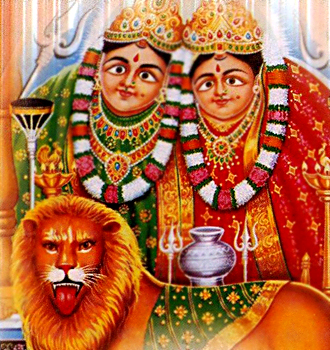
Goddess Chamunda is considered to be the personal deity of the Mysore royal family. The idol of Chamunda residing in the Mysore Palace is depicted wearing a saree and riding a lion with a trident that she is holding in her powerful hands.

Associations of Goddess Chamunda with the Festival of Dasara

Goddess Chamunda gave the city of Mysore the very reason for celebrations by slaying Mahishasura. The Vijaynagara Kings are credited with the birth of the festivities associated with Dushera in the city of Mysore. These festivities were kept alive by the Wadiyars. During the bygone days of the monarchy, the festival of Dushera was characterized by uniformed soldiers and marching bands leading a retinue of courtiers, honored guests and a host of attendants. The Royal sword smeared with vermilion would ride in its own palanquin. The streets would be filled with people to get a glimpse of their king. The Chamunda would then journey on the golden howdah. The procession would also have decorated horses, jeweled elephants, adorned camels and cows.

Dushera is celebrated on the first day of Ashwiyja, which is the seventh month of the Hindu lunar calendar. This festival is celebrated around September or October every year. In the city of Mysore, this festival is marked by wrestling matches, acrobats and fireworks. On the tenth day, the demon is destroyed and the celebration is marked by a magnificent procession through Mysore. The beginning of the Parade is announced by the blow of conch shells and the trumpets. The parade is known to follow the same itinerary which was followed before independence.

Recently updated articles in Cities of India

Deoghar in Jharkhand
Deoghar in Jharkhand Thumbnail

Deoghar in Jharkhand

Deoghar is the divisional headquarters of Santhal Parganas located in Jharkhand and is popular for the famous Baidyanath temple and Shiva Temples.

The Asiatic Society of Mumbai
The Asiatic Society of Mumbai Thumbnail

The Asiatic Society of Mumbai

Asiatic Society in Mumbai is the temple of Asian Studies from the time of British rule in India.

Vasco da Gama / Vasco City
Vasco da Gama / Vasco City Thumbnail

Vasco da Gama / Vasco City

Vasco da Gama / Vasco is the biggest city of Goa and is one of the most visited for its perfect amalgamation of business as well as leisure options.

Agriculture of Ladakh
Agriculture of Ladakh Thumbnail

Agriculture of Ladakh

Agriculture in Ladakh is primarily practiced in the short summer season due to its cold desert climate. Farmers grow hardy crops like barley, wheat, p...