Effects of Ghadar Movement worked both in favour and opposition of the leaders of the movement. Ghadar leaders were successful to agitate and stir up the Britons quite drastically. The activities made the autocrats rise up and take notice of the clandestine activities happening around them. They could not anticipate that such daring and intimidating activities could actually be committed by any native. As a result, they were armed with every measure to repress them to the full. The Ghadarites had made a decision to work from the country, instead of remaining in hiding overseas. The effects of the gory war were far-reaching and several Indians lost their lives in the ruthless bloodshed.
Ordinance against Indians
The British authorities however had received prior information about the arrival of Ghadar Party leaders and workers in India. They armed themselves with the legislative measures by issuing the Foreigners Ordinance on 29th August 1914 in order to prevent the entry of undesirable aliens in India. On 5th September 1914, it was followed by Ingress into India Ordinance devised to check the movements of returning emigrants which empowered the provincial governments to check the people entering India. Even though they were Indian residents, the authorities had the power to order them to vacate a particular area, or to take them to a particular place or to confine their movements to their villages. The provincial governments were also empowered to punish them or even imprison them without trial.
Prohibition of Punjabis from Entering India
Since the people entering India were Punjabis, the
Punjab government sent its police to the Calcutta (now
Kolkata) shores. The Bengal police with the help of Punjab police used to beleaguer the passengers arriving in India. Their names, addresses and particulars were noted. The suspects were nabbed and under police escort, were taken by train to
Ludhiana where the interrogation centre was set up. The revolutionaries got prior information of these harsh measures and they started taking steps to avoid the police dragnet. Pt. Jagat Ram and
Kartar Singh Sarabha reached Madras (now
Chennai) on 15th September 1914 and reached Punjab safely.
Assault on Ghadarites
Kamagatamaru was the first ship to reach the shores of Calcutta on 27th September 1914 after the issuing of Ingress into India Ordinance. The passengers of Kamagatamaru were subjected to bullets at Budge Budge Ghat. This left nineteen dead, twenty-one injured, seventy-two imprisoned, while many others went missing. This infuriated not only those who suffered the blows, but also all those countrymen who had national love close to their bosom.
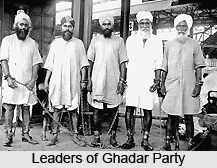
After Kamagatamaru, the first ship Chai Sang reached Calcutta on 12th October 1914 with fifty-seven Ghadarites. The second ship was Nam Sang that reached Calcutta on 13th October 1914 carrying eighty-three Ghadar leaders including Baba Sohan Singh Bhakna, Bhai Jawand Singh and Bhai Bir Singh Bahowal. After some more arrivals, the ship Tosha Mam reached on 29th October 1914 bringing 173 Ghadar leaders and workers. Of all the emigrants returning in November and December, those of Tosha Mam were termed as most dangerous by the Sedition Committee. Pt. Kanshi Ram Marholi reached Calcutta on 2nd November 1914 by the ship Lama. He had brought some money and had also got booked some boxes of weapons. Baba Sohan Singh Bhakna, Bhaijawala Singh Thathian, Bhai Wasakha Singh, Bhai Kesar Singh Thathgarh and Bhai Sher Singh Vain Poin, Master Udham Singh Kasel, Mangal Singh Bhanger and Lai Singh Dhotian were the central leaders of the Ghadar Party who, among others, were arrested on their landing in India either at Calcutta or at Madras.
Planning and Collaboration of Ghadarites
Although the arrest of these leaders was a hindrance to their planning, it did not dampen the spirit of those who had escaped the dragnet of the police. Kartar Singh Sarabha, aged eighteen was an active revolutionary. He had been contacting all those who had escaped and an important meeting was held in the house of Bhai Nanak Singh in
Amritsar on 16th and 17th October 1914. Distribution of Ghadar literature and Ailan-i-Jang was planned. The duties were assigned. The villages were allotted. The new arrival of Ghadar leaders and workers was to be noted and they were to be informed and associated. The decisions were also taken on how to raise the funds, how to collect arms and how to establish contacts with Bengal patriots. Bhai Prem Singh Sur Singhia, Bhai Gujar Singh Bhakna, Bhai Jawand Singh Nangal, Bhai Uttam Singh Hans, Bhai Isher Singh Dhudike, Bhai Gandha Singh, Bhagat Singh Kacharabhan and others dispersed in the villages allotted to them for carrying the Ghadar propaganda and preparing the people to join the movement. Bhai Parmanand had a close association with the Ghadar leaders and his shop in Machhi Hatta in Lahore was the meeting point for the revolutionaries. He also served as link between the Punjab Ghadar work and San Francisco headquarters.
Kartar Singh Sarabha and Ram Saran Das Talwar also tried installing a press to re-publish Ghadar literature but were unsuccessful. However, they got copies of explosive Ghadar literature reprinted and arranged its distribution in the public and in barracks even situated at far off places. Kartar Singh Sarabha and Bhai Nidhan Singh Chugh also urged on and enrolled the students of Islamia High School Ludhiana for this purpose.
Allotment of Duties among Ghadarites : 
Areas were also allocated to the Ghadar leaders for working in the military barracks. Bhai Hirde Ram was sent to
Jalandhar Cantonment. Kartar Singh Sarabha went to
Ferozepur, Bhai Harnam Singh Kahuta visited
Jhelum, Rawalpindi, Peshawar and Mardan, Piara Singh Langari had gone to frontier stations of Banu Kohat to stimulate the troops there. Kartar Singh Sarabha accompanied by a student also visited
Ambala, Meerut,
Kanpur,
Agra,
Allahabad,
Dinapur,
Benaras, Lucknow and Faizabad military cantonments for instigating the defence personnel to join the national struggle for liberation. Vishnu Ganesh Pingle was assigned work in Meerut Cantonment. Pt. Jagat Ram Hariana went to the independent area of western frontiers for weapons where he was arrested on 23rd November 1914.
Prosecution of Ghadar Leaders : But success escaped from the Ghadar leaders as betrayers had entered into the rank of these dedicated patriots. The plan was leaked out in advance by these betrayers to the British police, which defeated the planned attack and also led to large-scale arrests of Ghadar leaders from their hideouts and from clandestine places of operation. The last blows were struck by the British when Kartar Singh Sarabha and his companions were arrested on 2nd March 1915 and Vishnu Ganesh Pingle was arrested on 23rd March 1915.
The Ghadar leaders were prosecuted in a number of criminal cases. Besides the Lahore Conspiracy Case, there were four Supplementary Lahore Conspiracy Cases, two Mandi Conspiracy Cases, two Burma Conspiracy Cases and one Lahore City Conspiracy Case. There were other cases also, like the Pherushahar Murder Case, Anarkali Murder Case, Padhri Murder Case, Walla Bridge Murder Case, Jagatpur Murder Case, Nangal Kalan Murder Case, Thikriwal (Gurdaspur) Army Act Case and Chawarian and Srigobindpur (
Gurdaspur) Dacoity Case. According to the summary of the criminal cases arising out of the Ghadar movement given by Isemonger and Slattery at the end of the Ghadar Conspiracy Report, 279 emigrants were tried. Out of them 46 were hanged, 64 were sentenced with expatriation for life and 125 were awarded lesser punishments. And the movement died down for the time being.

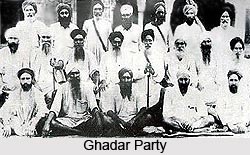 Ghadar Movement was a secular movement launched with the aim of liberating India from the clutches of British rule. After the British government decided in April 1914 to stop the deportation of political prisoners to the Andamans (and subsequently a majority of them already sent were repatriated to the Indian jails by September 1914), the revolutionary activities again flared up in 1915 onwards which were more authoritative in intensity, serious in nature and larger in dimension. The prevailing laws, the existing judicial system, the procedure of trial and the Indian jails, all weapons of the administrative set up, were found highly inadequate to contain the terrorist activities and penalise the revolutionaries. As a result, the British not only ordained new legislations, but also changed the judicial procedure of trial so as to reduce it only to a semblance of trial.
 The gates of the Cellular Jail in the Andamans were reopened to imprison and punish the political prisoners. This time, among other revolutionaries convicted in other cases, Punjabis in general and Sikhs in particular, primarily convicted in fake trials known as Lahore Conspiracy Case and other related cases, were deported to the Andamans. These revolutionaries, well settled in various countries like Canada, America, Philippines, Burma, Hong Kong, China and Japan, had come to the country with a missionary zeal to wage war against the British Empire in India. They were either leaders or members of the Ghadar Party, or they were influenced by its ideology and patriotic fervency. Ghadar Movement thus gradually took the shape of a dynamic movement.