
 Bengaluru Rural District is situated in the state of Karnataka. It came into existence in the year 1986 after the division of the erstwhile Bengaluru district into two separate districts of Bengaluru urban and Bengaluru rural district. Lying in the South Western corner of Karnataka state, it is primarily an agricultural area and dry farming is a characteristic feature of this district. Situated in the beautiful Arkavati River Valley, there are a number of famous tourist spots in the district, such as Mekedaatu, Sawan Durga, etc. The district is famous for the lacquer ware works of Channapatna. The new district physically almost surrounds the Bengaluru (Urban) District except having an opening in the South-East, the Anakal Taluk, the connecting area between Kanakapura and Hosakote Taluks, being a part of the Bengaluru (urban) district and the headquarters of the new district is at Bengaluru itself. Bengaluru Rural District is bounded on the North by Tumkur and Kolar District; on the South by Mandya and Mysore Districts and Tamil Nadu State; on the east by Kolar District and Tamil Nadu State and on the West by Tumkur and Mandya Districts.
Bengaluru Rural District
Bengaluru Rural District is situated in the state of Karnataka; it was formed in 1986 with the division of Bengaluru district into Bengaluru rural and Bengaluru urban district.
Introduction
Bengaluru Rural District is situated in the state of Karnataka. It came into existence in the year 1986 after the division of the erstwhile Bengaluru district into two separate districts of Bengaluru urban and Bengaluru rural district. Lying in the South Western corner of Karnataka state, it is primarily an agricultural area and dry farming is a characteristic feature of this district. Situated in the beautiful Arkavati River Valley, there are a number of famous tourist spots in the district, such as Mekedaatu, Sawan Durga, etc. The district is famous for the lacquer ware works of Channapatna. The new district physically almost surrounds the Bengaluru (Urban) District except having an opening in the South-East, the Anakal Taluk, the connecting area between Kanakapura and Hosakote Taluks, being a part of the Bengaluru (urban) district and the headquarters of the new district is at Bengaluru itself. Bengaluru Rural District is bounded on the North by Tumkur and Kolar District; on the South by Mandya and Mysore Districts and Tamil Nadu State; on the east by Kolar District and Tamil Nadu State and on the West by Tumkur and Mandya Districts.History of Bengaluru Rural District
Historically, the earliest dynasty which established its sway over this district is that of the Gangas. In about the fourth century A.D., the Ganga dynasty was established at Kolar and the territory comprised in Bengaluru Rural district formed part of Gangavadi. Honganur of Channapatna Taluk was the chief town of a sub-division, called Chikka Gangavadi, which occupied the Shimsha valley. During the Seventh century, Mankund was a place of great importance and was the second royal residence of Ganga Bhuvikrama (654-79) and also of Shivamara (679-726). In the eight century Shri Purusha made Manyapura (Manne of Nelamangala Taluk) his royal residence and later it was a major centre under the Rashtrakutas. Manne had been the headquarters of Rashtrakutas Governor Kambarasa. Certain parts of the district, especially in the East, were held by the Nolamb Pallavas.
Geography of Bengaluru Rural District
Bengaluru Rural District is located in the South-Eastern corner of Karnataka State. Spanning a geographical area of 5,814 sq km, the district lies stretched between the latitudinal parallels of 12 degrees 15 minutes North and 13 degrees 35 minutes North on the one hand and the longitudinal meridians of 77 degrees 5 minutes East and 78 degrees East on the other.
 The district, lying on the plateau with an average elevation of 600 to 900 metres from mean sea level, has ranges of hills which are actually spurs of the Eastern Ghats mountain range stretching northwards with peaks like the Banantimari Betta, Mudawadi Betta, Bilikal Betta, Siddadevara Betta, etc. The Savandurga and Shivaganga peaks are another row of hill ranges, spreading upto the Nandi Hill running across the Bengaluru (Urban) district. The major portion of Bengaluru rural district lies in the Arkavati valley. The Arkavati, the Kanva River and the Dakshina pinakini (southern Pennar River) are the rivers which flow through the district in the general direction from north to south. Bengaluru Rural District is located in the south-eastern corner of Karnataka spanning a geographical area of 5,814 sq.km and it forms about 3.02 percent of the total area of the state. Cultivable lands are mainly rain-fed and dry farming is a characteristic feature of the district. By and large this rural district is agricultural and Ragi is the main crop though mulberry is raised over considerable tracts. The climate of the region is moderate and is devoid of extremes. But rainfall is meagre, and as no major river flows in the district, irrigation facilities are also limited.
The district, lying on the plateau with an average elevation of 600 to 900 metres from mean sea level, has ranges of hills which are actually spurs of the Eastern Ghats mountain range stretching northwards with peaks like the Banantimari Betta, Mudawadi Betta, Bilikal Betta, Siddadevara Betta, etc. The Savandurga and Shivaganga peaks are another row of hill ranges, spreading upto the Nandi Hill running across the Bengaluru (Urban) district. The major portion of Bengaluru rural district lies in the Arkavati valley. The Arkavati, the Kanva River and the Dakshina pinakini (southern Pennar River) are the rivers which flow through the district in the general direction from north to south. Bengaluru Rural District is located in the south-eastern corner of Karnataka spanning a geographical area of 5,814 sq.km and it forms about 3.02 percent of the total area of the state. Cultivable lands are mainly rain-fed and dry farming is a characteristic feature of the district. By and large this rural district is agricultural and Ragi is the main crop though mulberry is raised over considerable tracts. The climate of the region is moderate and is devoid of extremes. But rainfall is meagre, and as no major river flows in the district, irrigation facilities are also limited.Education of Bengaluru Rural District
The proximity of Bengaluru rural district to the state capital has not influenced favourably the educational levels in the district. The district educational profile reflects the complex socio-economic factors affecting education. The district is economically backward and it comprises of eight blocks.
Economy of Bengaluru Rural District
Cultivable lands are mainly rain-fed and dry farming is a characteristic feature of the district. By and large this rural district is agricultural and ragi is the main crop though mulberry is raised over considerable tracts. Agriculture forms the main occupation of the people of the district. Bee keeping is a major rural industry here in the various taluks, and this industry is based on agriculture, forestry and horticulture. Fisheries has gained a lot of importance and play a significant role in the economy of the country- as a good source of foreign exchange, a wholesome source of healthy protein and in providing a wide source of employment opportunities to several millions who are solely dependent on fisheries. Sericulture is an important rural, agriculture-based cottage industry. Sericulture has a standing of more than two centuries in the state and has contributed to the improvement of economic status of people. This industry is an agriculture-based industry and consists of activities like mulberry cultivation, silkworm rearing, silk reeling, twisting, weaving.
Administration of Bengaluru Rural District
 Administration of Bengaluru Rural district in Karnataka is carried out by the Deputy Commissioner. Deputy Superintendents for the district were appointed when districts were created during the days of the Commissioner`s rule. In 1869 when the commissioner was designated as the Chief Commissioner, the Deputy Superintendents of the district came to be stated Deputy Commissioners. The district being a viable administrative unit below the State level, the Deputy Commissioner plays a pivotal role particularly after 1956.
The Deputy Commissioner has a number of functions to perform which fall under two broad categories- revenue and judicial administration. The Deputy Commissioner has been invested with large powers under the land revenue Act and Rules.
The power of collecting and accounting of all revenue vests with the Deputy Commissioner who has to see that the revenue dues to the Government is recovered regularly without much coercion and that all such collections are properly credited and accounted for. In addition to the duties relating to land revenue, the Deputy Commissioner is responsible for collection of fees and taxes under various other enactments like Stamps and Registration Act etc. He exercises various powers under several Acts and Rules, such as the Land Reforms Act, Land Acquisition Act, Religious and Charitable endowments Act, Irrigation Act etc.
The Deputy Commissioner is also empowered to survey and settle boundary disputes relating to lands. He is the custodian of all Muzrai Institutions in the district and he is also concerned with the Small Savings Scheme. Recently he has been invested with powers to inspect all Government Offices, except judicial and police officers in the district.
As regards his judicial functions, the Deputy Commissioner being the District Magistrate is responsible for the maintenance of law and order in the district. Being the head of all Executive Magistrates in the district, he exercises extensive powers under the code of Criminal Procedure, Indian Penal Code, Karnataka Policy Act etc., for the maintenance of law and order. In his capacity as the District Magistrate he directly controls the police force at times of protecting public peace; he has special powers to make use of preventive detention or get persons bound in the interest of public safety.
Being the head of the executive machinery in the district, he issues licences and permits under Indian Arms Act, Indian Explosives Act, etc., with powers to supervise the general administration of these Acts. He is also authorised to issue licences under the Cinematograph Act and exercises power vested with regard to the Prevention of Untouchability Act and the like.
The Deputy Commissioner was the Deputy Development Commissioner till the starting of the Zilla Parishads. As such now the District Rural Development Society (DRDS) ceases to exist as the entire activities of the society came to be transferred to the Zilla Parishad.
The Deputy Commissioner is assisted by a number of people in the exercise of his functions. These include the Head Quarters Assistant who also functions as the Additional District Magistrate. He is also assisted by a Food Assistant and a Food and Civil Supplies Assistant. There is a group -B officer designated as Office Assistant for supervising the subordinate staff of the office and a District Planning Officer to assist in planning matters. There are various sections in the establishment of the Deputy Commissioner. In the Revenue section, there is one Head Quarters Assistant, three Tahsildars (one Leave Reserve Tahsildar, One Municipal Tahsildar and one Muzrai Assistant), one Office Assistant, two Stenographers, four Sheristedards, Rent Control Inspector and other subordinate staff. The registration section has one Headquarters Assistant to the District Registrar and other staff. The food section has one Food Assistant, Food Tahsildar, one Accounts Superintendent and other necessary staff. In the Planning Section, there is one District Planning Officer, one Assistant Director of Planning, one Assistant Statistical Officer and other subordinate staff.
The post of the Special Deputy Commissioner (Development) for the Bengaluru rural District was originally created to mainly look after the developmental projects and schemes of the Government. But, with the starting of the Zilla Parishad all development functions have been transferred to the Parishad. But the revenue functions of the Special Deputy Commissioner who still assists the Deputy Commissioner remain unchanged. The Office of the Special Deputy Commissioner comprises of one Gazetted Manager, two Accounts Superintendents and other necessary staff. The Special D.C. will deal with various matters relating to Land and Land Revenue including recovery of all Government dues, Land Acquisition, Stamps and Registration, Societies Registration Act (1950), Registration of Firms under Indian Partnership Act (1932), Religious and Charitable Institutions and Endowments etc.
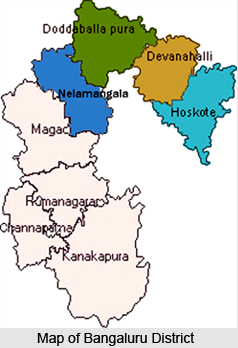
Each Sub-division is under the charge of an Assistant Commissioner who is responsible to the Deputy Commissioner. The Bengaluru Rural District has the sub divisions at Doddaballapur and Ramanagaram respectively. The Assistant Commissioner is the immediate superior authority over the Tahsildars and Chief Officers of the Town Municipal Councils.
The Assistant Commissioner is generally assisted by a Manager (Sheristedar), four First Division Assistants, four Second Division Assistants and other subordinate staff. He should exercise effective supervision over the whole office establishment, systematise and co-ordinate the office administration and guard against delay in official procedure. The Assistant Commissioner in charge of the Sub-division has been vested with powers of the Deputy Commissioner under many sections of the Karnataka Land Revenue Act (1964) and also other state laws. He is the first appellate authority in respect of revenue matters and he is also the authority at the lowest level, at which powers of revision under section 56 of the Karnataka Land Revenue Act (1964) are vested. The Assistant Commissioner is also the Land Acquisition Officer and Betterment Levy Officer. He is the Chairman of the Tribunals constituted under Karnataka Land Reforms Act (1961), for the taluks in his sub-division. He is the Returning Officer for one or more of the Assembly constituencies in his sub-division. Being the head of the General Administration of the sub-division, the Assistant Commissioner also discharges several magisterial powers. He has been designated as the Sub-divisional Magistrate. At the taluk level, he is the presiding authority of several committees.
The Tahsildar (or "Amildar" as formerly known) is in charge of the taluk. The Tahsildar is responsible to the Assistant Commissioner of his sub division and through him to the Deputy Commissioner. He has also to execute the orders passed by them. The Tahsildar is generally regarded as representative of the Government at the taluk level; he has to accept mutations, hear and pass orders in disputed cases, test the Record of Rights and crops in respect of the village sites etc. The Tahsildar is assisted by taluk Shiristedars (Deputy Tahsildars), Revenue Inspectors, Special Revenue Inspectors, Record keepers and other staff. There had been Special Tahsildars for the purpose of effecting Land Reforms. Twenty Point Economic Programme etc.
The Block Development Officer also functions at the taluk level each taluk being regarded as a Community Development Block. With effect from 1-4-1987 the revenue functions of the Block Development Officers have ceased as he has to work under the purview of the Zilla Parishad. He is assisted by one Manager, and other necessary staff. He is the Secretary of the Taluk Panchayat Samiti under the newly introduced set-up.
The taluks are further divided into hoblis or revenue circles. The Revenue Inspector is in charge of the administration of the hobli. The eight taluks of the Bengaluru Rural District have been further sub-divided into 33 hoblies or revenue circles, each under the charge of a Revenue Inspector. In the administration of revenue matters, he is directly responsible to the Tahsildar of the taluk. He is the main field official, who will be instrumental in the actual execution of the orders of the government in respect of revenue matters. The Revenue Inspector has to supervise the work of the Village Accountants in charge of the villages and also to inspect the boundary/marks, government lands, and encroachments etc.
With a view to decentralise the revenue administration and ease the pressure of work on the taluk offices, whose powers and functions have increased enormously, Nad Kacheris or hobli level offices have been opened on an experimental basis from the 15th August 1986. The Nad Kacheri is headed by one Deputy Tahsildar and the necessary staff. Out of the 21 revenue functions of the Tahsildar, nine have been delegated to this office at present. These Nad Kacheris are functioning in all the taluks of the Bengaluru Rural District selected in one of the revenue circles.
With the abolition of the hereditary Shanbhogues as per the provisions of the 1970 rules, the village administration is entrusted to the Village Accountant. He is the lowest revenue functionary in the administrative chain, being the custodian of village revenue records and collector of revenues. The Gram Sahayak assists him in survey work and serves as a messenger.
Tourism In Bengaluru Rural District
Tourism in Bengaluru rural District is a relaxing experience. There are a number of places located here which are of immense tourist interest, as they reflect the culture and tradition of the place. Some of the most prominent ones are discussed below.
Leisure Tourism in Bengaluru Rural District
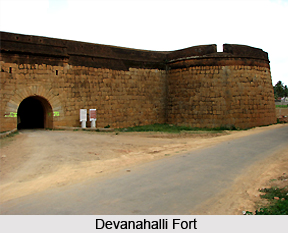
The Devanahalli Fort was built in 1501 by Mallabairegowda of Avati clan, with the consent of `Devappa` a feudatory at Devanadoddi. Subsequently the name was changed to Devanahalli. The fort remained under the Avati rulers until 1747, when Mysore Dalawai, Nanjarajaiah, attacked the fort and captured it. Subsequently Devanahalli was usurped by the Marathas and reclaimed by the Mysore army under the leadership of Hyder Ali. During the reign of Tipu Sultan, Lord Cornwallis laid siege to the fort and took possession of it during the Mysore War of 1791.The original mud fort built by the Avati rulers was renovated and the present stone fort was built by Hyder Ali and Tipu Sultan after they recaptured the place from the Marathas.
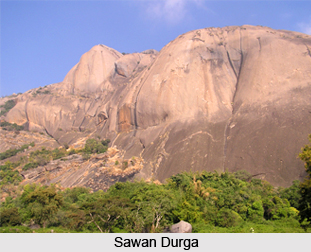
Sawan durga is situated at a distance of around 50 Kms West of Bangalore near Magadi. In the Kannada language, Durga means fort. Sawandurga is one of the nine such forts around Bengaluru. This fort is the biggest monolith in all of Asia. There are several routes to the monolith at Sawan Durga, rising to the height of more than 1000ft. At the foothill there is a village by the same name and the forest around has been declared as Reserved Forest and there is found here a protected garden of the herbs of medicinal interest.
Channapatna, a small hamlet 46 Kms from Bengaluru on the Mysore highway, excels in lacquerware, a craft practised today by over 3000 local craftsperson. Lacquerware products include brightly coloured wooden toys, door curtains, powder boxes and napkin rings, besides a range of distinctive jewellery. These are a must visit for the tourists in Bengaluru district.
Janapada Loka in Karnataka or "Folk-Culture World" is a world of simplicity and art. Janapada Loka, a subsidiary of the Karnataka Janapada Parishath, is dedicated to preserve and promote folk art and culture. The complex has an art gallery, an open-air theatre, a studio and a museum. Situated 53 Kms on the Bengaluru-Mysore highway, this 15-acre complex is a treasure-trove of Karnataka`s folk heritage. The museum, drawn from the life and arts of a large number of tribal and rural folk across Karnataka, has an amazing collection of 5000 artefacts that represent the essence of Karnataka`s folk culture. The display includes an array of agricultural hunting and fishing implements, weapons, ingenious household gadgets, masks, dolls and shadow puppets.
 Nature Tourism in Bengaluru Rural District
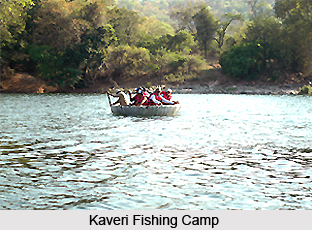
The Kaveri Fishing Camp is located at Bhimeswari. The Kaveri River at Bhimeswari abounds in a variety of fish including the Carnatic Carp and the Mahaseer. This place is a protected area for the fish, as the anglers are advised to release the fish, after catching them. The wild beauty of the river and the countryside, are sure to hook any tourist. Cottages run by the Jungle Lodges and Resorts make this place a definite tourist attraction.
Manchina Bele, Magadi, is about 36 Km from Bengaluru by road. Manchinabele Dam is situated in the midst of hills and forests. Even though it is not a big dam, it is a good picnic spot.
Mekedaatu in the Kanakapura talak is about 90 Km from Bengaluru via Kanakapura. Mekedatu means goat`s leap in Kannada. Mekedatu is a beautiful picnic spot where the Kaveri River and Arkavati River after their confluence at the Sangam, squeeze though a narrow gorge. Gushing waters, imposing landscapes, and untouched picnic spots is what Mekedatu is all about. The Kaveri River squeezing through a narrow gorge before traversing its south-bound terrain is a breathtaking sight.
Pilgrimage Tourism in Bengaluru Rural District
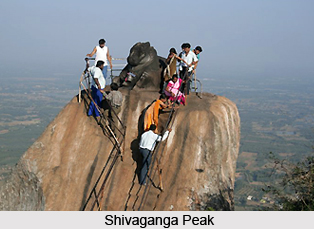
Shivaganga is around 8 Kms from Dabas Pet on the way to Tumkur District from Bengaluru on NH 4. Shivaganga gets its name from the various holy temples and holy places that it is home to. The spring water found here is considered to be the sacred water of the Ganga River. The hillock has few temples atop and a statue of Nandi carved out of single stone is a beauty. It is about two kilometres from the bottom of the hillock where there is a village to the top of the hill. There are many temples all along the way.
The place being a huge collection of boulders and solid granite rock structures, it invites not just pilgrims but rock climbers and adventure lovers as well. Though there are no bolted routes, there is plenty of climbing.
Recently updated articles in States of India
Bandare Waterfalls, Meghalaya
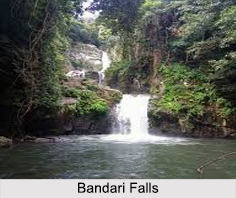
Bandare Waterfalls in South Garo Hills, Meghalaya, is a secluded natural attraction surrounded by dense subtropical forests and rugged mountain terrai...
History of Thissur District
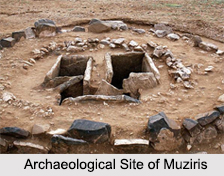
Early History of Thissur District explains flourishing of the port cities. Now these port cities are transformed into archaeological sites.
Tippi Orchid Research Centre, Arunachal Pradesh
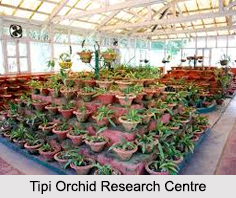
Tippi Orchid Research Centre in Arunachal Pradesh is renowned for its rich collection of exotic and endangered orchids. Surrounded by lush rainforest...
Tourism in Nashik District
Pilgrimage tourism in Nashik district involves visiting the various places of Hindu and Jain worship located here. Some of the holiest sites for Hind...
Mangadu, Kerala
Mangadu in Kerala’s Kollam district is a significant megalithic site known for its urn burials, cist burials, menhirs, and stone circles. Excavations...
Related articles in States of India
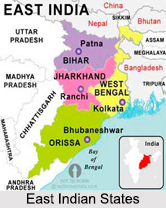
East Indian States
East Indian States comprises of Bihar, Jharkhand, West Bengal, Odisha and also the Union Territory of Andaman and Nicobar Islands. It defines the cult...
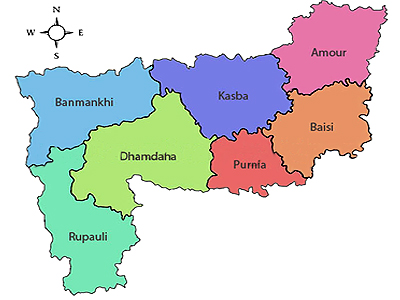
Purnia District in Bihar
Purnia District is located in Bihar and extends from River Ganga to Nepal. The district has a rich Hindu history and glorious past.
Hooghly district
Hooghly District along the bank of the river Hooghly is one of the principal trading ports of West Bengal.
Geography Of Chittoor District
Geography of Chittoor district is spread along the topography of the land which is divided into two natural divisions; Chittoor has a dry and healthy...
Districts of West Bihar
Districts of West Bihar is comprised of medieval monuments that were built by the different governors of Mughal era.