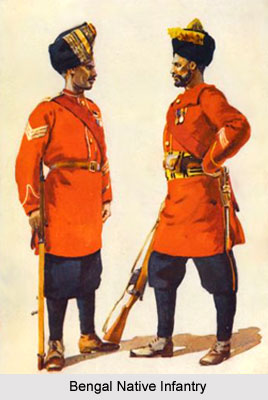
 The 43rd Regiment of Bengal Native Infantry was primarily an infantry battalion of the British East India Company, which existed from the year 1858 to 1922. It was a part of the Bengal Native Infantry under the Army of the Bengal province, before the commencement of the Great Revolt of 1857. The Bengal Army was the armed forces of Bengal Presidency and was amongst the 3 main Presidency Armies in British India. The British Presidency Armies belonged to the British East India Company until the Sepoy Mutiny of 1857. Later the 3 separate presidency armies were merged to form the United British Indian Army. King Edward VII acted as the Colonel-in-Chief of the battalion in the year 1904.The army unit was also incorporated as a part of the Bengal Command. The 43rd Regiment of Bengal Native Infantry was also known as the 6th Jat Light Infantry.
History of 43rd Regiment of Bengal Native Infantry
The 43rd Regiment of Bengal Native Infantry was a raised as the 1st Battalion, 22nd Regiment of Bengal Native Infantry in the year 1803. The army unit was re-designated several times over a number of years, such as the 43rd Bengal Native Infantry from 1824 to 1842; the 43rd Bengal Native (Light) Infantry from the year 1842 to 1861; and the 6th Bengal Native (Light) Infantry from 1861 to 1897. Eventually the battalion was renamed as the 6th Jat Bengal (Light) Infantry, after the Kitchener reforms of the British Indian Army.
Operations of 43rd Regiment of Bengal Native Infantry
The 6th Jat Light Infantry took part in many battles and military conquests, namely the First Anglo Sikh War, the First Anglo Afghan War, the Boxer Rebellion, the Second Anglo Afghan War and the First World War. It also participated in the conquest to Nagpore (now Nagpur), Afghanistan (1838 to 1842), Ghuznee, Kandahar, Kabul (1842), Sobraon, Maharapore, Ali Masjid (1878), Afghanistan (1878 to 1880) and China (1900).
The 43rd Regiment of Bengal Native Infantry did not participate in the Great Revolt of 1857, also known as the Sepoy Mutiny in 1857. Several of the regiments in the Army of Bengal Presidency had rebelled and accordingly the regiments of the armed force were dissolved. Later the British Empire in India took control over the British East India Company and the three Presidency Armies, namely the Bengal Army, the Madras Army and the Bombay Army after the Government of India Act 1858 was institutionalized.
Dissolution of 43rd Regiment of Bengal Native Infantry
After the completion of the First World War, the British Government of India renumbered and re-organized the Indian army. The separate single battalion infantry regiments were merged together in order to develop multi battalion regiments. As a result, the 6th Jat Light Infantry regiment was restructured as the 1st Battalion, 9th Jat Regiment. After the country gained freedom from the rule of the British Empire in India on 15th August 1947, the nation was divided into the Union of India and the Dominion of Pakistan through the Partition of India. The British Indian Army was divided amongst the 2 nations and the military unit was assigned to the modern Indian Army.