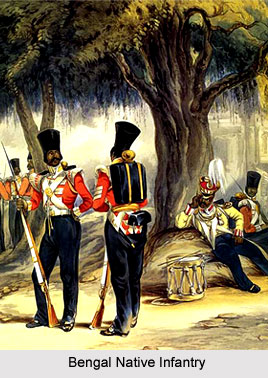
 The 42nd Regiment of Bengal Native Infantry was primarily an infantry battalion of the British East India Company, which existed from the year 1803 to 1922. It was a part of the Bengal Native Infantry under the Army of the Bengal province, before the beginning of the Sepoy Mutiny, also known as the Great Revolt of 1857. The Bengal Army was the armed forces of Bengal Presidency and was amongst the 3 main Presidency Armies in British India. The military regiment was also included as a part of the Bengal Command. The 42nd Regiment of Bengal Native Infantry was also known as the 5th Light Infantry. King Edward VII acted as the Colonel-in-Chief of the battalion in the year 1904.
The Government of India Act 1858, which was authorized after the Sepoy Mutiny in the year 1857, transferred the authority of the 3 Presidency Armies from the British East India Company to the British Empire in India. During the late 19th century, several of the regiments in the Bengal Army were disbanded due to their participation in the Indian Rebellion of 1857. Subsequently the British Empire took control over the British East India Company and the three Presidency Armies, namely the Bengal Army, the Madras Army and the Bombay Army.
History of 42nd Regiment of Bengal Native Infantry
The 42nd Regiment of Bengal Native Infantry was raised as the 2nd Battalion, 21st Bengal Native Infantry in the year 1803. In the year 1842, the unit was rewarded the distinction of becoming light infantry. The 42nd Bengal Native (Light) Infantry was awarded battle honours for Cabul in 1842 and it also participated in the Anglo Sikh Wars. The battalion was amongst the 12 infantry regiments of the former Bengal Army that did not rebel against the British administration during the Sepoy Mutiny in 1857. During the late 19th century, most of the units in the Bengal Army were dissolved due to their participation in the Indian Rebellion of 1857. However, the 42nd Regiment was not dissolved and was carried on as a part of the British Indian Army. Later it was renumbered as the 5th Bengal Native (Light) Infantry.
Operations of 42nd Regiment of Bengal Native Infantry
The army regiment served in the Second Anglo Afghan War from 1879 to 1880 and the Third Burmese War from the year 1885 to 1887. Later it served in garrison duty until the outbreak of the First World War. The 42nd Regiment of Bengal Native Infantry was posted at Nowgong in the Central Provinces in 1914. Later the troops were stationed at Singapore and substituted a British battalion in garrison. In the same year, Lieutenant Colonel Edward Martin acted as the Commanding Officer and the unit constituted of completely Muslims, including the Ranghars from eastern Punjab and Delhi and also Pathans and Baluchis.
The 42nd Regiment of Bengal Native Infantry also participated in Kandahar, Arracan, Afghanistan (1838 to 1842), Cabul (1842), Ferozeshah, Ghaznee, Sobraon, Burma (1885 to 1887), Moodhee and Afghanistan (1878 to 1880).
Designations of 42nd Regiment of Bengal Native Infantry
The 5th Bengal Native (Light) Infantry was popularly renowned as Johnson`s Regiment or Jansin-ki-Paltin, named after Captain Jeremiah Johnson, the first commander of the regiment. The unit was renamed and re-designated a number of times, including, 42nd Bengal Native Infantry from 1824 to 1842; the 42nd Bengal Native (Light) Infantry from the year 1842 to 1861; the 5th Bengal Native (Light) Infantry from 1861 to 1885 and the 5th Bengal (Light) Infantry from the year 1885 to 1903. After the Kitchener reforms of the British Indian Army, the regiment was finally renamed as the 5th Light Infantry.
During the First World War, the regiment 42nd Regiment was sent to Singapore and fought in the Singapore Mutiny in the year 1915. Later in 1917, the unit was stationed in Aden and went back to British India in 1918. The 5th Bengal Native (Light) Infantry was dissolved in 1922 as part of a general reforms and reorganization of the British Indian Army after the First World War.