Introduction
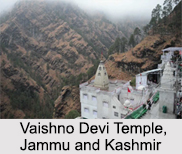
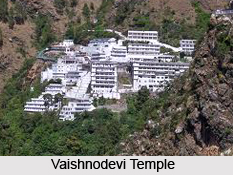
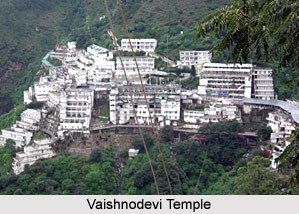 The pilgrim to Mata Vaishnodevi is to the cave where she merged her human form with the astral form of the three energies. A pilgrimage to this shrine is considered to be the holiest. She resides in a cave located among the Trikuta Mountains. Over five million pilgrims visit here every year. It is situated at an altitude of 5200 feet above sea level. The pilgrims trek 12 km from the base camp at Katra with the journey ending with the darshan of the pindis within the cave.
The journey usually starts according to the pilgrims with the call from Her - Maan Aap Bulandi or Bulawa aya hey. For no one can visit the Shrine without her express blessings.
History of Vaishnodevi temple
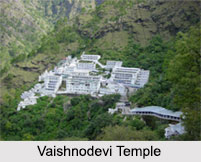 The Vaishnodevi cave according to geological studies is a million years old. Rig Veda does mention Trikuta but has no reference about the worship of Mother Goddess. The worship of Shakti started only in the Puranic period.
Stories behind the Vaishnodevi Temple : The first mention to the Mother Goddess is in the Mahabharata during the battle of Kurukshetra, where Arjun is said to have invoked the blessings of Mother. He calls her "Jambookatak Chityaishu Nityam Sannihitalaye" which means "you who always dwells in the temple on the slope of the mountain in Jamboo". It is also believed that the Pandavas were the first to build the temples at Kol Kandoli and Bhawan in gratitude. There are five stone structures believed to represent the five Pandavs.
The oldest historical reference is of Guru Gobind Singh, the tenth Guru of the Sikhs to visit the Holy Cave via Purmandal. The old foot track to the Holy Cave passed through this well-known pilgrimage centre. Some traditions believe this Shrine to be the holiest of all since the skull of Mata Sati fell here. Others believe her right arm had fallen here. A place called Gandarbal in Kashmir is seen in the records where the right arm of Sati is said to have fallen. Inside the holy cave there are the remains of a stone hand called Varad Hast (the hand that grants boons and blessings).
 The Devis (Mother Goddesses) pooled their collective power and created a beautiful young girl. They had created her so she would live on earth and spend her time in upholding righteousness. She was ordered to be born in the house of Ratankar and his wife who resided in South India. They told her to live on earth, uphold righteousness and to evolve her spiritually - "once you have attained the level of consciousness you will merge into Vishnu and become one with him." Soon a girl was born to Ratankar, they named her Vaishnavi. The girl hungered for knowledge since an early age and nothing could satisfy her. So Vaishnavi started to look at her inner self for knowledge, through meditation and penance. She gave up all comforts and went into deep meditation. At the same time Lord Rama was in exile and visited Vaishnavi one day. Recognizing him she requested him to merge her into himself.
Lord Rama dissuaded her by saying he would visit her again after his exile, and if she could recognize him, he would fulfill her wish. He is said to have visited her but as an old man, whom she failed to recognize. Lord Rama consoled her that the time would come for to merge with the creator in Kaliyug and he would incarnate as Kalki. He directed her to meditate at the base of Trikuta hills so she could elevate herself and also bless mankind and remove their sufferings. She immediately set out and installed herself at Trikuta. Her glory spread and people flocked for her blessings.
After sometime Saint Gorakh Nath becomes curious about the incident between Lord Rama and Vaishnavi and whether she had reached the high level of spirituality. He sent his disciple Bhairon Nath and he located the ashram and started to observe her secretly. Although a Sadhvi, she carried a bow and arrows with her, and was surrounded by langoors (apes) and a ferocious looking lion. Her beauty soon enamoured him, and he began to pester Vaishnavi to marry him.
Once Vaiashnavi organized a Bhandara (Community meal) for the whole village and Gorakh Nath was invited with his followers including Bhairon. During the Bhandara, Bhairon Nath tried to grab Vaishnavi, but she decided to flee into the mountains and remain there undisturbed. But Bhairon Nath chased her.
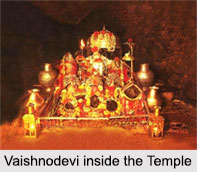
The Goddess halted at (present day) Banganga, Charan Paduka, and Adhkwari, reached the holy cave. When Bhairon Nath continued to follow her, she beheaded him. The head fell on a distant hilltop. On his death Bhairon Nath realized his futility, he prayed to Vaishnavi to forgive him. Mata had mercy on him, so she granted him a boon that devotees of the goddess would pay obeisance after the darshan of the Goddess. Vaishnavi then shed her human form and became a rock and immersed herself in meditation forever. This rock form is 5.5 feet tall with three heads or Pindies as they are called. This is the centre of the Sanctum Sanctorum of the holy cave.
Pindies in Mata Vaishnodevi
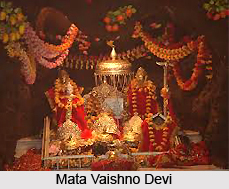 The three pindies in the Maha Kali , Maha Lakshmi and Maha Saraswati .
Maha Kali : Towards the right of the devotee is the Holy Pindi of Mata Maha Kali (the Supreme Energy of Dissolution) in the colour associated with Her i.e. black. The Supreme Energy of dissolution is Mata Maha Kali. She represents the Tam Guna- the quality associated with the darker and unknown realms of life. Tam stands for darkness. A very small per cent of the Universe is conscious. The remaining is still subconscious or unconscious. These unknown realms contain all the mysteries of life. However the Energy that transcends the barriers of time is the Eternal Time or Maha Kali. Since man`s knowledge about life is very limited and he remains in the dark about most of it, it is represented by the colour black which is associated with Mata Maha Kali. She is the basic source of all that is mystical and unknown to man. In her attribute of Maha Kali, the Mother Goddess constantly guides her devotees to conquer the forces of darkness.
Maha Lakshmi : In the centre is the Holy Pindi of Mata Maha Lakshmi (the Supreme Energy of Maintenance) with a yellowish-red tinge, the colour associated with Mata Maha Lakshmi. Mata Maha Lakshmi is the Supreme Energy of Maintenance. She represents Rajas Guna- the quality of inspiration and effort, and is considered to be the basic source of wealth, prosperity, material gains, quality of life etc. Wealth and prosperity are better represented by the colour of gold, which is yellow, and hence associated with Mata Maha Lakshmi.
Maha Saraswati : The pindi to the extreme left is worshipped as Mata Maha Saraswati (the Supreme Energy of Creation). It looks more white than the rest. White is associated with Mata Saraswati - the Supreme force of Creation, she is considered the basic source of all creation, knowledge, wisdom, righteousness, art, spiritualism, piousness etc. Hence this pindi is associated with Mata Saraswati. She represents the Satva Guna- the quality of purity. Mata Vaishnodevi is considered to be an incarnation of the three Supreme Energies.
 Ornamentation : The ornamentation of the Holy Pindies was done gradually over a period of time since the discovery of the Holy Shrine. Various devotees offered jewelry, crowns, Chhatras, idols etc, for the ornamentation of the Holy Pindies. The same ornamentation continued all these years and everything was kept practically untouched. Various idols and statues donated by the Kings and placed in the Sanctum Sanctorum were also visible immediately behind the Pindies. This resulted in a cluttering of the Sanctum Sanctorum and many pilgrims complained that the decorations and ornamentations tended to overshadow the Holy Pindies themselves.
With the inception of the Shrine Board, it was decided to use a curtain behind the Holy Pindies and use fewer flowers for day-to-day ornamentation and decoration, in order to enable the pilgrims to have more visibility and better Darshans of the Holy Pindies. Then, in 2000-01, the entire ornamentation of the Holy Pindies was redone in 52 kgs of pure gold, besides diamonds and precious stones. The platform around the Holy Pindies and the patio type structure just outside the Holy Cave, popularly known as Atka were also renovated with white marble. The work was completed on 31st January 2001 and after Poojan and Havan, the items of the ornamentation were presented at the lotus feet of the Divine Mother.
While smaller ornaments can be put into the jewelry box placed on the platform in the Holy Cave, larger ornaments may be deposited with the Board`s Office at Katra or Holy Bhawan under proper receipt. The larger ornaments are then carefully stored in the Strong Room and used for ornamentation and decoration of the Pindies on a rotational basis.
Architecture of Mata Vaishnodevi Temple
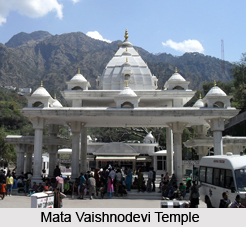 While on the way to the Sanctum Sanctorum, one crosses a small patio type of structure on the right hand side of which, there is a cave opening. This is the original cave leading to the Holy Pindies. Earlier, the yatris used to reach the Sanctum Sanctorum through this cave only. Nowadays, this cave is kept closed for a large part of the year. Since this cave is quite narrow, it takes several minutes for a single person to cross it and reach the Sanctum Sanctorum. Considering the rush that the Holy Shrine normally witnesses, it is not possible to keep the original cave open except when the yatra is less than 8000 pilgrims per day.
Therefore, two new tunnels have been constructed to facilitate a larger number of pilgrims for darshans or visit. One tunnel is used for the entrance and leads directly to the Sanctum Sanctorum. The other tunnel is used for exit. The original cave is opened during the lean periods or on traditional festivals or for ritualistic occasions.
When one crosses the portion where the original Cave is located, one walks further through a corridor on which numerous bells stand suspended from the ceiling. After walking a few yards, one reaches a broad platform where statues of the Lions, the mount of the goddess and a life size statue of the goddess are enshrined. This is the entrance of the new tunnel. This tunnel is only 200 meters long.
The Holy Cave is around 98 feet long. With the Pindies there are other holy places inside the cave. It is believed that the 33 crore (330 million) Gods and Goddesses are present in the Holy Cave and are said to have worshipped the Maa Durga and have left their symbols inside. At the entrance to the Holy Cave, on the left hand side, is the symbol of Vakratund Ganesha. Adjacent to it are the symbols of Surya and Chandra Dev. Inside the cave one has to cross the torso of Bhairon Nath, which is 14 feet long. The head is said to have fallen atop the adjacent mountain, where a temple exists.
After the torso, there is the symbol of Lord Hanuman as Launkra Beer. Later Charan Ganga arrives, the legendary river flowing from the feet of Mata. Those going through the old Cave have to wade through water beyond this point. Around 23 feet beyond Launkra Beer, on the left upper hand one can see the weight of the entire cave seems to rest on the many heads of Shesh Nag. Immediate below this, there is a Havan Kund of Mataji and close to it is the symbols of Shankh, Chakra, Gada and Padam.
Almost touching the ceiling are the symbols representing the five Pandavas, the Sapta Rishis, the udders of the divine cow Kamdhenu, symbols of Brahma-Vishnu-Mahesh and Shiv-Parvati. Further on, one can see the khamba (pillar) that is gripped by the legendary worshipper Prahlad. Diagonally close to the water level is a yantra that has many mystical signs and symbols inscribed on it. 22 feet ahead is the paw marks of a lion - symbolizing the mount of the Mata Vaishno Devi. Six feet ahead, on the left side, are the symbols of Shankar and Gauri.
13 feet beyond are the Holy Pindies. To the right one can see the symbols of Lord Ganesha, Surya Dev, Chandra Dev and Goddess Annapurna. Slightly behind the Pindies, and on the right side is the symbol of a seated lion. A little ahead is the Varad Hast - the hand of Mata Rani, raised in granting boons. Immediately opposite of the Holy Pindies is the natural symbol of Lord Pashupati Nath. These sites can be seen only if one goes through the original cave. But due to the rush, the new tunnel is used.
There are other deities to visit in the Bhawan or temple area including a Shiva Linga cave, Mata Durga, Lord Shiva, Shri Rama with Sita and Lakshmana, Lord Hanuman etc; these temples are situated at different points. There are Yagyashalas in the Bhawan where yagyas and havans are performed round the year and especially during the Navratris. The main Yagyashala is situated at Saraswati Bhawan.
Preparing for Darshan of Mata Vaishnodevi
Most pilgrims prefer to take a bath before proceeding for darshans. In the olden days pilgrims used to take a bath at the Bathing Ghat, with the water that flows from the feet of Mata. Attempts have been made to channelise the water from the Holy Cave to all these new Bathing areas, so that irrespective of where the pilgrim takes a bath, he receives the cleansing effect of the Holy Water. The traditional Bathing ghats have also been enlarged and developed many pilgrims would still like to take a bath at the original ghats. Pilgrims are required to deposit all their belonging in the free cloakrooms, as nothing except cash and selected offerings are allowed inside the Holy Cave. All articles of general use like belts, wrist watches with leather belts, combs, pen, pencil, purses, handbags, etc. are prohibited. In particular, a shoes/bags cloakroom has been made operational just outside Gate No.1, which is the entrance to the queue complex. This cloakroom can be used for depositing all leather and other goods, which are prohibited, inside the Holy Cave. No sweets are allowed either. After taking a bath at the Bathing Ghat or elsewhere, pilgrims can reach Gate No.1 where upon announcement (and/or display on the display board) of the group number, they are allowed inside the queue which would lead them eventually to one of the greatest moments of their lives, a Darshan of the Divine Mother inside the Holy Cave in the natural rock form i.e. the Holy Pindies.
Waiting in the Queue in Mata Vaishnodevi Temple
Immediately after a pilgrim`s group number is called or displayed, he/she is ushered in through Gate No.1 into the queue complex. The queue complex is a long corridor, which opens first into two large waiting halls, one after the other and finally opens at the mouth of the Holy Cave. The Shrine Board has installed coloured Television sets all along the queue corridor. These television sets relay a direct telecast of the Holy Cave and the Holy Pindies. Pre recorded messages explaining the procedure of darshans are also relayed since the time available for darshans inside the Holy Cave is limited, yatris are advised to carefully watch the television sets and hear the pre-recorded messages. This will help them in having proper darshans inside the Cave.
Prasad of Mata Vaishnodevi
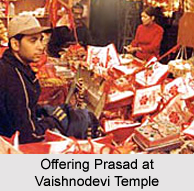 The traditional offering to the Goddess invariably comprises a coconut. However for reasons of time and security, coconut offerings are not allowed to be carried by the pilgrims beyond a designated point.
Instead, at a designated point in the main waiting hall, pilgrims have to deposit their coconuts to the temple priests who then take responsibility for the rituals. The pilgrim is handed over a token and the offered coconuts can be reclaimed after darshans upon producing the token at the Coconut Prasad Counter.
Outside the exit tunnel and just beyond the Amrit Kund lies the Prasad counter. The temple priests hand over the blessings of the Mother Goddess in the form of Prasad pouches to the devotees. Each Prasad pouch comprises the Mishri Prasad plus a blessed coin, carrying the image of the Holy Pindies. In addition, Khazaana (coins) are given to the devotees. This Khazaana Prasad is believed to be a good luck coin(s) and devotees would do well to keep it in their cash boxes, temples or other important places in their homes or establishments. There are other blessed items too, especially the chunnis and the cholas which are used for Shringar of the Holy Pindies. Since the Vastras of the Pindies are changed twice a day during Aarti, the Vastras, which have been used once but are subsequently changed, are offered as Aashirwad (blessings) to the devotees. These are readily available at the Souvenir shops run by the Shrine Board at Katra, Adkuwari, Sanjichhat and Bhawan. Gold and Silver coins of the Holy Goddess are also available. One may contact the officials of the Shrine Board for more details.
Darshan of Mata Vaishnodevi
Just like the Trikuta Mountain, which is one at the base but has three peaks (hence the name Trikoot), the revelation of the Mother Goddess in the Holy Cave is in a natural rock form, which is one at the base but has three heads at the top. The entire rock body is immersed in water, and a marble platform has now been constructed all around. The main Darshans remain to be of the three heads called the Holy Pindies. The uniqueness of the Holy Pindies is that although they emanate from one single rock form, each one is distinctly different from the other two in colour and texture.
Puja of Mata Vaishnodevi
The arti is performed twice a day first time in the morning just before the sunrise and second time in the evening immediately after the sunset. The procedure is very sacred and a lengthy one. It is performed by the pujaris inside the sanctum-sanctorum and than again outside the cave. Before the arti the atam pujan or self-purification is done. Then the Goddess is bathed in water, milk, ghee (clarified butter), honey and sugar. Thereafter she is dressed in a saree, chola and chunri and ornaments. This takes place while the mantras are being recited. The tilak is placed on the forehead of the deity and prasad is offered. The pujaris also perform puja of various Gods and Goddesses, as it is believed that during the arti, all the Gods and Goddesses are present inside. The jyoti (lamp) is lighted and arti is performed. After this the thaal-plate that contains the lamp is brought outside the holy cave, where arti is again performed in the presence of pilgrims. After the arti the pujari distributes prasad and the charanamrit (the holy water) to the devotees. This takes nearly two hours during which darshan remains suspended.