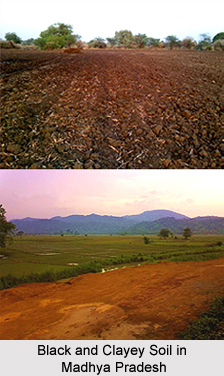
 Soils of Madhya Pradesh vary as per the structure, colour, texture and composition in the different regions. Madhya Pradesh is that part of the peninsular plateau of India where residual soils are found in an extensive area. The rock formation determines the soil structure and composition in this state. As a result of this organic materials are found at a large scale in soils. In this state the problem of soil erosion is almost negligible but due to excessive use of the land, the problem of soil erosion is accelerating. Madhya Pradesh comprises of a variety of soils ranging from rich clayey to gravelly. According to the survey done in the state, the major groups of soils found in the state can be divided into five major categories namely Alluvial Soil, Black Soil or Regur Soil (medium and deep black, shallow and medium black, mixed red and black coloured), Clayey Soil, Mixed Soil and Red and Yellow Soil.
Alluvial soil is mostly found in the northwest part of Madhya Pradesh, mainly Morena district, Bhind district, Gwalior district and Shivpuri district. It is spread over a large area in the frontier region of the Gangetic Valley, which is made of Bundelkhand gneiss and soil deposited by the Chambal River and its tributaries. Due to lack of Nitrogen, biotic components and phosphorus, the vegetal cover over the part of land is very thin.
 Medium and deep black coloured soil is extensively found in the Valley of Narmada River, Malwa Plateau, and Satpura mountain range, which contains about 20 to 60 percent clay and has a depth of near about 1 to 2 metres. This soil is highly fertile for the production of wheat, oilseeds, and jowar crops. Shallow and medium black coloured soils constitute the maximum part of the black soil. It is comparatively less fertile than the medium deep black soil. The whole northern part of the Malwa plateau and Nimad region comprises this soil. It is 15 cm to one metre depth and the colour of soil is grey or light black. Mixed red and black soil spreads about 75 lakh hectares land comprising the Satpura region. Most of the part of the region has very shallow soil. Three districts namely Chhindwara district, Betul district, and Seoni district comprise this type of soil.
Clayey soil is mostly found in the flood plain, and it is mainly transported and deposited by the rivers during flood. This soil is favourable for the production of wheat, sugarcane, and cotton. The areas which consist of this type of soil include Bhind, Morena, and Gwalior. Clayey soil is mainly deposited by the river Chambal and its tributaries. Vindhya region and the central part of the state of Madhya Pradesh have a deposition of mixed soil composed by red, yellow and black soils. The soil lacks phosphate, nitrogen, and carbon, and hence it is less fertile. Mostly, the millets are grown in this soil. The entire Baghelkhand region including Balaghat district, Mandla district, Dindori district and Shahdol district of the state have a deposition of red and yellow soils.
In Madhya Pradesh the problem of soil erosion is mostly found in Chambal valley, where channel formation is very common and known as Chambal ravines. Soil contents are characterised by soft and alluvial soil, which help in the formation of these channels. Further, the semi-arid climate aggravated the agent of erosion that is why the entire Chambal valley is characterised by heavy soil erosion. Soil erosion is also active in the valleys of Narmada, Chambal, Kali Sindh, Betwa, Son, etc. Soils of Madhya Pradesh are divided again into several categories according to availability of major nutrients like nitrogen, phosphorus and carbon in the soils.