 Modern history of India generally refers to the period of colonial rule and domination on India. The advent of the British on the Indian soil at around 17th century can roughly be delineated as the beginning of the modern age in Indian history. For two centuries, the British exercised complete subordination over the Indian landmass till the blazing inferno of the freedom fighters forced their departure. The two hundred years of their rule not only had an impact in the sphere of politics and economy, but also was instrumental in bringing about considerable changes in the realm of education, society and culture.
Coming of British in India
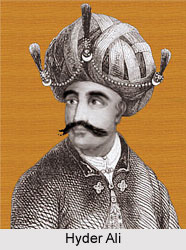
The British, however, were not the first of the foreign powers to set their foot on the Indian soil. In the closing years of the 15th century, the Portuguese explorer Vasco Da Gama had reached Calicut in south India. Since then, the French, the Dutch and subsequently the British colonisers made their foray into India, the land of immense wealth and riches. By the 18th century, the British Empire in India had already established their supremacy. The enormous Indian Territory was characterised by a comprehensive lack of unity amongst the independent rulers, an aspect of which the British took complete advantage. It was further escalated by the fall of the Mughals in 1739 and the constant strife between the various ruling dynasties and the power monger nobles in the various Indian provinces who wanted to establish their supremacy independently. Some of the most powerful ruling clans in India during this period were the Marathas, Hyder Ali and Tipu Sultan of Mysore, the Nawabs of Bengal and the Sikhs under the leadership of Ranjit Singh. The British encouraged rampant commercial exploitation to exercise their dominance and soon the British East India Company`s policy of annexation resulted in securing the influence of the British Empire as the supreme authority. The Governor-Generals and Viceroys during this time unleashed unscrupulous means to implement their authority. The imposition of the Dewani (1765), the practice of "Private Trade" by the East India Company, introduction of the "Permanent Settlement" (1793) by Lord Cornwallis were some of the reforms that the British introduced during their tenure, adding to the woes of the colonised.
Influence of British Empire
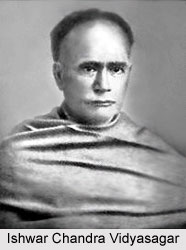
While the British left no stone unturned to ascertain their influence over the Indian population, they were also prominently involved in bringing about certain changes in the field of education, culture as well as society. This was primarily a form of their cultural imperialistic designs. Macaulay, an eminent member of the Governor-General`s Council, in his Minute (1835), despised the scriptures and wealth of knowledge that India treasured and called for the introduction of English education which he considered to be superior and necessary to educate the barbaric Indians. However, noted educationists like Raja Ram Mohan Roy and Ishwar Chandra Vidyasagar were instrumental in imbibing the intellectual trends of western education with those of the ancient Indian scriptures and literary works. It was towards the end of the 18th and the beginning of the 19th century, that some of the premier educational institutions like the Hindu College or the Presidency College were established in Bengal. This era is often referred to as the Bengal Renaissance. The spread of education though was masked by the spread of Christian religious doctrines with the Christian missionaries being deputed the task of extending education.
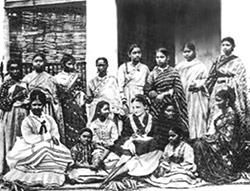
The cause of women`s education was propagated by Vidyasagar, who set up around thirty schools for women in Bengal. Social reformers like Ram Mohan Roy played a key role in the abolition of the Sati (1829) or the custom of women surrendering their lives in the funeral pyres of their husbands. In 1856, the Widow Marriage Act was sanctioned by the British Government under the patronage of Ishwar Chandra Vidyasagar.
The British were also instrumental in the establishment of the Indian Railways which began functioning in 1853. This too was a means of extending their imperialistic designs as the British believed that the railways would not only make communication swifter, but at the same time they would escalate the swift movement of troops which had become extremely necessary to subjugate the uprisings and rebellions that recurrently spurted against their domination.
Revolts against British Domination
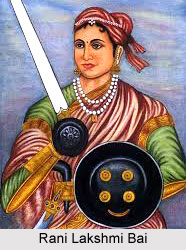
The 19th century bears testimony to the mass struggles and peasant revolts against the British colonisers. Unable to withstand the devious means unleashed by the British, the citizens of India took up arms against the colonisers. The Indigo rebellion of 1860, the Santhal Rebellion (1855-56), the Deccan Riots (1875) were some of the prominent peasant movements and these protests finally culminated in the form of the Revolt of 1857, popularly referred to as the Sepoy Mutiny. Some of the prominent leaders of the nationalist struggle in the 19th century include Rani Lakshmi Bai of Jhansi and Tantia Tope. This nationalistic fervour was further enhanced with the birth of the Indian National Congress in 1885. During this era, various literary works condemning British action on the Indians were written and performed. Regulatory actions were taken against such events with the execution of the Dramatic Performances Act (1876) and the Vernacular Press Act (1878) curbing the freedom of the press. The proposal for the Partition of Bengal in 1905 was the final straw that ignited the flames of freedom amongst the Indian nationals.
 Indian Freedom Struggle
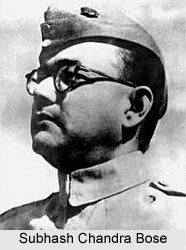
The nationalist struggle of the 20th century was spearheaded by premier figures like Sardar Vallabhbhai Patel, Bhagat Singh, Bal Gangadhar Tilak, Khudiram Bose, Lal Bahadur Shastri, Netaji Subhash Chandra Bose and Mahatma Gandhi. Various nationalist movements like the Khilafat Movement, Non Cooperation Movement, Civil Disobedience Movement and Quit India Movement echoed the cry for freedom.
Indian Independence and Partition
Finally on 15th August 1947, after centuries of vigorous struggle, India attained independence and became free from the shackles of British colonisation. The Partition of India was concluded and Pakistan was formed in its north-western frontier. Jawaharlal Nehru was sworn in as the first Prime Minister of independent India and the country came to be recognised as a Sovereign Socialist Secular Democratic Republic with the implementation of the Constitution of India on November 26th, 1950.