Indianetzone.com - Web Portal on Indian Culture & LifestyleArt & Culture  •  Health  •  Movies & Entertainment  •   Society  •  Reference  •   Sports  •  Travel  

  Home >> Travel >> States of India >> Jammu & Kashmir , Indian State
Forum
Forum on States of India
Discuss Now
Free E-magazine
Subscribe to Free E-Magazine on Indian Culture & Lifestyle.
Learn More
Interesting Readings
  - Indian Union Territories
  - Madhya Pradesh , Indian State
  - Karnataka , Indian State
  - Haryana , Indian State
  - Chhattisgarh , Indian State
  - Arunachal Pradesh , Indian State
  - Andhra Pradesh , Indian State
  - Himachal Pradesh , Indian State
  - Uttarakhand , Indian State
  - Uttar Pradesh , Indian State
  - Jammu & Kashmir , Indian State
  - Mizoram , Indian State
  - Meghalaya , Indian State
  - Nagaland , Indian State
  - Sikkim , Indian State
  - Tripura , Indian State
  - Manipur , Indian State
  - Assam , Indian State
  - Jharkhand , Indian State
  - West Bengal , Indian State
  - Tamil Nadu , Indian State
  - Bihar , Indian State
  - Punjab , Indian State
  - Rajasthan , Indian State
  - Gujarat , Indian State
  - Kerala , Indian State
  - Orissa , Indian State
Jimtrade.com : India Business to Business Directory
Business Directory of Indian Suppliers Manufacturers and Products from India.
India`s leading Yellow pages directory.
Jammu & Kashmir , Indian State

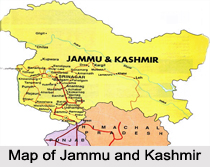
Jammu & KashmirBordered with Himachal Pradesh to the south, Azad Kashmir to north and west, Pakistan to the southwest and People`s Republic of China to the northeast and east. It has three divisions: Jammu, Kashmir Valley and Ladakh.The state has two capitals, Srinagar being the summer capital and Jammu as it`s winter capital. In recent years Jammu and Kashmir has been the subject of international focus. Unfortunately, misunderstanding of the State`s history and its present situation has largely flawed discussion on the issue. The state is working for the overall socio-economic development of the state. Infrastructure sectors such as, roads, irrigation and basic minimum services like education, health and water supply are the areas of major thrust in the state. Given the vast large opportunities, the sector constitutes one of the topmost priorities of the state.

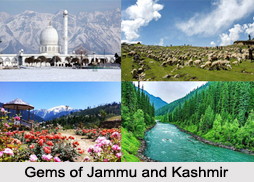
The Kashmir valley is well known for its beautiful mountainous landscapes. Jammu attracts approximately 10,000 of Hindu and Muslim pilgrims every year and Ladakh is known as "Little Tibet" for its remote mountain beauty and Buddhist culture although Muslims are a majority. Though Islam is practiced by 80% of the population, the state has significant minorities of Hindus. Also found in a considerate number are Buddhists mainly in Ladakh and Sikhs.

Origin of the Name of Jammu & Kashmir
Satisar LakeThe Nilamata Purana describes the Valley`s origin from the waters, a fact corroborated by prominent geologists, and shows how the very name of the land was derived from the process of desiccation. Ka means "water" and Shimir means "to desiccate". Hence, Kashmir stands for "a land desiccated from water". There is also a theory which takes Kashmir to be a contraction of Kashyapmir or Kashyapmeru, the "sea or mountain of Kashyapa", the sage who is credited with having drained the waters of the primordial lake Satisar, that Kashmir was before it was reclaimed. The Nilamata Purana gives the name Kashmira to the Valley considering it to be an embodiment of Uma and it is the Kashmir that the world knows today. The Kashmiris, however, call it Kashir, which has been derived phonetically from Kashmir. The name Kashmir is derived from the Sanskrit words kasyapa that means "the sea of the sage Kashyapa".

History of Jammu & Kashmir
Jammu and Kashmir came into being as a single political and geographical entity following the Treaty of Amristar between the British Government and Gulab singh signed on March 16, 1846. The Treaty handed over the control of the Kashmir State to the Dogra ruler of Jammu who had earlier annexed Ladakh. Thus a new State comprising three distinct religions of Jammu, Kashmir and Ladakh was formed with Maharaja Gulab Singh as its founder ruler. Jammu and Kashmir was one of about 565 princely States of India on which the British paramountcy lapsed at the stroke of midnight on August 15, 1947. While the power was transferred to the people in British India, the rulers of the princely States were given an option to join either of the two Dominions – India or Pakistan.

Geography of Jammu & Kashmir
Strategically located Jammu and Kashmir State constitutes the northern most extremity of India. Situated between 32.17 degree and 36.58 degree north latitude and 37.26 degree and 80.30 degree east longitude, the total area of the State is 22,22,236 sq. kms including 78114 sq kms under the illegal occupation of Pakistan and 42,685 sq kms under that of China, of which Pakistan illegally handed over 5130 sq kms to China. The State is bounded by Pakistan, Afghanistan and China from the West to the East. The State ranks 6th in area and 17th in population among the States and Union Territories of India. The State consists of 14 districts, 59 tehsils, 119 blocks, 3 municipalities, 54 towns and notified area committee, 6477 inhabited villages and 281 uninhabited villages.

Flora and Fauna of Jammu & Kashmir
The State is rich in flora and fauna. In Jammu, the flora ranges from the thorn bush type of the arid plain to the temperate and alpine flora of the higher altitudes. In the hilly regions of Doda, Udhampur, Poonch and Rajouri there is a large and varied fauna including leopard, cheetah and deer, wild sheep, bear, brown musk shrew, muskrat. Varieties of snakes, bats, lizards and frogs are also found in the region. The game birds in Jammu include chakor, snow partridge, pheasants, and peacock. The dense forests of Kashmir are a delight to the sport-lovers and adventures for whom there are Ibex, Snow Leopard, Musk deer, wolf, Markhor, Red bear, Black bear and Leopard. The winged game includes ducks, goose, partridge, chakor, pheasant, wagtails, herons, water pigeons, warblers, and doves.

Economy of Jammu & Kashmir
Jammu and Kashmir`s economy depends mainly on farming and animal husbandry. Though the manufacturing and services sector is small but it is growing rapidly. Several consumer goods companies have opened manufacturing units in the region. Before insurgency intensified in 1989, tourism formed an important part of the Kashmiri economy. Jammu and Kashmir has reaped the benefits of the recent surge in India`s economy. In 2006, the state`s GDP rose to 12 billion USD in current prices. The `new Kashmir`, which the people of Kashmir had adopted as their programme as early as 1944, has been the target of economic development of the state ever since1947.

Government & Politics of Jammu & Kashmir
The flag of Jammu and Kashmir state is the native plough on a red background; that is a symbol of labour, designed by New Delhi and the three stripes represent the three Indian regions namely Jammu, Vale of Kashmir, and Ladakh of the disputed territory. Like all the states of India, Jammu and Kashmir has a multi-party democratic system of governance. Main political parties include the Jammu & Kashmir National Conference, the Indian National Congress and the Jammu and Kashmir People`s Democratic Party (PDP). Presently, the Indian National Congress and its ally PDP hold the maximum number of seats in the Jammu and Kashmir state assembly. Congress leader Ghulam Nabi Azad replaced PDP`s Mufti Mohammed Sayeed as the Chief Minister of Jammu and Kashmir in late 2002.

Omar abdullaThe Constitution of India grants Jammu and Kashmir special autonomous status as a temporary provision. However, some Kashmiri political parties demand greater autonomy and sovereignty, while others would like to see the state fully integrated into India. Jammu & Kashmir National Conference is the largest political party in Jammu and Kashmir, India. Led at the time of Indian Independence in 1947 by Sheikh Abdullah, it has since then dominated electoral politics in the state, and was led subsequently by the Sheikh`s son Farooq Abdullah and now by his son Omar Abdullah.It was defeated by a huge margin by Jammu and Kashmir Peoples Democratic Party.

Jammu and Kashmir People`s Democratic Party is a political partyin Jammu and Kashmir, India. It was founded in 1999 by the former Union Home Minister, Mufti Mohammed Sayeed, and captured power in the state of Jammu and Kashmir in October 2002 assembly elections. Since 2004 it has one member each in the Lok Sabha and in the Rajya Sabha. It is a member of the ruling United Progressive Alliance. Peoples Democratic Party is presently headed by Ms Mehbooba Mufti, while Mufti Mohammad Sayeed, who headed the PDP-Congress Coalition Government between October 2002 and November 2005, is the party`s Patron.

Transport of Jammu & Kashmir
The State is well connected with rest of the country by air, rail and road. The Indian Airlines and private airlines operate regular flights to Srinagar, Jammu and Leh. The National Highway 1-A connects the capital cities of Srinagar and Jammu with rest of the country. There are daily passenger trains connecting Jammu with most of the major cities of the country. Within the city the main travel is through matadors, buses, cars, scooters and horses or mules for hilly areas where other transportation is not possible.

Demographics of Jammu & Kashmir
Jammu and Kashmir is the only state in India that has a Muslim majority population. Though Islam is practiced by over 70% of the population of the state and by 95% of the population of the Kashmir valley, the state has large and vibrant communities of Buddhists, Hindus and Sikhs. In Jammu, Hindus constitute 66% of the population and Muslims approximately 30%; In Ladakh, Buddhists constitute a little over 50% of the population, the remaining being Muslims. The people of Ladakh are of Indo-Tibetan origin, while the southern area of Jammu includes many communities tracing their ancestry to the nearby Indian states of Haryana and Punjab, as well as the city of Delhi.

Approximately 95% of the total population Kashmir brahmins, also called Kashmiri Pandits, left the Kashmir Valley in 1990 as militant violent engulfed the state. According to an estimate by the Central Intelligence Agency, about 300,000 Kashmiri Pandits from the entire state of Jammu and Kashmir have been internally displaced due to the ongoing violence. Population density according to 2001 census in Jammu and kashmir was 99,decadal growth from year 1991 to 2001 was 29% and gender ratio as per census in 2001 was 900 females per 1000 males.

Performing Arts of Jammu & Kashmir
Kashmir is rightly said to be Nature`s grand finale of beauty. In this masterpiece of earth`s creation seasons in strong individuality vie with one another in putting up exquisite patterns of charm and loveliness. Nature has left an indelible mark on the folk performances of Kashmir as they are intimately interlined with the moods and movements of the seasons. Jammu the land of the Dogras, offer an entirely different fare of dances and music. Over the centuries long spell of separation from their soldier, husbands and brothers have led the hardy but graceful women of the Duggar to evolve many diverting dances and songs to keep themselves in cheer in their free moments. The songs of separation the ever-increasing yearning for reunion with the beloved, the hard life on the mountain slopes and various other themes connected with their day-to-day life find their echo in folk songs and dances. Some of the popular performing traditions of J&K are Kud, Heren, Fumenie and Jagarana, Bakh/Gwatri/Kark/Masade, Gwatri , Karak, Benthe, Bhand Pather, Chakri , Sofiana Music , Marriage songs and dance , Jabro , Alley Yate, etc.

Education in Jammu & Kashmir
Government Medical college of JammuUntil 1970 Jammu and Kashmir has its own boards and university that provide the opportunities to the residents. The education is divided into primary, middle, high secondary, college and university level. The state follows 10+2 pattern for education of children. This is handled by Jammu & Kashmir State Board of School Education (JKBOSE). Various private and public schools are recognized by the board to impart education to students. Board examinations are conducted for students in class VIII, X and XII. In addition there are various Kendriya Vidyalayas, Army schools and Sanik Schools that also impart secondary school education. These follow the CBSE pattern/sallaybus rather than JKBOSE pattern/sallaybus. The technical college level education is carried out by various colleges such as Government College of Engineering and Technology, NIT Srinagar, Government Medical College Jammu. The general education is provided by general colleges spread across various districts. University level education is provided by University of Jammu and University of Kashmir.

Media in Jammu & Kashmir
Jammu and Kashmir is a picturesque province renowned for its breathtaking locales. The Jammu and Kashmir Media play a monumental role in extensively covering all events of significance all across the globe.Both the Print and electronics Media contribute a lot for the improvement of local people.
Though the main language in Jammu and Kashmir is Kashmiri, Jammu and Kashmir radio stations also broadcast in Hindi, Urdu, English and other languages. The radio stations differ with every city like Kargil radio stations, Poonch radio stations, Srinagar radio stations and many more. All radio stations belong to All India Radio (AIR). In Jammu there is one station that belongs to Adlabs network-BIG 92.7Fm.

Various official media units of the Government of India, primarily Doordarshan, shell out a good amount of money every month on making special programs and documentaries With an electronic boom in the country and many new channels coming up every year, the viewer now has a choice to make.

Sports in Jammu & Kashmir
Kashmir`s two major natural advantages are its mountains on the one hand, and lakes and rivers on the other. These waterways enhance the beauty of the land and are one of the chief sources that attract tourists to its verdant valleys. But more than just a means of pleasure, the water-ways and mountains are an activity oriented way of discovering new leisure sports.

More on Jammu & Kashmir
Cities of Jammu and Kashmir
Culture of Jammu and Kashmir
Festivals of Jammu and Kashmir
Temples of Jammu and Kashmir
Tribal jewellery of Jammu and Kashmir
Tribes of Jammu and Kashmir
Universities of Jammu and Kashmir

Recently updated articles in States of India
Home | Sitemap | Contact Us