 The region of Kashmir valley, with its sylvan surroundings, heavenly set up of the undulating hills, the lush and more lush green coiffed surroundings, the snow-topped peaks, the chilled climate - everything can be coupled as playing as the perfect Eden-like environ to create history in the placement of gardens and the constant flow of water through narrow streams. Indeed, since the Mughal times, Kashmir was made legendary and famous for its garden architecture, which indeed had received peak status during the times of Shah Jahan. And the pinnacle of Kashmiri gardens and its beautification can be described in the establishment of the celebrated Shalimar Garden under Shah Jahan`s brilliant architectural genius, which can be comprehended as under. Amidst such auspicious Mughal presence, garden architecture of Shalimar Garden emotes out umpteen folk lore, which can truly be justified with the garden`s majestic presence that is felt by one and all. Indeed, it can also be informed that after setting his foot on Kashmiri soil, it was the man Shah Jahan himself who had given birth to that phrase that has now turned into a legacy, that - if there ever have existed something named `heaven`, it is perfectly here in Kashmir. Thus, Kashmir and its tag-line "heaven on earth" wholly justify the emperor`s reason to have conceived and completed the Shalimar Garden amidst the Himalayan territory of Jammu and Kashmir. Shalimar Garden, during Mughal times, i.e., during Shah Jahan was lovingly called as Shalimar bagh, keeping in mind Urdu as the language of artistic expression and of course Babur, who had begun the tradition of char bagh in India.
Shalimar Garden, situated on the edge of Dal Lake in Srinagar and set against the breathtaking Pir Panjal mountain range, was termed by the Frenchman Bernier as the most beautiful of all the gardens. While this site long had served as a garden, its conversion into a terraced Mughal-type garden was commenced in 1620, when Mughal emperor Jahangir had ordered the then prince Shah Jahan to dam up the stream near Shalimar. In 1634, Shah Jahan further had enlarged the garden. Shalimar Garden, once was thus extended to reach the foot of the mountains and additional pavilions were then built. Although the older name Shalimar bagh was never abandoned, the Mughals named their new garden the Bagh-i Faiz Bakhsh and Farah Bakhsh, reflecting its division into two parts. The lower terraces, employed for imperial audiences, formed the Farah Bakhsh garden (Garden of the Bestower of Pleasure), while the higher terraces nearer the mountains - intended for private use - were acknowledged as the Faiz Bakhsh (Bestower of Plenty). The ensuing Shalimar garden by Shah Jahan was hence approached from the side of Dal lake. According to Bernier, a tree-lined canal led to a small fore-garden that originally fronted the Shalimar proper.
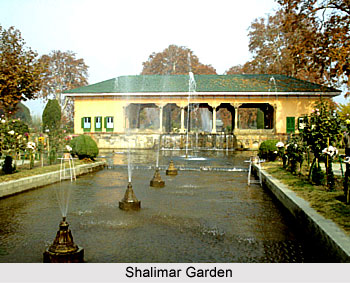
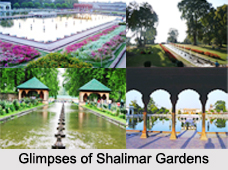
The whole of Shalimar Garden in Srinagar, Kashmir is divided laterally by a wide stream, which commences from the mountains behind and runs the entire length of the garden through the terraced levels. Carved water chutes enhance the effect of rapidly running water. Recessed niches for lamps were carved into the terraced walls over which cascading water fell, illuminating the water at night, for the gardens were utilised as much then as during the day. Pools with spouting fountains further embellish Shalimar garden, truly a pleasure worth noticing. In the centre of each part of the garden is a black stone pavilion, covered with a tiered roof. Serving as imperial seats, these pavilions stretch across the canal overlooking cascading waterfalls. Within the lower garden, a centrally placed black platform, serving as the imperial throne, is situated across the water between bracketed pillars. Shah Jahan`s vision of Shalimar Garden epitomises the long-standing Mughal love of architectural setting amidst "ordered nature". Although the most famous and celebrated Shalimar Garden is the one in Kashmir, another Shalimar, also known in contemporary times as the Bagh-i Faiz Bakhsh and Farah Bakhsh, was constructed by Shah Jahan in Lahore, which very much had fallen within the then Indin jurisdiction of the Mughal Empire, presently separated to two unlike border lines.
 History of Shalimar Bagh is counted from the early era of 75 AD. While the recent history and development of the Mughal types of gardens is credited to Emperor Jahangir, the ancient history of the garden can be traced to the 2nd century when it was built during the reign of Pravarsena II.
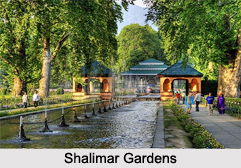 Architecture of Shalimar Gardens covers three terraces of the garden, which are elaborate and the designs are similar to the Persian Gardens, which are the epitome of Mughal and Turk architecture.