Zebunissa
Zebunissa was a Mughal Princess, the daughter of the Emperor Aurangzeb and the eldest child of the family. She was a very well educated lady, much interested in the arts, particularly poetry, and was an outstanding poet herself. Unfortunately, though she was her father’s favourite daughter and was given a lot of encouragement by him, she was imprisoned later in life and died in confinement. Her contribution to Persian literature is praiseworthy.

Share this Article:

About Zebunissa

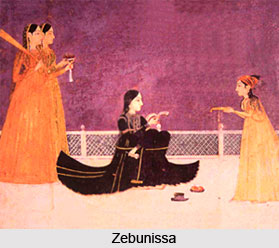
Zebunissa, Mughal PrincessZebunissa was the first-born of the Mughal Emperor Aurangzeb and the granddaughter of the Emperor Shah Jahan. She had also descended from the royal family of Persia, the Safavids, on her mother, Dilras Begum`s side. The eldest and favourite daughter of Aurangzeb, the last Great Mughal, she was beautiful, educated, and witty, a Sufi initiate patron of poets and philosophers, and a collector of books. Though not much has been written about her, some biographers have attempted to put together knowledge about the princess and the kind of life she must have led, the daughter of a great Mughal Emperor and a Mughal Princess.

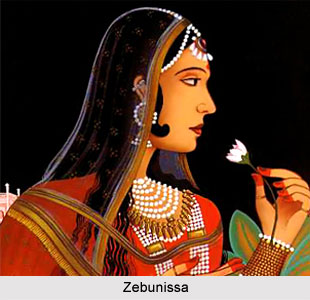
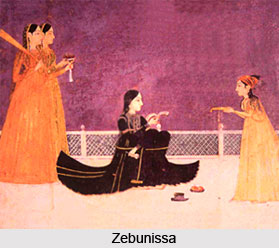
The very name the Prince chose indicates a special affection for this child, matching it with his own. `Zeb` means beauteous ornament- Aurangzeb means `Ornament of the Throne` and his daughter`s name means `Ornament of Womankind`. From her portraits, it can be seen that she was slim and tall, with a round face adorned with two moles on her left cheek. It was said that her skin rivalled the cascades of pearls that adorned her ear-lobes and neck. In fact it seems that her skin was not only fair but almost pale. No doubt she inherited this feature both from her father and from her noble Persian mother, who was reputed to have a delicate beauty. Zebunissa had lustrous hair, which shone with Sandalwood Oil, and her eyes were as black as her tresses. Zebunissa had naturally large, shapely eyes and did not need to outline them with antimony powder, or to thicken her long eyelashes with Mikhal or Kajal (made of soot from oil lamps), which was the contemporary fashion. Her lips were fine and she had small teeth. There was a fashion at the time for the women of the Mughal court to polish their teeth with a herb called Missi, which was like a black lacquer. However, Zebunissa`s teeth were naturally lovely and she never followed this unusual fashion. Homage was paid to the looks of this basically provincial young lady, a dedicated scholar and poetess who overnight was cast into the role of a leading beauty. When she granted audience from behind a silver trellis, supplicants would invariably begin by praising her reputed good looks.

However, despite her good looks the princess gave up dressing in a grand style rather early on and adopted the habit of wearing only black clothes. In the young Princess`s strange choice of colour for her dress, there may have been an element of astrology. On the other hand, her reason for deciding to wear black may have been because black gowns were supposed to be a sign of a person studying a vocation or searching for knowledge. In Islam, black is the colour of scholars and wise men. It is also the colour of the Abbasid caliphs. However she later discarded black when she imprisoned and took to wearing white only.

Religious influence on Zebunissa

Zebunissa`s religious experience followed a variegated path. She started by accepting some of her mother`s Shia practices in spite of herself, and then having Shahzadi Jahanara Begum Sahib`s, and also Dara Shikoh`s, somewhat unique Qadiria beliefs propagated to her. Subsequently she became interested in the Shattari Silsila for a time, but more so in an ardent disciple of this order, Aqil Khan. Finally, following the inclination of her father, she took up the Naqshbandia Order of Sufism, going to the extent of being initiated into the brotherhood like her aunt Raushanara.


Zebunissa, the patron of arts

The Princess was very well educated and was an avid reader with a quest for knowledge. She loved to read and write and has been constantly associated with her desk and inkwell.

The Princess was also quite well-versed in astrology and while still very young, she was capable of drawing her own horoscope. She became `very knowledgeable` in these sciences, according to her biographer Magan Lai. Zebunissa was a patron of poetry and the arts, and greatly encouraged this practice in her court. She was most interested in intellectual and edifying pursuits. The atmosphere at her personal court was pious, refined, and intellectual, as well as witty and enthusiastic. Verses would flow to and fro across the filigree screens separating the ladies from the men; there would be many impromptu gems of thought from the most brilliant contemporary literary minds of Delhi; there would be poetic jousts and much acclaim and appreciation all around. She conducted many poetry recitals in her Mahal, and became quite renowned for these gatherings. The sessions were attended by nobles, courtly ladies, men of letters, poets, and various intellectuals. There would be poetic tournaments in which guests would propose a subject, riddle, or question, to which the more learned guests would respond turn by turn, quoting verses or making a clever play on words or airing their wit on the chosen topic, which could be anything poetic or something that would impress the audience-cum-participants. There would be many beautiful couplets quoted, and intellectual jousts, often in verse, and these would be met by shouts of acclaim from the gathering. Zebunissa was known to excel in this play of retorts, quoting deftly or weaving an impromptu verse in appropriate reply to whatever was said. Poetic inspiration and sharpness of wit never failed her. A musician sometimes accompanied her, and often she would sing her verses. Her melodious voice was so moving that she brought tears to the eyes of her audience.

The princess`s standing as a patron of learning, literature, and poetry steadily grew. Mullah Mohammed Ardebil in honour of his benefactress gave her the flattering title of `Zaib al Tafari` (worthy of praise). One of her most ardent admirers was a poet called Waliullah. He idealized this distant poetess who already had become something of a mythical figure. He admired her and praised her beauty in his stylized poetry which was philosophical and, at the same time, full of imagery, of a mysticism inspired perhaps by Zebunissa herself. Her father was proud of her fame and encouraged her in her patronage.


Zebunissa the Poet

Zebunissa was a poet twice born, first of inspiration, then of pain. She assumed the pen-name of Makhfi (that which is concealed), representing her dark and Saturnine side. Slowly, the transformation of Princess Zebunissa into the poetess Makhfi began, in the bare halls of Salimgarh. Her poetry now reflected certain bitterness. Her poetry now spoke of the bitterness of her heart, her disappointments in love, regret at her own carelessness, and a deepening emotional resolution. Her poetic outbursts carried her towards more divine planes, far from the misleading emptiness of the world. Even before her incarceration, her poems had a deep emotional content often bordering on the profane. Her writing was never the dry, sophisticated, cerebral type. But she was always discreet to the extent of being mysterious, hence her pen-name, the Hidden One.


Early Life of Zebunissa

Early Life of ZebunissaEarly life of Zebunissa was spent in much happiness and comfort. Zebunissa, the eldest daughter of the Mughal Emperor Aurangzeb, was born on 15 February 1638. She had royalty on both sides of her family, her mother belonging to the Royal family of Perisa and her father a mighty Mughal. Zebunissa therefore grew up as a princess, much loved and amidst the greatest comfort and luxury. Nine months after the grand wedding ceremony of Aurangzeb and Dilras Begum, the princess Zebunissa was born in the heart of the formidable and archaic fortress of Daulatabad. After birth, Zebunissa was entrusted to a wet-nurse, Mian Bai, chosen by the wives of the court officials, according to custom. She was very devoted to Zebunissa, and after her death the Princess had an magnificent tomb built in her memory.
The very name chosen for the princess reflects the love and affection the Emperor had for his daughter. Zebunissa means the ornament of womankind. The early days of the princess were spent with her many half brothers and sisters and cousins. Most of these children passed their childhood among the steep defiles and parapets of that fortress in the Deccan, surrounded by armed guards. It is likely that here Zebunissa played with toy swords with her half-brothers, thus acquiring the prowess in martial arts with which she is credited. It may be noted here that this was not an unusual feature. Some Mughal women were quite warlike. Zebunissa`s first cousin, Jani Begum, Dara Shikoh`s daughter, is known to have accompanied her husband, Azam, to the battlefield, and to have fought in the siege of Bijapur.

As they grew, the temptation to see the outside world was great. They had seen only distant visions from their fortified enclosure on the top of the rock. From up there they could view far-away villages looking tiny and toy-like, and behold the surrounding wild hills with white limestone arches carved into mysterious grottoes. At least once, Zebunissa obtained permission to accompany her father in a palanquin when he went to visit the site of the new capital which he was building and later named after himself, Aurangabad. There she followed him while he surveyed the building of his future palace, a mosque, and the ramparts which would later surround the city to protect it from the Marathas. She was an impressionable and precocious little girl. She saw the old Hindu temples being destroyed and must have contemplated the strange idols lying in the dust. Later she describes these in her books- dancing deities with a hundred arms, another with an elephant`s head, the strange blue Lord Krishna.

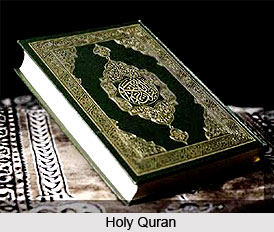
Zebunissa grew up amidst great splendour and luxury. Her education was one of the finest and comparable to that received by a prince. The emperor made no distinction in the education he imparted to his sons and daughters, and greatly encouraged Zebusnissa when she displayed a great desire for knowledge and learning. She was an avid reader and spent much of her time with books and in the pursuit of education. She had also learnt the teachings of the Holy Quran at a very early age. Thus from her early days, she led a very unrestricted and carefree life and was allowed to fully develop her mental and intellectual faculties which became the source of her sustenance in later life.


Education of Zebunissa

Education of ZebunissaEducation of Zebunissa was of the highest order and not left lacking in anything. Zebunissa`s education began at four and a half years of age. The child showed exemplary powers of retention and a gift for learning from a very early age. It was the Muslim custom to have the Holy Quran learnt by heart from beginning to end. The final examination was as much a test for the teacher as for the pupil. The child had to read or recite verses from the Quran, particularly certain chosen passages, before a gathering of specially-invited male guests. If the pupil did well, the master was honoured and he was awarded a ceremonial garment and other gifts. He would also read a benediction over certain dishes, which were prepared for distribution among the poor and needy. Zebunissa was gifted with the extraordinary memory of her ancestor Akbar. Even before she learnt to read and write she was able to memorize works read to her. By the time she was seven she knew the Quran by heart. It was not customary to celebrate this achievement for a daughter, but for Zebunissa, her father, the Mughal Emperor Aurangzeb made an exception. The proud father commemorated the occasion with unparalleled splendour in his capital of Aurangabad. He rewarded her female tutor, Hafiza Maryam, 30,000 pieces of gold. He added a spectacular new dimension to the occasion by having the royal guard present arms. Silver coins were thrown to the crowd, and all the public offices were closed for two days. He also undertook to educate Hafiza Maryam`s son Inayat Ullah, whom he later raised to some of the highest positions in the land.
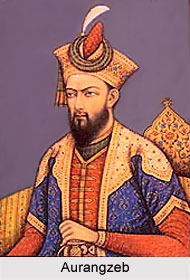
Aurangzeb personally followed the religious education of his daughter and would listen carefully when he asked her to repeat certain verses from the Quran. It is said that he embroidered these passages on cotton caps with his own hand and sold them in the bazaar. The money he earned he distributed among the poor. Aurangzeb was not against the prevalent secular education system, but he had serious reservations about it. Thus, the education he gave his first-born was strict and methodical. Nothing was left to improvisation or the personal whims of the teacher, for he was conscious of the faults he perceived in his own education. From childhood, Zebunissa was treated like a prince and not a princess. She was taught all the subjects that Aurangzeb considered important, including the arts of war and administration, which were normally only taught to boys. Young Mughal princes were thoroughly grounded in these two subjects. However, she did better than all her male counterparts in theology and literature. Aurangzeb made it a point to find better teachers for his children than he had had, men like Mullah Abdul Latif of Sultanpur in the Punjab, who was well versed in the sciences and had been the first religious master of Dara Shikoh, and Aitmad Khan who, according to Khafi Khan, taught Zebunissa the Quran by heart.

Education of Zebunissa Although her father was against the custom of Arabic being the medium of education and would have preferred it to be in the language of the country, Zebunissa learnt this language in four years under the sage Shah Rustam Ghazi. She also mastered Persian, her mother`s language. Finally, she was taught calligraphy. Aurangzeb remembered with pleasure her apprenticeship with the Persian calligrapher Mir Sayyid Ali al Husseini of Tabriz, who later became Superintendent of the Imperial Library, or Kitabdar, to Aurangzeb. Under him Zebunissa soon learnt how to write in the different styles of calligraphy: Shikast, Nastaliq, and Naskh. As a reward for her first works, her father presented her one of the famous writing-desks made in the Deccan, which were inlaid with ivory and tortoiseshell and enamelled with gold and silver (the plainer ones were inlaid with copper). She valued her desks highly, and they would always accompany her on her travels. They even appear in some of her portraits.
When she grew older, Hafiza Maryam taught her mathematics and astronomy. The clear winter nights must were ideal for studying the skies above the high towers of Daulatabad with the help of long telescopes brought from Holland by foreign merchants. And along with astronomy, of course, Zebunissa took an interest in astrology, a very important and much studied science among the Mughals since Humayun. It was often confused with astronomy. Astrology requires minute and knowledgeable calculations along with the study of stars, which Zebunissa`s enquiring mind picked up easily. She must also have witnessed her father consulting various divining objects before going into battle or taking other important decisions. Astrology influenced the Princess very strongly, though she was affected more by its poetic than its lunar aspect. This is often reflected in her works; her metaphysical questioning sometimes delves deeply into religious dilemmas and torturous self-analysis.

Thus Zebunissa, the eldest daughter of Aurangzeb, was a well-read and learned lady due to the all-round education provided to her by her father and her own intellectual inclinations.


Zebunissa’s Mystic Poetry

ZebunissaZebunissa`s mystic poetry has earned her a prominent position in the realm of Persian literature. Since her childhood, the Mughal princess had shown strong academic inclinations and a keen intellect. This was reflected in her love for reading and knowledge and later was manifested in the poetry that she composed. Zebunissa was so much in love with the poetic form that she encouraged the same in her court. She often held Mushairas where the best poets of the kingdom would recite their compositions. She herself was a remarkable composer of poems and was known to have a quick and sharp wit. Poetic inspiration and sharpness of wit never failed her.
Later on, when imprisoned by her father Aurangzeb>, she assumed the pen-name of Makhfi (that which is concealed), representing her dark and Saturnine side. This was the period of time when the princess slowly turned into the poetess Makhfi. Her poetry now reflected the bitterness in her heart and a deep emotional resolution. Her poetry was now moving along divine planes, far from the misleading vanities of the world. Sufi Philosophy and religious concepts occupied centre stage in her poetry. She was always discreet to the extent of being mysterious, hence her pen-name, the Hidden One.

In the mystic poetry of her later days, periodic despair at her human frailties is a recurring theme. In her spiritual striving she describes herself as standing fearfully on the threshold of the temple, waiting and hoping to achieve a higher state of communion with the Almighty, but it seems that she is afraid of venturing forward to achieve her goal and awaits some sort of sign from God. She always seemed to be wary of committing herself wholeheartedly to love or allowing herself to revel in imperial glory before her fall. There is a quality of genuine modesty and humbleness about her; her humility is so great that she does not even dare to presume that she is worthy. During this forlorn period she dressed simply in white, wearing only one symbolic necklace of pearls around her neck. Now her alienation from the world became complete.

Her mystic poetry combines a number of different spiritual elements. In fact, it is a classic model of Sufi poetry, with some overtones of Hinduism and Zoroastrianism. In a few verses she refers to the fire which consumes and purifies as in the Zoroastrian religion. In another, she describes a Brahmin ascetic thus:

"The knotted veins his wasted body bears, Are like unto the sacred thread he wears."

In yet another poem, she speaks of her own sacred thread, which is a purely Hindu concept. There is an element of Platonism in her writing as well, like in those poems where she is seeking the truth. Platonic learning is apparent throughout her works. Furthermore, there are also several references to Biblical themes. She compares herself with the suffering Ayub (Job) in one of her poems. There is the idealization of the psalms of David, King of Israel, Yaqub (Jacob) is mentioned several times, as well as Noah in. She is moved by Yousuf`s (Joseph) legendary beauty, which she lauds. In the opening poem she hopes, above all, to see her prayers answered as Solomon`s were, and further on she regrets that she will never be able to follow Abraham, Friend of God, to contemplate the Holy Kaaba.

Apart from the Sufi and religious concepts, there are historical references peculiar to the intellectuals of her times. She cites Alexander of Macedon opposing Darius, the Persian ruler, and poignantly compares her assumptions to that of this unfortunate King. She writes about Kaikobad, the Seljuk Sultan who was victorious in war and glorious in peace, and Firdausi`s famous Persian hero, Rustom, features significantly. She dreams of herself being the Rustom of her age.

There are also the tales of famous lovers. Laila and Majnu`s tragic story reminds her of her own. Majnu`s beloved gets married to another, and he goes mad and wanders in the mountains for seven years, learning the language of birds and wild animals. Zebunissa interprets her poetic progress in this manner. In the fable of Shirin and Farhad, Farhad`s rival uses magic to make a spring of milk burst from a mountain, then announces that Shirin has died; the faithful lover is so heartbroken he commits suicide. Zebunissa refers to the tragedy of this couple in her poems.

Apart from those who have died for love, Zebunissa also writes about martyrs to Divine love. She cites the example of Mansur Al Hajjaj, who was crucified and cut up into little pieces in Baghdad in the ninth century because he declared that he was one with God. The concepts of fate, luck, capricious princes, etc., often recur in her poems. Her sensibility reflects the chaotic history of her dynasty, and contemporary examples also inspire her.

Zebuniussa`s mystic poetry has earned her an important place in Persian literature, wherein she is remembered as a mysterious and romantic figure. Her works were published long after her death when they were compiled and published under the title of Diwan i Makhfi. Once her complete works were brought out, people could appreciate the full depth and scope of this painful and passionate poetry, this dialogue of a soul with its creator. Imprisonment broke the lock of repression in her heart and gave a more turbulent and passionate quality to her verses, along with a higher divine striving.


Imprisonment of Zebunissa

During her lifetime, the young girl was in the midst of machinations that were both political and spiritual, yet Zebunissa played out the numerous traps that arose with surprising maturity. However, she fell prey to a misunderstanding on part of her father later in life and was imprisoned by him in the fort of Salimgarh. Zebunissa was forty-three when she was incarcerated within the walls of Salimgarh. The glare of the blazing hot summer sun on the flat sand of this islet was so severe that it was known as Noorgarh, `noor` meaning light- `the fortress of light`. She turned deeply religious while in confinement and in isolation and anguish, she contemplated, and plumbed the depths of her heart till finally she confronted the infinity of the Creator. In her prison in Salimgarh she too wore only white, and no longer put on any jewellery apart from a necklace of tiny pearls. She abandoned the sumptuous black clothes which had been her emblem and with which she had started a fashion. In Salimgarh, Zebunissa`s poems developed the same tragic intensity. Perhaps, without Salimgarh, her poetry might never have gained the beauty and heights of passion which have passed down to posterity. In prison she learnt patience.

Zebunissa died in isolation, abandoned by her contemporaries, but posterity has accorded her a very prominent position in Persian literature, and she is remembered as a mysterious and romantic figure. Forty-five years after her death, in 1752, her works at last saw the light of day. Her scattered writings were compiled and published under the title of Diwan i Makhfi. It comprised 421 Ghazals and several quatrains. Hitherto, only the literati had heard of this obscure lady who was accounted a good poetess, even maybe come across an occasional verse by her. Once her complete works were brought out, people could appreciate the full depth and scope of this painful and passionate poetry, this dialogue of a soul with its creator. Her personal legend adds a dimension of drama and tragedy to the vast history of Persian and other related literature. Among the women of prominence during the Timurid dynasty, she forged her own characteristic and outstanding position.


Share this Article:

Related Articles

More Articles in History of India


History of Uttar Pradesh
The state was the heart of Mahabharata war and the history of Uttar Pradesh is very much the history of India. The place finds its mentions in Hindu epics Ramayana and Mahabharata.
History Of Archaeology In India
History of archaeology in India contributes a lot to define the past history and the social life of India.
Mughal Architecture during Babur
Mughal architecture during Babur marked the foundation of a new architectural era in India, blending Timurid, Persian, and local influences. His reign emphasized garden design, notably the Charbagh layout, and modest yet elegant structures. As the first Mughal emperor in India who introduced this architecture during 16th century Babur’s creations reflected symmetry, functionality, and a deep appreciation for nature.
Princely State of Patdi
The Princely State of Patdi was one of the many princely states under the British Raj, ruled by local Kadva Patidar leaders under indirect British control. Known for its strategic location near the Little Rann of Kutch, Patdi played an important role in salt production and regional trade. Princely State of Patdi or Patri was incorporated as a part of the Baroda Agency, which was a sub division of Western India States Agency.
Architecture during Sayyid and Lodi Dynasty
Architectures during the Sayyid and Lodi dynasty were mainly the tombs and monuments for the dead rulers. It were carefully designed and meticulously constructed.
Brahmanical Sources of Ancient History
Brahmanical Sources of ancient history are contained in the Vedas and they constitute one of the most important literary sources of information about ancient India.
Female Education In British India
The over brimming enthusiasm among zealous Hindu reformers welcomed female education in British India.
Revenue System of Mauryan Empire
Revenue system of Mauryan Empire can be divided into eight categories. The principal revenue of the state was the land revenue, taxes from traders, artisans and professional taxes were also collected.
Mughal Architecture During Jahangir
Mughal architecture during Jahangir`s period was relative dull in comparison to that of Akbar dynasty.
Princely State of Satlasna
Princely State of Satlasna was amongst the former native states of India that was appointed as one of the Indian princely states during the early 19th century.
Coins of Chola Empire
Coins of Chola Empire were issued in gold, silver and copper and carried the Chola emblem.
Social Life during the Pala Period
Religious toleration and simple living were the characteristics of social life during the Pala period.
Coins of the Chalukya Dynasty
Coins of the Chalukya Dynasty was reintroduced in the South India after a brief break of coinage less period of nearly three century. Chalukyas issued coins only in gold and they exhibit a brilliant artistic skill of the engraver.
Costumes of Indus Valley Civilisation
Costumes of Indus valley Civilization have been considered as the basis for Indian clothes. Sophisticated ornaments and make up were used during that age.
Development of Science under Gupta Empire
Development of Science under Gupta Empire was progressive and it had attained considerable perfection. Mathematics, astronomy, medicine, chemistry, physics and metallurgy were the most prominent of the sciences at that time.
Culture under Delhi Sultanate
Culture under Delhi Sultanate had enduring aspects to it. It included the society, the religious condition, literature and art and architecture of that period.
Princely State of Hapa
Princely State of Hapa was incorporated as a part of the Baroda Agency, which was under the administrative control of the Western India States Agency.
Economy Under Chola Dynasty
Economy under Chola dynasty was strong and well developed. The economic life of the people of the Chola Kingdom was well balanced with their social life.
Coins of Khilji Dynasty
Coins of Khilji Dynasty had an influential feature that was followed by the other dynasties.
Religion During Mauryan Dynasty
Religion during Mauryan dynasty became a considerable episode in Indian history with an esteemed lineage of rulers.
Copyright Jupiter Infomedia Ltd. All rights reserved including the right to reproduce the contents in whole or in part in any form or medium without the express written permission of Jupiter Infomedia Ltd.