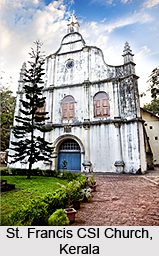
 St Francis Church was constructed during 1503 and is historically significant since it has witnessed the European colonial conflicts in the country and is situated in Fort Kochi in the southern Indian state of Kerala. Vasco da Gama, the renowned Portuguese explorer had died in Kochi during his third visit to India in the year 1524 and for 140 years his mortal remains were buried in St. Francis Church. However, they were later transferred to Lisbon.
History of St. Francis Church
The great Portuguese sailor Vasco da Gama who was credited for discovering the sea route to India, all the way from Europe, had arrived at Kappad, close to Kozhikode or Calicut during 1498. Pedro Alvares Cabral and Alfonso de Albuquerque followed him in his mission and erected a fort at Kochi after obtaining official permit from the Raja of Cochin. They also established a wooden structured church dedicated to St. Bartholomew within the fort premises. Presently, the area of Fort Kochi is termed as its neighbourhood. In the year 1506, the Portuguese viceroy known as Francisco de Almeida was allowed to renovate the wooden buildings by the Raja of Cochin which was accomplished with the aide of masonry and stone. It is said that some Franciscan friars had reconstructed St. Francis Church with mortar and bricks, fixing a tiled roof over its terrace and it was finally completed in 1516. Thereafter, it was dedicated to St. Anthony.
This church was being administered by the Franciscans, till Kochi was captured by the Dutch in the year 1663. The Dutch were Protestants and the Portuguese were all Roman Catholics. All the churches of Kochi were destroyed except this church and it was transformed into a government church by the Dutch who had remodified the appearance of the St. Francis Church. The British conquered Kochi in 1795 though they permitted the Dutch to control the church. However, the church was peacefully transferred to the Anglican Communion voluntarily by the Dutch in 1804. Finally, the church was governed by the Ecclesiastical Department of the Government of India.
The Anglicans later altered the patron saint of St. Francis Church, to Saint Francis and the church was proclaimed a protected monument during April 1923, by the Protected Monuments Act, 1904. The Archaeological Survey of India or ASI has been entrusted the responsibility of maintaining this church. Currently this church is regulated by the North Kerala diocese of Church of South India. Services are conducted on Sundays as well as commemorative occasions and events.