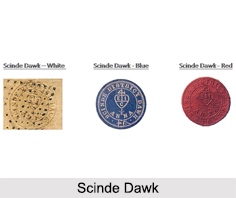
 A rare type of postage stamp, the Scinde Dawk is the forerunners of the adhesive stamps used throughout India. It was the first adhesive postage stamp to be produced in Asia by Sir Bartle Frere, the then Governor of Scinde.
Etymology of Scinde Dawk
The word Scinde is a derivation of the British spelling of the name of the province of Sindh and the word Dawk is an anglicised spelling of the Hindi word Dak which also means post.
Origin of Scinde Dawk
The earlier system of post or dawk was an ancient form of postal system of runners, who were paid according to their distance of travel and the weight of their letters. This postal system of runners served the Indus Valley of Sindh. Following the Battle of Miani, after the conquest of Sindh in February 1843, this system of runners was inefficient and inadequate for the military and commercial needs of the British East India Company. And thus, eventually the Scinde Dawk was issued.
History of Scinde Dawk
It was during this time in 1850 under Sir Bartle Frere, who was then Governor of Scinde that a cheaper and uniform system of postage was issued, which was independent of the distance travelled. Frere was inspired by the works of Rowland Hill, the English postal reformer, who had introduced the Penny Black, which was the world"s first adhesive postage stamp.
And in 1852, India became the 10th country in the world and the first country in Asia to issue postage stamps. It was expected that the stamps would be produced in Calcutta, the erstwhile capital of British India, but instead postage stamps were issued in a remote province called Scinde and thus the name Scinde Dawk came to play.
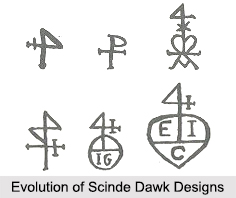 Design of Scinde Dawk
Sir Bartle Frere with the help of Edward Coffey, the postmaster of Karachi, had designed the Scinde Dawk, which was a set that comprised of three embossed stamps, round in shape, in white, red and blue. These stamps were first issued on 1st July, 1852 and bore the Merchants" Mark of the British East India Company, with the mystic sign of four found at the head of almost every marine merchant"s mark.
Initially, the design was embossed on wafers of red sealing wax impressed on paper but as they cracked and disintegrated, they were soon replaced by a colourless design embossed on white paper which was hard to see in a dim light. The last stamps were a blue embossing on white paper. Currently, the Scinde Dawk stamps are rare classics of philately but earlier, these stamps had a value of only one- half anna each.
Forgeries of Scinde Dawk
Given their rarity, the Scinde Dawk stamps have been forged over the ages and most of these fakes can be detected easily as they are not embossed on paper. Other types of forgeries of these stamps show a misalignment of the second letter "A" of ANNA with the "K" of DAWK; and in other fakes the "1/2" is not separated from the central heart shaped emblem.