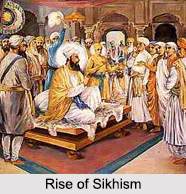
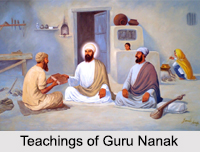
 Rise of Sikhism had begun from the time when Guru Nanak had declared, "There is no Hindu. There is no Muslim". Guru Nanak (1469-1538) sculpted Sikhism on the elevated ideology of Equality. His keen interest in the unexplored mysteries of the world enhanced his spiritual quest. A true messenger of God, Guru Nanak, went ahead to distribute the precious "Truth" among the ignorant mass. His teachings generated a resurgence of reformation that precipitated into the growth of Sikhism.
Various Invasions in Punjab
Punjab was the wealthiest province of the Mughal Empire in the late 16th and 17th centuries. As the empire weakened in the 18th century, Punjab was repeatedly invaded. Sikhism, meanwhile, had evolved from the original gentle emphasis given to it by Guru Nanak. Religious persecution meant that the Sikhs had to fight back in order to survive, and the formation of the Khalsa helped create cohesive identity.
By the 18th century, Sikhs had formed twelve loose groups, or misls, to protect themselves and their territories. The Afghans invaded Punjab between 1747 and 1769, and Mughal persecution was often brutal. Internal quarrels prevented the misls from uniting to control the region until the 12 year old Ranjit Singh became head of the Sukerchakia misl in 1792.
 By 1799 he had captured Lahore and, two years later, was proclaimed the Maharaja of Punjab in this former Mughal capital. The decline of the Mughal Empire was marked by the rise of the Sikhs under the outstanding leadership of Maharaja Ranjit Singh on April 12, 1801. Ranjit Singh architectured a pan-Sikh empire which earned a national identity for Sikhism. By his death in 1839, the Sikh kingdom stretched over the Punjab Hills and Kashmir, over the Himalayas as far north as Ladakh. His rule was characterised by his tolerance, with Hindus, Sikhs and Muslims all holding equally high office at court. However with the death of the monarch, the empire crumbled into dust, owing to the turbulent Anglo-Sikh Wars. British overpowered their land of Punjab.
Sikhs joined the freedom-fighting of Indian National Congress. The resolute Sikhs cemented their Sikh foundation through the setting up of Shiromani Gurudwara Prabandhak Committee and the Shiromani Akali Dal. The weird Partition of 1947 witnessed a massacre of thousand Sikhs and forced immigration to West Punjab as destitute refugees.
In1970"s the state of Punjab flourished with the boon of Green Revolution. Punjab tasted optimum progress and prosperity. Today, the Sikhs stand forthright as an educated and successful community all over the globe.