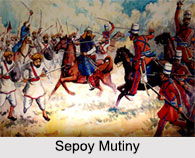
 The Sepoy Mutiny of 1857 was against British rule in India, when many Indian states were attacked to remove Britishers from the respective territories. But the Britishers proved to be to a strong opponent. They planned attacks and gathered resources to regain control over different parts of India and weaken the Indian rebels. Given below are the Re-conquests of Indian States during Sepoy Mutiny by the Britishers.
Re-conquest of Rohilkhand and Western Bihar
To re-conquer Rohilkhand, various columns of armed forces were gathered under the guidance of Penny and Colonel Jones. Under Sir Colin, these columns were to attack Rohilkhand from the eastern side. It was arranged that a brigade under Colonel Coke would enter it from Roorkee. The contest in Western Bihar assumed all the character of guerrilla warfare. When the rebels were beguiled, beaten and pursued, they reappeared again. From the end of April to the end of November, they kept the district in constant turmoil. It is Sir Henry Havelock-Allan who is credited with the final expulsion of Indian rebels.
Re-conquest of Central India
Sir Hugh Rose played a very important role in the re-conquest of Central India, making the campaign flawless. In five months, Sir Hugh traversed Central India facing several difficulties. He had crossed deep rivers, stormed strong fortresses, defeated the rebels in the field and re-established British authority in an important region called Central India. He had struck a blow on the morale of the rebels, dispersing them in all directions.
Re-conquest of Oudh
The re-conquest of Oudh required army corps under Hope Grant to move to Ban, 29 miles from Lakhnao (presently Lucknow). The instruction was to expel the rebels collected there under the Maulavi and to march eastward thence Muhammadabad. Following the course of the Gogra, they were to reconnoiter Bitauli. From there, the battalion was to cover the return of the Nepal troops, under Jang Bahadur. Walpole was to march up the Ganga River with a moveable column and await near Fathgarh the arrival of Sir Colin. Colin would draw to himself, as he advanced, other columns converging to the same point. It is known at Hope Grant executed the instructions appropriately.
Re-conquest of Azamgarh
When Lord Mark and his entire force of twenty-two officers and 444 men had reached Sarsana, eight miles from Azamgarh, Kunwar Singh (the famous chieftain of Western Bihar) became aware of his arrival and prepared to ambush him. More specifically, as Singh wanted to entrap Mark, Mark was to push on in the wee hours of the next morning. Lord Mark did not push on and resultantly got trapped. It was collective coolness and courage which helped Mark to free his men, defeat the rebels and relieve Azamgarh.