 During British rule in India (which covers both the British East India Company rule and later the British Raj), the princely state of Padukottai was ruled by different people. Given below are the kings of Padukottai.
Raya Raghunatha Tondaiman
Raya Raghunatha Tondaiman was the ruler of Pudukkottai from 28th of December, 1769 to 30th of December, 1789. Tondaiman is credited with the creation of a Telugu work, Parvathi Parinyamu.
Vijaya Raghunatha Tondaiman
Vijaya Raghunatha Tondaiman was the ruler of the pudukottai village from 30th of December, 1789 to 1st of February, 1807. His tenure coincided with a period of unrelenting wars in South India. He supported the British in their wars. After gaining control over the Carnatic kingdom in 1801, the British East India Company attained supreme power in South India. Pudukkottai was permitted to remain independent at that time in exchange of their support and services to the Britishers in their wars.
Vijaya Raghunatha Raya Tondaiman II
Vijaya Raghunatha Raya Tondaiman II was the ruler of from 1st of February, 1807 to 4th of June, 1825.
Raghunatha Tondaiman Bahadur
Raghunatha Tondaiman Bahadur was the ruler of Pudukkottai from 4th of June, 1825 to 13th of July, 1839. He was unsuccessful in putting into effect the scheme to bring the Cauvery River water in Pudukkottai in 1837 due to inadequate funds.
Ramachandra Tondaiman
Ramachandra Tondaiman was the ruler of Pudukkottai from 13th of July, 1839 to 15th of April, 1886. His reign coincided with extravagance and financial mismanagement. Thus, necessary changes were brought about in the administration of the state. A. Seshayya Sastri, former Diwan of Travancore was hired as the Diwan of Pudukkottai. He had reframed the city of Pudukkottai following the modern principles of town planning. Ramachandra on Sastri`s suggestion renovated many Hindu temples in the state.
Martanda Bhairava Tondaiman
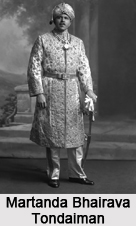
Martanda Bhairava Tondaiman was the ruler of Pudukkottai from 15th of April, 1886 to 28th of May, 1928. Martanda petitioned for the restitution of the Manovarti Jagir, which consisted of four villages. A representative assembly of 30 members was set up by Martanda in 1902, the members of which were nominated by the heads of government departments and public institutions.
Rajagopala Tondaiman
Rajagopala Tondaiman was the 9th and the last ruler of Pudukkottai from 1928 to 1948. On 17th of January, 1944, he got control over the administration of the state. As Pudukkottai came under the dominion of India on 3rd of March, 1948, it became a part of Trichirappalli district of the Madras Presidency.