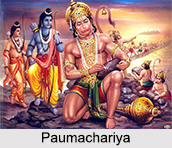
 Paumachariya is the earliest Jain work dealing with the story of Rama written by Acharya Vimalasuri in Prakrit language in Arya meter. The life of Padma, Jain name of Rama is narrated in 118 cantos. Paumachariya is said to be the Jain version of the great epic "Ramayana".
Aim in writing Paumachariya
Vimalasuri was a champion of Rationalism. According to him, most of the stories in Ramayana are certainly not true. There are many absurdities regarding the life of Rama, Ravana, Kumbhakarna and others which are not worthy of belief.
Hence, the aim was to eliminate all such absurdities, inconsistencies and incredible elements found in the popular stories of Rama and to compose "Paumachariya" to present faithfully the story of Rama as was proclaimed by Lord Mahavira himself. However, the main intention was the propaganda of Jainism.
Conceptions in Paumachariya
According to Vimalasuri, neither Rakshasas are not man-eating demons with fearful and hideous appearance nor are the Vanaras animals having long tails as described by Valmiki.
Rakshasas are a race of Vidyadharas, a class of beings endowed with many supernatural qualities. Their appearance and behaviour is not beastly. They are depicted as highly civilized. They strictly follow vow of Ahimsa. The dynasty of Vidyadharas at Lanka came to be called as Rakshasas after the great and celebrated Vidyadhara hero named Rakshasa.
Vanaras were not monkeys but tribes who had the image of the monkey on their flags. The Vidyadharas of Kishkindhapura received the name of Vanaras because of their custom of wearing the pictures of Vanara as a symbol on their banners and crowns.
Vimalasuri also gives a realistic interpretation of epithet of Ravana as Dasamukha. He did not have 10 heads. Ravana"s mother hangs around his neck a wondrous necklace of Ratnas in which, Ravana"s face is reflected 9 times, hence Dasamukha. Ravana is a devotee of Munisuvrata, the 20th Jain Tirthankara.
Lakshmana kills Ravana as Rama prefers non-violence. For this act, Lakshmana is cast in hell for a long duration.
Sita is Ravana"s daughter according to one version of the Jain Ramayana. When Sita steps into the fire to prove her chastity, the fire turns into a lake and she becomes a Jain monk.
Thus, in Jain version of Ramayana, Rama, Lakshmana and Ravana are followers of Jainism.