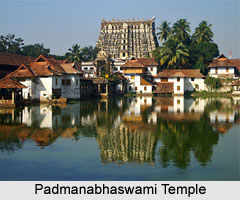
Sri Padmanabhaswami Temple is the main landmark of the Indian state of
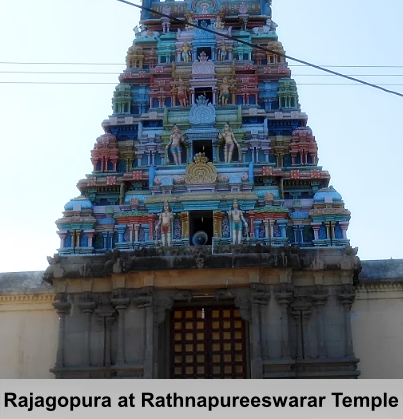
Kerala. The temple stands on an elevated part of the town. The high eastern gopuram rises seven storeys high and has a curious pagoda effect at its peak. It is one of the most notable temples of Kerala known for its architectural beauty. The temple is the perfect blend of the indigenous style and the features of
Dravida style architecture. According to legend the temple was built in 3000 B.C. The temple can be entered by three doors. The ottakkal or single stone slab mandapam in front of the idol was rebuilt with a single slab of granite. It is two and half feet thick and twenty feet square. The eastern gopuram, for which the foundation had been laid in 1566, was also rebuilt upto the fifth storey. As per an inscription in
Sanskrit and Malayalam characters carved on the base of the mandapa inside, the temple was reconstructed from the Vimana down. The work began in 1729 A.D. presently what can be seen today within the temple walls are attributed to Marthanda Varma, the builder of modern Travancore or
Thiruvananthapuram. He had planned of reconstructing the temple much before he became a king in 1729. When he succeeded to the throne he personally supervised the construction work of the temple. Notable among these works were the reconstruction of the sanctum sanctorum and the replacement of the old, recumbent wooden idol of Sri Padmanabha with a new one, fashioned out of 1200 `shalagrams.`
Designs of Padmanabhaswami Temple : Sri Padmanabhaswami Temple covers an area of 25,700 sq. feet or about 7 acres. It faces east and is surrounded by massive fort walls. There is a flight of stone steps on the eastern side. The tower of the temple is 100 feet in height and has storeys with window light openings in the centre of each of them. The stone basement of the tower has been adorned with intricate sculptural designs. The masonry is embellished with ornamental work of Puranic figures. The main gateway is located underneath the gopura that leads to the temple. There is a fine broad open corridor located between the gateway and the inner shrine. These corridors are in the form of an oblong that is supported by 324 pillars and covered with terraced roof. On one side, it is 450 feet long and on the other side 350 feet. It is 25 feet broad.
The two rows of granite pillars and the stone ceiling above are decorated with fine sculptures. The figure of a Nayar girl can be seen on every pillar. The Nayar girl is seen bearing a lamp in the palm of her hands joined together and raised above her waist. The top of each pillar has been surmounted by the head of a unicorn in the mouth of which is a loose ball of stone. There are four stone platforms built at the four points of the oblong corridor. It is from here the devotees witness the God`s procession during any important festivals in the temple. There is a flagstaff of gold that is almost 80 feet in height and circular in shape. On its top there is an image of Garuda, the God`s favourite riding bird. South of this flagpost and connected with the corridor is the Kulasekhara mandapa, containing most impressive stone sculptures of the early eighteenth century. The main altar of the temple is located between the flagstaff and the inner shrine. The shape of the inner shrine is rectangular and is comprises of two storeys and is ornamented with gables. It is an important characteristic of the Kerala style of temple architecture. Apart from the main shine there are other small shrines within the enclosures that are dedicated to
Lord Krishna, Kshetrapala, Sasta, Narasimha, Vyasa,
Lord Shiva,
Lord Ganesha,
Lord Rama,
Sita,
Lakshmana and others.
The walls of the temples have also been decorated with mural paintings that depict scenes from the
Indian Puranas. The temple maintains some of the best traditions of stone sculpture in Kerala. These designs are some of the finest examples of the sculptor`s art of the eighteenth century. Some of the finest pieces of sculpture can be seen in Kulasekhara mandapa. It contains representations of various deities, especially of Lord Vishnu and Lord Shiva. The image of
Lord Vishnu is in a sitting posture with
Goddess Lakshmi on the left. He is seen holding in his hands the Shanka (Conch) and Chakra (wheel) and his other emblems. Another image of Lord Ganesha can be seen in seated position with his portly belly and stout diminutive limbs. Images of three Brahmin priests can be seen on his sides performing puja which are masterpieces of realistic art.
Various other Puranic scenes and figures are also depicted. Some of them are Markandeya embracing Lord Shiva, Lord Krishna playing on the flute with the gopis dancing, the incarnation of Vishnu as
Vamana (dwarf), Kaliyamardhana (Lord Krishna trampling on the serpent, Kaliya), various scenes from the
Ramayana such as the presentation of Rama and Lakshmana to
Vishwamitra, the departure of Rama with his brother and wife to the forest, the abduction of Sita, the fight with Bali,
Lord Hanuman setting Lanka on fire and the fight with
Ravana. The story of the
Bhagavad Gita is also depicted in small reliefs.
Thus, from time immemorial, the temple is considered one of the important Vaishnavite centres of pilgrimage.

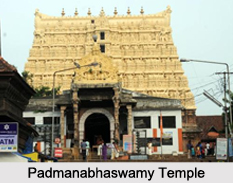 The Padmanabhaswami temple is one of the main temples located in Thiruvananthapuram, the capital of Kerala. Thiruvananthapuram itself derives its name from Tiru-Ananta-puram, which means the place of the sacred serpent, Ananta or Adi-sesha on which the Lord Padmanabha reclines. The temple stands on an elevated part of the town and with its lofty eastern gopuram rising seven storeys high with a curious pagoda effect at its peak.
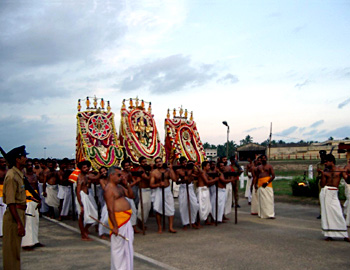 There are mainly two annual utsavams at the Padmanabhaswami temple, one in the month of Meenam (March-April) and the other in Thulam (September-October). Both are 10-day festivals with the inaugural flag-hoisting (Kodiyettam) ceremony on the first day, the Pallivetta (hunting) ceremony and procession on the 9th day and the arattu, the ritual bathing of the deities on the 10th day. On all these days, within the temple, there are elaborate pujas and ceremonial processions.