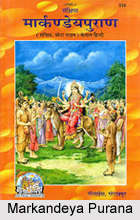
 Origin of Goddess Durga is described in details in Devi Mahatmyam. Goddess Durga is an incarnation of Devi, the supreme goddess, and is depicted with ten hands, carrying weapons and a lotus flower, riding a lion or tiger. The account of the origin Goddess Durga is described in the Hindu spiritual text, Markandeya Purana, in the tales of Devi Mahatmyam. It was composed in the Sanskrit language by the sage Markandeya, during c. 400-500 CE. Devi Mahatmyam is also referred to as the Durga Saptashati or Chandi Patha.
Background of Mahishasura
According to the myths, Mahishasura, the king of the demons, fought with Lord Indra, the king of the Devas, for a hundred years and defeated Indra. Mahishasura then earned invincible strength and the favour of Lord Shiva through a long and pious meditation and hard penance. Shiva impressed by his devotion, blessed the Asura and gave him a boon that neither any Deva nor any man would be able to kill him, he will die only in the hands of a woman. Mahishasura, being arrogant, thought that a woman would never be able to kill him. Thus he started to terrorise heaven and earth and killed many people, tortured several deities and conquered heaven.
Birth of Durga
The gods or Devas took the refuge of Lord Brahma, who took them to Vaikuntha, to Lord Vishnu and Lord Shiva. Brahma eloquently described all the events related to the reign of terror that Mahishasura had unleashed. It was decided that the solution was the creation of a powerful woman to vanquish the demon. Upon hearing about the misdeeds of Mahishasura, Shiva and Vishnu, as well as all other gods and Devas became extremely angry and beams of intense and radiant light emerged from them. All the energy of the light united at the Ashram of Katyayan, a priest. Thus goddess Durga evolved out of the divine radiance and obtained the name Katyayani. She explained that she was a form of the ultimate Brahmin who had formed all the gods; the gods did not create Durga, rather it was her Lila that she emerged from their unified divine radiance. She had appeared to annihilate Mahishasura and rescue the gods.
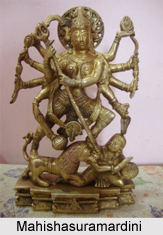 Different parts of the body of Goddess Durga were created by the radiance and energy of different gods. The face of Durga came from Shiva, her tresses came from Yama, her ears from Vaayu, her three eyes come from Agni, her nose from Kubera, her teeth from Prajapati, her ten arms from Vishnu, her fingers from Vasus, her breasts from Chandra, her waist from Indra, her feet came from Brahma, her thighs from Varuna and her toes from Surya. She then received her weapons from various gods. Shiva gave the Trishula (trident), Vishnu gave the Chakra, Varuna a Conch shell, Agni gave Shakti or a missile, Indra gave Vajra (thunderbolt) and a bell, Yama gave an Iron rod, Varuna gave pasha or noose, bow and arrow from Vaayu, a necklace of beads from Daksha and a vessel of sacred waters came from Brahma. Kala gave her shield and sword. Durga received her clothes, jewelry and necklaces from the ocean. Himalaya provided her with the Lion and more jewels. Kubera gave her wine, and a garland of snakes that were provided by the king of the Nagas.
Battle with Mahishasura
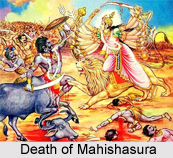
After being armed and fully prepared, Goddess Durga laughed so loud that it shook the entire world. Mahishasura went to find the origin of the sound, along with his soldiers. He found that a goddess with thousand arms stood across the earth. Durga fought valiantly with the demon army and their chariots, elephants and horses. She killed and mutilated thousands of demons with her weapons and her lion. Mahishasura, upon viewing the demise of his soldiers, took the form of a buffalo demon. Durga crushed him with her sword. Mahishasura charged against her, taking several forms. But all proved useless against the power of the supreme Goddess. Mahishasura again changed his form and took the shape of an elephant and grabbed her lion. Durga sliced the asura`s trunk with her heavenly sword. The demon continued his rampage by changing his forms and turning into a lion and then a man. But again they were defeated by goddess Durga.
 Death of Mahishasura
Mahishasura again turned into a demonic buffalo and attacked her. The goddess became very annoyed and angry. Just as the demon was half-way through his transformation into a buffalo, he was paralysed by the intense light that emitted from the goddess. Durga laughed out loud and impaled Mahishasura with her trident. She then beheaded him with her sword and killed the evil demon. All the gods, devas and sages prayed, chanted and sang in the praise of Goddess Durga. Peace and joy had once again returned to heaven and earth.
Thus, Goddess Durga is also known as Mahishasurmardhini as she slayed the demon Mahishasura.