Introduction

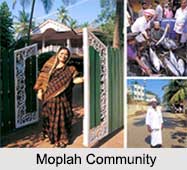
Moplah Community, Islam, Indian CommunityMoplah Communities are the Malayalam speaking Muslims of Kerala and have the same culture and outlook as the rest of the Malayalis. The community arose primarily as a result of the pre and post-Islamic Arab contact with Kerala, mainly based upon trade.

Muslims form some 15% of the total population of Kerala which is more than 20 million. In the 3 districts of Kannur, Kozhikode and Palakkad, the Moplah population numbers about 2 million. They are not a separate ethnic or linguistic entity but have a certain group individuality of their own. This individuality has been rendered to them by their tradition and religion.

Etymology of Moplah Community

The word, `Moplah` comes from Mapillai, supposed to be derived from `Mam Piltai` the great or respected person, indicating the honoured status in society of the early Muslim settlers. Mapilla also means son-in-law in Tamil and husband in colloquial Malayalam. The early Muslim immigrants who married into the local families and settled down in the region would have been addressed as `Mam Piltai ` by the local inhabitants. Even today the word "Mapilla" is used for Christians (Nazarene Mapilla) and "Jonaka Mapilla" for Muslims.


History of Moplah Community

The Malabar Coast, noted for its spices and other products from time immemorial, had a regular trade with the Greeks, Romans, Mesopotamians and Arabs long before the advent of Islam. Foreigners, traders and scholars were all welcomed and treated with hospitality in Kerala. Islam first came to India through Malabar. A party of Muslims, under Malik Ibn Dinar, reached Kodungalloor where they were most hospitably welcomed and the first Muslim mosque was established there with Malik Ibn Dinar, as the Kazi, which still exists. Intermarriages with the local families were frequent and it was thus that the small band of Muslim settlers grew into the Moplah community of today.

The Moplahs grew in numbers and influence. The people from this community are primarily from the agricultural, labour and fisher folk classes. The lower castes had an inducement to become Muslims as they were treated as equals by their new coreligionists irrespective of wealth and influence.

Vasco da Gama`s landing at Kapat near Calicut in 1498 marked a significant turning point in India`s history as apart from objectives of trade, the Portuguese wanted to establish a political hegemony which they set about by playing one chieftain off against another.

The Moplahs and the Arab traders waged a relentless and bitter struggle against the Europeans. The Moplahs manned the navy of the Zamorins of Calicut which, under Kunjali Marakkar I and II, the Moplah admirals, inflicted many defeats on the Portuguese, sometimes pursuing them far out into the ocean.

During British rule, Malabar became a single administrative unit under a British collector but Travancore and Cochin continued to remain under Indian rulers. When Mahatma Gandhi linked the Civil Disobedience movement with the Khilafat agitation, the Moplahs took the opportunity to settle old scores with their landlords. Between July 1921 and February 1922 hardly any administration existed in central Malabar. One of the heroes of the rebellion was Variamkunnath Kunhamed Hajee who proclaimed himself king. The reprisals were total and satanic, about four thousand Moplahs being killed and wounded and thirty-eight thousand captured.


Religion of Moplah Community

The Moplahs are strict in adherence to their faith but follow the customs and manners of the local people of whom they are a part. A number of Moplah families, especially in north Malabar, conform to the Hindu marumakkathayam (matrilineal) system.


Society of Moplah Community

The Moplahs speak Malayalam and all Moplah children are taught to memorize the Quran. Islamic religious and social tenets were also taught in the same manner. This gave rise to a class of priests who specialized in Islamic theology and were called `Musaliyars.` The Moplahs are Sunni Muslims and mainly follow the Shafei school of thought. However a Shia shrine at Kondotti (near Calicut) is also to be found. It is looked after by a family of Thangals who migrated from Iran.

The Moplahs did not take kindly to modern education. They developed a form of writing known as Arabi Malayalam in which Malayalam is written in the Arabic script. They also composed songs and ballads which are essentially based on Malayalam but they have borrowed freely from Arabic, Persian, Urdu and Tamil. This literature is known as Mapilla Patu.

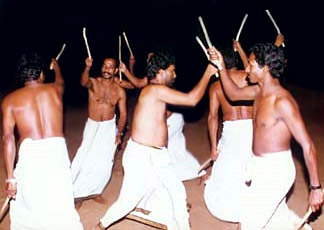
KolkaliBecause of religious inhibitions, the only dance form developed by the Moplahs is the vigorous Kolkali. Twelve muscular men, with sticks and tiny cymbals attached to them, dance in a circle with the leader in the middle who sings, the players joining in the refrain. Some very intricate steps and a great deal of acrobatics are involved and the training generally takes place in Kalaris (local gymnasia). The women also have a sort of dance called Kaikotti Kali, which is accompanied with songs and hand clapping and is generally performed at the time of weddings.
The average Moplah is independent, self-respecting and upright. Some of the finest delineation of Moplah character is to be found in the novels Vroob by K.C. Kuttikrishnan and Asura Vittu by M.T.V. The study of the Moplahs has been done with originality and lyrical beauty by Vaikom Muhammed Basheer in the milieu of his own village in central Travancore. Dalya Kala Sakhi`s Childhood Friend and Kunhipathumaayude Adu`s Kunhipathumma`s Goat are other Moplah stories. N.P. Mohammed, too, has written some fine stories centering around Moplah life and character.

The Moplahs are hardworking and adventurous. The peasantry fishermen and traders are industrious and thrifty. A large number of them plied lucrative trades in Burma, Singapore, Malaysia, Indonesia, in the Gulf Sheikhdoms and the Arabian mainland.

Many have married and settled down in these countries though they keep up their contacts with India. They are some of the best lumberjacks in the country and are also very good at bridge and pier construction in underwater conditions. There are influential trading people in the higher strata, especially in Calicut and Cannanore, particularly in the timber and timber-based industries. Some are large land owners and planters as well.