 Major crops of Mughal India included both rabi and kharif crops. In fact, production of a large number of crops was one of the main aspects of agriculture in Mughal India. The main basis of the economy of that era was agriculture and thus, cultivation of good quality crops was an integral part. Historical records show that in and around the province of Agra near about 16 rabi crops while 25 kharif crops used to be cultivated. Further, allowing for two crops that were common to both the harvests, near about 39 crops were being cultivated within a year in almost every revenue circle of the province. Lists of taxed crops are likewise extensive for the other provinces. Like for instance, in southern region of Gujarat, near Surat, official surveys in 1595-96 recorded around 16 crops in land that was not larger than 19.4 hectares. It was also believed that peasants of Mughal India possessed the skills as well as the knowledge to deal in a large stock of crops whose cultivation was supported by the tropical climate.
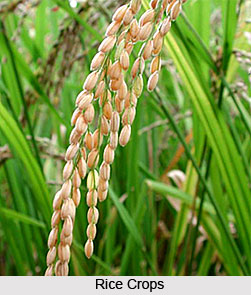
Different cropping patterns were observed in Mughal India. In the production of food grains, Mughal India had broad division of rice, wheat and millet zones. It included Assam valley, Bengal and Orissa on the eastern coast and region around Tamil, narrow strip along the western coasty and Kashmir. Rice was cultivated to the virtual exclusion of wheat and millets. In Bihar, Allahabad and Awadh rice enjoyed a partial domain. It was mostly cultivated in Gujarat, especially in southern coastal belt. Rice was one of the major crops cultivated in the Sindh province because of well irrigation facilities from the Indus River and its branches. Another most important food cultivated was wheat. It was largely cultivated throughout the province of Bengal. Further, like wheat, barley also grew abundantly mostly in the central plains and Gujarat.
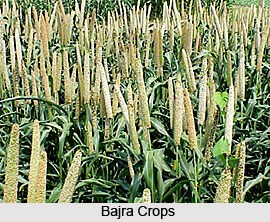
The region of millets coincides mostly with that of the region of wheat cultivation. As a result, jowar and bajra were not cultivated in and around the province of Allahabad. However, in the western province, jowar was the main kharif crop, while wheat was the main cultivated rabi crop. In Ajmer, Gujarat, and Khandesh, millets dominated over cereals. Pulses were also cultivated in huge quantities. Maize was another most important food crop cultivated in India during Mughal rule. It was cultivated as a kharif crop and mostly around the province of eastern Rajasthan.
 Major crops cultivated in Mughal India also included `cash crops`. In that period, cash crops were popularly known as `high-grade crops`, chiefly grown for the market. Sugarcane and Cotton were the two most popular crops belonging to the category of cash crops. Cotton was mostly cultivated throughout the northern region of the country and was also considered as an important crop in Bengal province. However, subsequent development of sea-trade and construction of the railways increased cotton cultivation in certain regions as compared to other crops. Moreover, the cultivation of sugarcane was quite widespread in Mughal times, even more than that of cotton. At that time, Bengal sugar was pre-eminent both in volume of output and quality. However, the cultivation of sugarcane subsequently declined in Bengal.
Cultivation of oilseed crops was also popular during Mughal reign. Its cultivation was mostly prominent in Bengal. Some fibre yielding crops as well as dye-yielding crops were also grown. Indigo cultivation was also popular to some extent. Bhang plant was also largely cultivated, although Aurangzeb ordered it to be completely exterminated. Another notable feature of the agricultural pattern under Mughal rule (around 17th century) was the introduction and rapid extension of the cultivation of tobacco. During the reign of Shah Jahan, tobacco had found a place in the perfumery of aristocratic households. Coffee as a beverage had become familiar to aristocratic and polite society. It was imported from the Arabian Peninsula and Abyssinia. However, a particular variety was being grown in the southern region of Maharashtra. Tea was not cultivated anywhere, not even in Assam.
The crops cultivated in Mughal India also consisted of spices; pepper was commercially the most important article. Long pepper was largely cultivated in Bengal, and mostly in the southern ranges of the Western Ghats. Capsicum or chilli and Saffron were almost unknown to Mughal India. Different types of vegetables were also widely cultivated in Mughal India.