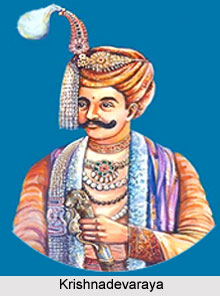
 Krishnadevaraya is the third ruler of the Tuluva Dynasty. He was known by various names like Andhra Bhoja, Mooru Rayara Ganda and Kannada Rajya Rama Ramana. He was the son of Tuluva Narasa Nayaka.
Krishna Deva Raya`s reign marks a period of great military success in Vijayanagar history. He was known to change battle plans abruptly and turn a losing battle into victory. The first decade of his rule witnessed long blockades, bloody conquests and victories. Gajapatis of Orissa, Bahamani Sultans and the Portuguese were his main enemies.
Conquests of Krishnadevaraya
During Krishnadevaraya`s rule plunder of towns and villages by the Deccan sultans came to an end during. In 1509 his army clashed with the Sultan of Bijapur at Diwani and the sultan Mahmud was defeated. Raya also invaded Bidar, Gulbarga and Bijapur and earned the title "establisher of the Yavana kingdom" when he released Sultan Mahmud and made him real ruler.
Krishnadevaraya subdued local rulers of Velamas of Bhuvanagiri and captured lands up to the Krishna River. He also defeated Ganga Raja, the Ummatur chief and seizer region till the Kaveri River. He went beyond Godavari River in 1516-1517. He was perhaps the only king of Vijayanagar who enjoyed great success in the wars with the Gajapati Emperors of the empire of Kalinga-Utkal Orissa. Saluva Timmarasa took over as governor of Kondavidu thereafter. The Vijayanagar army then accosted the Gajapati army at Kondapalli area and laid another siege.
Krishnadevaraya did plan for an invasion of Kalinga-Utkal but the Gajapati Emperor; Prataparudra came to know of the plot and had built up a massive strategy to destroy the Vijayanagara army and along with it its king. However Timmarusu came to know of this strategy and managed to dissuade Krishnadevaraya from further confrontation with the empire of Kalinga-Utkal. Peace was secured through diplomacy and the king Krishnadevaraya married the daughter of the Gajapati emperor Prataparudra deva called jaganmohini. His other two wives were: Tirumala Devi and Chinna Devi.
He established friendly relations with Portuguese. The Emperor obtained guns and Arabian horses from them. He utilized their expertise in improving water supply to the city of Vijayanagar.
He defeated Golconda and captured its commander Madurul-Mulk, crushed Bijapur and restored Bahmani sultanate to Muhammad Shah. On May 19, 1520 he secured the fortress of Raichur from Ismail Adil Shah of Bijapur after a difficult cordon. Several Vijaynagar soldiers were killed. His managed to extend his empire over whole of South India.
Krishnadevaraya died in 1529. Achyuta Deva Raya, his brother was his successor. Vijaynagar witnessed a glorious rule of Krishnadevaraya.
Administration of Krishnadevaraya
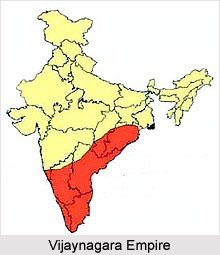 Empire was divided into a number of provinces often under members of the royal family. The official language was Kannada. Krishna Deva Raya was a monarch, a de-facto sovereign with extensive powers and personal influence. He administered the Kingdom well with the help of his prime minister. He maintained peace and cared for the prosperity of the people.
He believed that the King should always rule with an eye towards Dharma. He would conduct annual tours all over the empire, during which he studied everything personally and tried to rectify the grievances of the people as well as punish the evil doers. He was a man of much justice. He was a follower of Vaishnavism. However he showed he showed respect to all sects and petty religious prejudices. He allowed ample freedom to his people.
Art and literature under Krishnadevaraya
Krishnadevaraya`s rule witnessed productive literature in languages like Telugu, Sanskrit, Kannada and Tamil. His rule was known as a golden age of Telugu literature. The king was fluent in many languages including his mother tongue Tulu.
He patronised Kannada poets like Mallanarya who wrote Veera-saivamrita, Bhava-chinta-ratna and Satyendra Chola-kathe, Chatu Vittal-anatha who wrote Bhaga-vatha, Timmanna Kavi who wrote a eulogy of his king in Krishna Raya Bharata.
Eight poets known as Astadiggajalu were part of his court. They included: Allasani Peddana, Nandi Thimmana, Madayyagari Mallana, Dhurjati, Ayyala-raju Rama-Bhadrudu, Pingali Surana, Ramaraja Bhushanudu and Tenali Rama Krishna.
Allasani Peddana wrote Manu-charitramu. Nandi Timmana wrote Paari-jaata-apaharan-amu and Raja-sekhara Charitramu was penned by Madayya-gari Mallana. Dhurjati wrote Kalahasti Mahatyamu and Ayyal-raju Rama-bhadrudu wrote Rama-abhyuday-amu. Pingali Surana authored Raghava-pandaveeyamu. Rama-raja-bhushanudu composed Kavyalankara-sangrahamu, Vasu-charitramu, and Harischandra-nalopakhyanamu. Tenali Ramakrishna first wrote Udbhataradhya Charitramu and later composed Vaishnava devotional texts Pandu-ranga Mahatmyamu, and Ghatikachala Mahatmyamu.
He patronised Tamil poet Haridasa. Vyasatirtha wrote in Sanskrit Bhedo-jjivana, Tat-parya-chandrika, Nyaya-mrita and Tarka-tandava. Krishna Deva Raya himself wrote Madalasa Charita, Satyavadu Parinaya and Rasamanjari and Jambavati Kalyana.