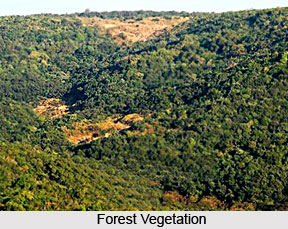
 Forest Vegetation in India is as varied as its land forms. The quantity and pattern of rainfall affects it to a great extent. Soil types, its structure, texture, humus content and reaction play large roles in determining the type of vegetation found in a particular area. Accordingly a panorama of forest vegetation presents itself. The types of forest vegetation occurring in different parts of the country are discussed below.
Forest Vegetation in West India
The most prominent type of vegetation in this area comprises tropical thorn forests and tropical dry deciduous forests. Thorn forests are basically low tree stands with predominance of thorny, usually hardwood, species. The tropical thorn forest is found mostly on flat ground or on low undulating hills and plateaus. Apart from this, tropical dry deciduous forests can also be found existing in the western area. In Rajasthan and Haryana, Desert Dune scrub is encountered. It is a very open and stunted formation of trees and bushes covering only a small proportion of the soil. Western India also contains tropical dry deciduous forests.
Forest Vegetation in Central and North India
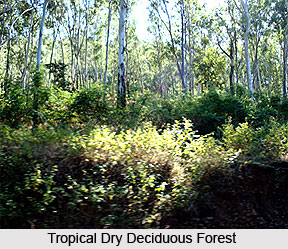
The largest cover of tropical moist deciduous and tropical dry deciduous forests is found in Central and Northern part of India. The tropical dry deciduous forests are a mixture of trees which are deciduous during dry season. In northern form of tropical dry deciduous forests most of the species of southern form are present. The tropical moist deciduous forests are found practically on every soil occurring in this part of the country from recent sandy alluvium to old red soils. In an area having moist deciduous forests, semi-evergreen forests are frequently found on favourable sites.
 Forest Vegetation in South India
The most dominant forest vegetation here in the Southern part of the country is tropical thorn forests. They exist through out dry peninsular tracts up to the lee of Western Ghats. The other forest type occurring in Southern India is tropical dry deciduous forest. The other forest type occupying the second largest area in Southern India is tropical dry deciduous forest. This type merges into thorn forests whenever the annual rain fall drops below 750 mm. This happens in a large tract to the lee side of the Western Ghats. In a linear strip all along the Western Ghats wet evergreen forests are met. They, however, occupy a relatively smaller area in the zone. Some evergreen and moist deciduous forests also occupy a small area in Southern India.
Forest Vegetation in East India
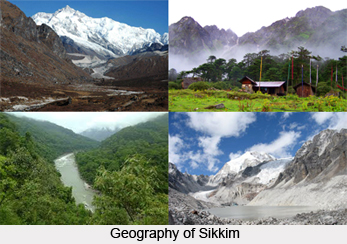
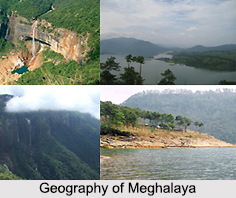
Eastern India comprises tropical wet evergreen forests and tropical moist deciduous forests. This area is also dotted by tropical semi-evergreen, sub-tropical pine and montane wet temperate forest patches. In the wet evergreen forest large tall evergreen trees form the bulk of the main canopy. Tropical semi-evergreens have developed in moderately heavy to heavy rainfall areas of Assam, Meghalaya, Manipur, Arunachal Pradesh and North Bengal plains. Sub-tropical pine forests are found in Khasi Hills and Naga Hills and in Manipur. Montane wet temperate forests occur in Eastern Himalayas from Darjeeling eastwards on the higher hills of West Bengal, Sikkim, Assam and Arunachal Pradesh. They also occur on upper levels of Manipur and Naga hills.