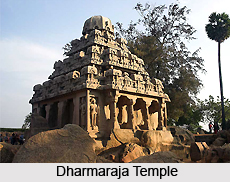
Dharmaraja Temple

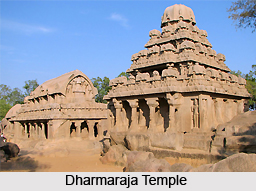
Dharmaraja Temple in Dindigul is almost three hundred years old. A lot of festivals are held in the temple even today.

About Dharmaraja Temple

Dharmaraja Temple, DindigulThe cult of Draupadi was very practiced in the Dharmaraja Temple of Dindigul in a very pronounced manner. The temple was founded about three hundred years around 1700 by one Erumaikkara Etaiyar, presumably an Itaiyar or Konar. There have been drastic and dramatic changes in the temple`s ritual cycle and mythology over the period of one hundred and seventy-five years since it was first established.

In the early 1800s the Dindigul temple celebrated a fire walking festival of basically the same type that one finds today in the more traditional, conservative temples of the core area. The Dindigul temple today, however, no longer holds either a spring festival or a fire walking festival.

A lot of rituals and festivals are part of the Dindugul Temple. It has been said that to retain the basic structure of an eighteen-day Draupadi festival with dramas and processions, a decentralized temple like that at Dindigul would thus have had to improvise, and to use local rather than itinerant professional talent for its ritual and dramatic recreations of epic scenes.

To retain the basic structure of an eighteen-day Draupadi festival with dramas and processions in a decentralized temple like that at Dindigul would thus have had to improvise, and to use local rather than itinerant professional talent for its ritual and dramatic recreations of epic scenes.

Today`s Dindigul Draupadi festival is a ten-day affair, comprising the nine days of Navaratra and the tenth day of Dasara. This rather crude processional drama seems incongruous, as its epic context is all but lost. But it is likely that it is more than just a condensation of the epic themes of violence. As a public drama with local actors, it is probably the last vestige of the eighteen processional dramas that were performed at Dindigul in the early nineteenth century.
Festival at Dharmaraja Temple

Festival at Dharmaraja Temple, DindigulFestivals at Dharmaraja Temple are very popular. Dharmaraja Temple in Dindigul is known for its ten day festival. In fact this ten day Draupadi festival is the most famous festival of the temple. Each of the eighteen processions in the ten day festival represents a different episode of the Mahabharata in a sequence.
The eighteen Dindigul processions involved the telling of Mahabharata episodes through their rendering into Tamil songs (pattu). These were sung to the accompaniment of the utuppumani, probably the hourglass-shaped utukkai drum and the mani, or bell. In at least one case the sixth-day procession enacting the marriage of Draupadi and Arjuna, the scene was dramatized by two actors dressed as the bridal pair, who performed the wedding scene on the street. In the Gingee core area, one finds all of these elements in contemporary Draupadi festivals.

Processions, on the other hand, though they may also occur on each day or night of the festival, normally represent epic scenes only by specific decorations (alamkdras) of the processional icons. Meanwhile, the hourglass drum and bell are not so much typical instruments of the Terukkuttu as infrequently found ritual paraphernalia of the Draupadi temple.

In the ten day long festival on the first day, Draupadi is simply taken out with the five Pandavas, and on the second, Lord Krishna goes on procession with Radha. On the third day, however, Draupadi`s processional icon is dressed as the distinctly "Vedic" goddess Gayatri, with six heads and many arms. And on the fourth day, Draupadi and Yudhisthira (Tarumar or Dharma) are dressed for their marriage as Minaksi (the "fish-eyed" goddess) and Cokkanatar (or Sundaresvara, the "Beautiful Lord"), these being the forms in which Parvati and Lord Shiva are worshipped at the great Meenakshi Temple in nearby Madurai. Indeed, it is notable that it is now no longer Draupadi`s marriage with Arjuna that is ceremonially most significant, but her marriage with the more Brahmanical Dharma, assimilated to Shiva`s most prominent regional form. On the fifth day, Draupadi is taken in procession with the "Eight Lakshmis." On the sixth day, Arjuna`s chariot is driven by Krishna to the Mahabharata war, highlighting Krishna in his favored form as Parthasarathi, "the charioteer of Partha" (Arjuna), and of course evoking the scene of the Bhagavad Gita. On the seventh day, a statue of Aiyappan set above eighteen steps is taken out to replicate Aiyappan`s famous pilgrimage temple atop Sabarimalai Mountain. And on the eighth day, a "hill" is made of books to represent Tirumalai Mountain, home of one of the most celebrated Vishnu temples in all South India. It is to be noted that Draupadi has not been taken on procession since the fifth day, a pattern that continues into the ninth, when the figures carried in procession are Goddess Saraswati, Goddess Lakshmi, and Lord Ganesha. The absence of Goddess Durga is also noted in the procession. Presumably it is she who is represented by Draupadi herself when the latter is finally taken on procession once again on the tenth day the day of Durga`s victory-this time in the company of her victorious husband, Arjuna. Draupadi and Arjuna are commonly paired for processions, most notably for their victorious crossing of the coals in fire walking ceremonies. And it is likely that this culminating procession at Dindigul is another vestige or fragment of a ritual of this type.

On the fourteenth day of the eighteen-day festival the procession involves an enactment of the episode of the Pandavas and Draupadi`s period in disguise.

Recently updated articles in Temples of India

Rathnapureeswarar Temple
Rathnapureeswarar Temple Thumbnail

Rathnapureeswarar Temple

Rathnapureeswarar Temple in Tiruvarur district, Tamil Nadu, is a revered Shaivite shrine among the Paadal Petra Sthalams. Dedicated to Lord Shiva, it...

Gayatri Temple, Sirmaur
Gayatri Temple, Sirmaur Thumbnail

Gayatri Temple, Sirmaur

Gayatri Temple is located in Sirmaur district, Himachal Pradesh. Gayatri Temple is a sacred shrine that belongs to the medieval age.

Thousand Pillars Temple
Thousand Pillars Temple Thumbnail

Thousand Pillars Temple

Thousand Pillars Temple, Andhra Pradesh possesses 1000 pillars built by the Kakatiya ruler Rudra Deva during 1163 AD and is adorned with beautiful scu...

Triloknath Temple, Mandi District
Triloknath Temple, Mandi District Thumbnail

Triloknath Temple, Mandi District

Triloknath Temple is built in the Shikhara style of architecture, situated in Mandi, HP.