Factors Governing Maritime Strategies in India
Several key domains are looked into while governing factors in maritime strategies in India.

Share this Article:

Factors Governing Maritime Strategies in India, Geography of India"Whoever controls the Indian Ocean dominates Asia. This Ocean is the key to the seven seas. In the twenty first century, the destiny of the world will be decided in its waters". -Alfred Mahan

The importance of the Indian Ocean was well understood by Alfred Mahan, one of the leading thinkers on maritime affairs in the world. With a host of countries, both regional and extra-regional having their presence in these waters, India felt necessary to adopt a maritime policy to certify that it is in a position to influence events in the region. Factors governing Indian maritime strategies were hence focussed on the entire spectrum of issues encompassing foreign policy, port infrastructure, labour laws, ship building industry, shipping industry, coastal and inland shipping, maritime forces, security arrangements with other powers in the region.

Infrastructure
The magnitude of the development of infrastructure, for attaining high growth rates, has successfully been grasped by the country. Presently, infrastructural supremacy is counted as the prime factor in governing maritime strategies of India. The major thrust is on the development of roads, power generation and telecommunication.

Ports: India has 12 major ports and 185 minor ports spread on India`s extensive coastline, with the bulk of the overseas trade being handled in the major ports. When it comes to ports, shipping and ship building in colossal dimension are some of the key factors governing maritime strategies of India.

Economic Activity

Off Shore Exploration: The oil exploration sector has received a boost in the recent past with the entry of private players in this field. ONGC (Oil and Natural Gas Corporation) has also unveiled major plans for exploration in the Indian EEZ (Exclusive Economic Zone) and other foreign oil fields. India has made a headway in the field of deep sea-bed mining. Being a technology intensive field, the country is working towards making a successful policy in maritime strategies.

Non Conventional Energy: The oceans afford India with an opportunity to develop energy through non-conventional means like tides and waves. The Gulfs of Kachchh and Cambay are ideal for production of electricity by harnessing the gigantic tidal variations. The long coastline provides many ideal locations to harness the energy of the waves to produce electricity.

Fishing Industry: The Indian fishing industry has terrific potential for growth. Most local fishermen exploit sections in the coastal waters. Hence, looking seawards, Indian maritime strategies assimilate several governing factors.

Share this Article:

Related Articles

More Articles in Geography of India


Geography of Uttar Pradesh
The fourth largest State in India UP is located in the Northern part of India whose area is 2,36,286 sq Kms.
Geography of Maharashtra
Covering an area of 308,000 sq. km, Maharashtra, the third largest state in India.
Geography of Kerala
Geography of Kerala includes plains, hills, valleys and coasts. With the Arabian Sea in the west, the Western Ghats in the east and networked by several rivers, Kerala enjoys diverse geographical features.
Geography of West Bengal
The geography of West Bengal is unique with high peaks of the Himalayan range in the north, the Bay of Bengal in the south and the remaining region is covered with both plains and plateaus.
Geography of Jharkhand
Geography of Jharkhand is comprised of the rich mineral resources and the highly agricultural prospect in this state.
Geography of Sikkim
Geography of Sikkim is characterised by a vast array of magnificent hillock that extends from one corner of the state to the other.
Geography of Meghalaya
The suitable climate, highland plateaus, rivers and the flora and fauna together forms the geography of Meghalaya.
Geography of Mizoram
Mizoram is surrounded by hills, valleys, rivers, waterfalls and lakes. The hills range from 1000 meters to 2000 meters. Rivers, lakes and waterfalls also play major role in forming the land of Mizoram.
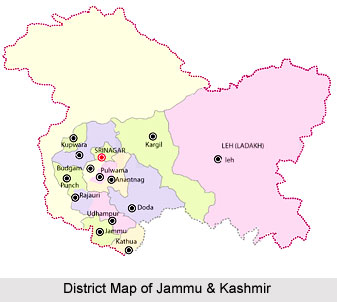
Geography of Jammu & Kashmir
Jammu and Kashmir is encompassed by valleys. Some of the dominant valleys of the state are Kashmir Valley, Tawi Valley, Chenab Valley, Poonch Valley, Sind Valley and Lidder Valley etc. Jhelum River is the only major Himalayan River which flows through the Kashmir valley. Indus, Tawi, Ravi and Chenab Rivers are the major ones flowing through the region.
Geography of Daman and Diu
Daman and Diu is situated on the west coast of India and are the smallest union territories of India.
Geography of Goa
Geography of Goa occupies a prime location along the Konkan coastal belt on the western coast of India. The state is bordered by Maharashtra in the north and Karnataka in the south. The Western Ghats in the east contribute to the flora and fauna of Goa.
Geography of Arunachal Pradesh
Geography of Arunachal Pradesh reveals that it is a hilly tract nestled in the foot of Himalayas.
Geography of Kutch
Geography of Kutch District is covering an area of 45,612 km. Kutch District is the largest district in the state of Gujarat.
Geography of Ladakh
Geography of Ladakh mainly comprises the huge Karakoram Range with long stretch of cold desert which mark the region separately from the rest of the states of Indian subcontinent. Surrounded with the mountain ranges from all corners this small region separates Indian subcontinent from rest of the Asian continent.
Geography of Rajasthan
Geography of Rajasthan defines the dry topography with arid climate of the western mountain region.
Geography of Tamil Nadu
The Indian state of Tamil Nadu is located in the Northern hemisphere in the hot zone.
Ganga River
Ganga River is a trans-boundary river which has religious, economic and historic significance. The river is considered to be the third largest river in the world by discharge. In 2007, Ganga River was ranked as the fifth most polluted river in the world.
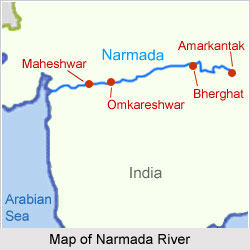
Narmada River
Narmada River is regarded as the 5th longest river of India and the life line of Madhya Pradesh. Narmada River basin spreads over an area of about 98,796 square kilometers. It comes next to Ganga River in terms of holiness and it has several legends associated with its origin.
Bhima River
The Bhima River is the largest tributary of the Krishna River and is significant in the western and southern Indian states.
Cauvery River
The Kaveri River or Cauvery River is one of the most important rivers in southern India.