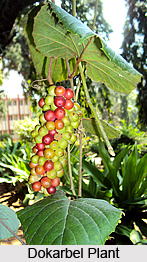
 Dokarbel is a plant in the "Vitaceae" subfamily of the Grape family native to the Indian subcontinent i.e. Bangladesh, India, Nepal and Pakistan. Dokarbel also known as "Wild Grape Vine" is found in most parts of India. It grows in an altitude of 1200 m in the sub-Himalayan hills and in the Western Ghats, typically in the hedges.
Different Names of Dokarbel
Dokarbel having the scientific name "Vitaceae Ampelocissus Latifolia (Roxb) Planch" has many other common names attached to it. The common name of the plant is "Jungli Angoor". In Bengali it is called "Govila" and in Gujarati it is known as "Junglidrakh". The tree is called "Dokarbel" or "Panibel" in Hindi, while in Marathi it is called "Golinda". In the Oriya dialect it is known as "Dibroli", "Kanjianoi" in Sanskrit "Amlavetasah", "Amrtasrava", "Ghanavalli", "Paniyavalli", "Sitalata", "Toyavalli", "Vrksaruha"; in Tamil "Kattukkodimundirigai", in Kannada "Kaadu Drakshi", in Malayalam "Katan Munthiri" and in Telegu "Bedasativva".
Characteristic Features of Dokarbel
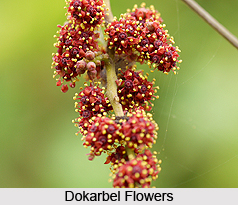
Dokarbel is a large herbaceous climber plant with forked tendrils. It has an extensive, scarcely woody climber with slender, hollow stems which are 3 to 6 m long and 7.5 to 12 mm diameter. The tree"s bark is quiet smooth, green in colour but at the nodes it is often tinged with purple. The leaves of the tree are simple, glossy, and orbicular in shape. The petioles vary in length up to 20 cm, deeply grooved above. The flowers of the tree are 2.5 mm in diameter and reddish-brown in colour. The petals are curved, glabrous on both surfaces and have stamens bright yellow in colour. Berries, the fruit of the tree are 7.5 to 9 mm in diameter usually having 2 seeds and are normally black in colour. In central India flowering occurs mainly in July and August and fruiting from September to November.
Medicinal Values of Dokarbel
The juice of the gentle leaves of the wild grape vine is used to relieve dental troubles. The roots are astringent, and their decoction is useful in treating chronic dysentery. The roots can be crushed to be applied on wounds. The plant is used in pneumonia. Decoction of the stem bark is given in stomach pain. The Santhal Tribe of Bihar use this plant to reduce muscular pains, sores and for healing of fractured bones. In Kerala, this plant is one of four Vitaceae species used as the source the Ayurvedic drug "Amlavetasah". This is used for treating indigestion, liver and spleen diseases, and respiratory disorders. Dokarbel is thus a very significant Indian medicinal plant, wide a large utility being employed for numerous purposes.