
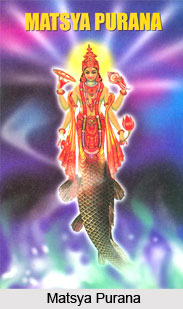
 The Matsya Purana is the sixteenth among the eighteen Puranas. The Matsya Purana deals with Matsya, the first incarnation of Lord Vishnu on earth and is so called as it was first recited by Vishnu in his Matsya avatar to Manu. The Matsya Purana is one of the older works of Purana literature, or at least one of those which have preserved most of the ancient text. It commences with the story of the great flood out of which Vishnu, in the form of a fish (Matsya) saves only Manu alone. While the ship in which Manu is sailing along is being drawn through the flood by the fish, there takes place between him and Vishnu, incarnated as a fish, the conversation which forms the substance of the Purana.
Matsya Purana
Matsya Purana narrates the story of the first avatar of Lord Vishnu in the form of a fish. It is the sixteenth among the ancient Indian Puranas.
About Matsya Purana
The Matsya Purana is the sixteenth among the eighteen Puranas. The Matsya Purana deals with Matsya, the first incarnation of Lord Vishnu on earth and is so called as it was first recited by Vishnu in his Matsya avatar to Manu. The Matsya Purana is one of the older works of Purana literature, or at least one of those which have preserved most of the ancient text. It commences with the story of the great flood out of which Vishnu, in the form of a fish (Matsya) saves only Manu alone. While the ship in which Manu is sailing along is being drawn through the flood by the fish, there takes place between him and Vishnu, incarnated as a fish, the conversation which forms the substance of the Purana.Content of Matsya Purana
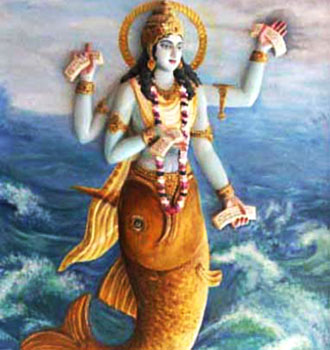 Content of Matsya Purana includes in the conversation between the Matsya avatar of Lord Vishnu and Manu. The story of the Matsya Purana begins with the king Manu, passing his days in observing "Dhyana" in his hermitage. A King of the Surya Vanshi dynasty, Manu handed over the kingdom to his son Iksvaku and went to the foothills of Malaya and performed Tapasya in order to please Lord Brahma. Pleased with his prayers Brahma appeared and gave him the holy blessing. King Manu was blessed with the power that he will be the saviour of the world when the Mahapralaya will come to destroy it.
After the passing of several days, Manu was performing rituals in the pond near his hermitage. While he immersed his hands in the water he found a minnow swimming around in the water. Manu did not kill it but kept it in his water pot or Kamandalu. But the minnow started to grow and within a day the water pot seemed so small. The fish started growing and everywhere Manu kept it -vat, pond, river and finally the ocean- seemed too small for the fish. Surprisingly overwhelmed Manu understands that it was not a mere fish. Unsure of the fact that whether it`s a demon deluding him, Manu came to know that it was the incarnation of Lord Vishnu himself on the earth. Then the Matsya avatar of Lord Vishnu revealed the truth and told that the earth would soon be flooded with the water. Vishnu gifted Manu with a boat. When the earth was flooded, Manu placed all living beings on the boat and thus saved them from immediate destruction. Vishnu himself arrived in his form of the fish and Manu tied the boat to the fish`s horn. Thus the living beings were saved. And when the waters of the flood receded, Manu populated the world afresh.
Saving the mortals from immediate destruction, Lord Vishnu disappeared and after that there was a terrible drought for hundred years on earth. Consequently there was famine and people died out of starvation. The sun also blazed in fury. At a time everything appeared to burn into ashes. The clouds of destruction named Samvarta, Bhimananda, Drona, Chanda, Valahaka, Vidyutapataka and Kona appeared on the sky. Again the rain began to pour from the water engulfed the entire earth. Then Manu again saved the living beings gathering them into the boat as instructed by Lord Vishnu. When the fish appeared, Manu tied the boat to the fish`s horn with a gigantic snake. While the boat was thus dragged around by the fish, Manu asked Vishnu several questions. The answer provided by the Matsya, formed the text of the Matsya Purana.
During this session of conversation Vishnu imparted to Manu, the Surya Vanshi king, the knowledge of the mystery of creation, destruction and recreation, the various eras in universe, knowledge about the solar and the lunar dynasties and the royal genealogies. Thus Manu achieved the wisdom that Divinity is eternal.
In the Matsya Purana, Creation is treated in detail, then follow the genealogies, into which is inserted a section about the Fathers and their cult (Chapters 14-22). The usual geographical, astronomical and chronological sections are also found as in the case of the other Puranas. Moreover, the lists of the kings in this Purana are held to be particularly reliable by most scholars. The lists of kings in this Purana are particularly reliable for the Andhra dynasty.
It has very much in common with the Mahabharata and the Harivamsa Parva - the legends of Yayati (Chapters 24-43), Savitri (Chapters 208-214), the incarnations of Vishnu (Chapters 161-179, 244-248); and there is often literal agreement. There are, however, very numerous later additions and interpolations. For instance we find a considerable section about all manner of festivals and rites (Vratas, Chapters 54-102), a glorification of the sacred places of Allahabad (Prayagamahatmya, Chapters103-112), Benares (Varanasi and Avimuktamahatmya, Chapters 180-185), and of the Narmada River (Chapters186-194); then sections on the duties of a king (Chapters 215-227), on Omina and Portenta (Chapters 228-238), ceremonies at the building of a house (Chapters 252-257), the erection and dedication of statues of deities, temples and palaces (Chapters 258-270), the sixteen kinds of pious donations (Chapters 274-289), etc.
As far as the religious content is concerned, the Matsya-Purana might be called Shaivaite with just as much reason as it is classed as Vishnuite. Religious festivals of the Vaisnavas are described side by side with those of the Saivas, and both Vishnu and Shiva legend are related. In Chapter 13 Devi ("the Goddess," Shiva`s wife Gauri) enumerates to Daksha the one hundred and eight names by which she wishes to be glorified. Thus it is seen that both sects used the work as a sacred book.
Characters of Matsya Purana
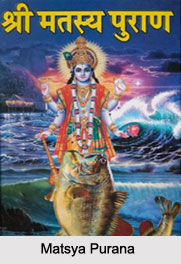 Matsya Purana, a Vaishnavism text is one of the eighteen major Puranas. In fact, it is one of the oldest and better preserved Purana in the Puranic genre of Sanskrit literature in Hinduism. The name of this Purana is based on half-human and half-fish avatar of Lord Vishnu, Matsya. This text contains diverse range of topics and has lasted and made its way into the modern era giving an idea about its contents and characters. Given below are the Characters of Matsya Purana namely, Matsya, Vishnu, Shiva and Shakti.
Matsya : Matsya, also known as the Fish God and the first avatar of Vishnu is a significant part of Matsya Purana. The Puran contains story of Matsya. More specifically, the holy book will intimate the readers with the mythology of a great flood, when humans led by Manu, the seeds of all plants, mobile living beings and the Vedas were saved by the Matsya avatar of Vishnu. Indian mythology highlights Vaikuntha to be the abode of Matsya, chakra and mace to be His weapon and Lakshmi to be His consort.
Vishnu :
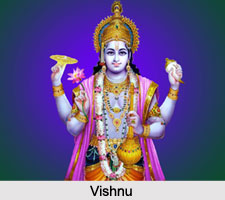 Vishnu, the Supreme Being according to the Vaishnavism tradition, is one of the major deities of Hindus. Vishnu forms a Hindu Trinity or Trimurti along with Brahma and Shiva. Indian mythology highlights Lakshmi to be the consort of Vishnu and Vaikuntha to be His abode. He can be recognized in places of worship with the help of dark or pale blue complexion and four arms. A padma or lotus flower in the lower left hand, kaumodaki gada or mace in the lower right hand, panchajanya shankha or conch in the upper left hand and the sudarshana chakra or discus in the upper right hand are His various symbols.
Shiva : Shiva, the Supreme Being according to Shaivism tradition, is one of the major deities of Hindus. Shaivism holds Shiva as the one who creates, protects and transforms the universe. Within the Hindu Trinity, Shiva is the "destroyer and transformer". Indian mythology highlights Parvati, Sati, Durga and Mohini as the consorts of Shiva, Mount Kailash to be His abode, Trishula to be His weapon and Lingam to be His symbol.
Shakti : Shakti, the Supreme Being in Shaktism is the Hindu goddess responsible for creation and is considered the agent of all change. She is the primordial cosmic energy and represents the dynamic forces that are thought to move through the entire universe. She is the embodiment of active feminine energy of Shiva and is His consort.
Recently updated articles in Indian Puranas
Mandakini, Holy River
Mandakini River is a significant Himalayan river in Uttarakhand, renowned for its ecological, cultural, and religious importance. Originating near the...
Kausika, Son of Vasudeva
Kausika is a minor figure in Hindu mythology and is identified in the Vishnu Purana as the only son of Vasudeva and his wife Vaishali. He is recognize...
Tandu, Attendant of Lord Shiva
Tandu is revered as the divine attendant of Lord Shiva and the foremost exponent of the Tandava dance. According to the Natya Shastra, he instructed S...
Niramitra, Mahabharata
Niramitra was a son of Nakula and Kareṇumati in the Mahabharata. A descendant of the Pandavas and the Kuru dynasty, he fought on the Pandava side duri...
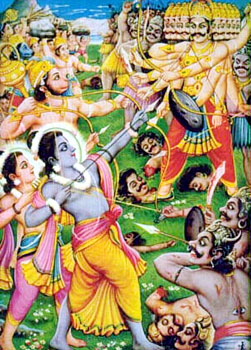
Mahodara, Ramayana
Mahodara was a prominent Rakshasa warrior, minister, and army chief who served under Rāvaṇa during the Battle of Lanka in the Ramayana. Celebrated for...
Related articles in Indian Puranas
Adhyayas in Agni Purana
Adhyayas in Agni Purana are all encompassing. The chapters have dealt with a variety of subjects related to human lives. A large number of chapters ha...
Indian Puranic Tribes
The existence of Indian Puranic tribes is often mixed with mythology and fiction that depict them as superhuman or sub.
Puranic Texts
Puranic Texts are vital according to Hindu, Jain or Buddhist religion; they describe the history of the Universe.

Puranic Shaivism
Puranic Shaivism established during the Gupta Dynasty. This puranic religion developed and expanded, and was accompanied by the development of Brahman...

Nilamata Purana
Nilamata Purana is a Kashmiri Purana that is referred by Kalhana. It is considered as one of the sources of ancient history of Kashmir.