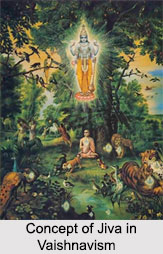
 Concept of Jiva in Vaishnavism means that which lives or sustains life. It is also known as "atman", a term which is more often used in the Upanishads. The word atman means that which pervades the body. It is applicable to both Brahman and the individual soul.
The Upanishads speak of the existence of jiva as a real spiritual entity and also as distinct from Ishwar. There are numerous other passages bringing out the difference between Ishwar and the jiva in terms of the ruler and the ruled, the all-knowing and the ignorant and the independent and the dependent. Though both are spiritual in character, Brahman is infinite (vibhu), whereas the jiva is monadic in substance (anu). In view of this, the Visistadvaita Vedanta has admitted jiva as a separate reality (tattva).
Concept of Jiva as Anu
One of the distinctive characters of the Jiva, according to the Visistadvaita Vedanta, is that it is anu or monadic in substance. According to the Mundaka Upanishad, "This atman is anu and to be known by mind". The jiva is said to exit from the body after death. The Brhadaranyaka Upanishad also speaks of its return to the earth to experience the effect of karma. If the jiva had been vibhu or all-pervasive this movement would not have been possible. Thus, the Visistadvaita Vedanta upholds the theory of jiva as anu.
Concept of Jiva as Karta and Bhokta
Jiva, which is the knower or the subject of knowledge, is also the agent of action (karta) and the enjoyer of pleasure and pain (bhokta). The same Upanishad text which speaks of jiva as boddha or knower, asserts that it is also karta. It stands to reason that the same jivatman which performs a particular deed (karma) should also enjoy the fruit of the deed. Jiva is regarded as karta or doer and Bhoga is an experience in the form of pleasure or pain.
Concept of Plurality of Jivas
The Visistadvaita Vedanta holds that jivas are infinite in number and are also different from one another. This is proved by the fact that the knowledge, memory, desire, happiness and suffering, birth and death of each individual differs from the other, thereby proving that jivas are different from one another.
Types of Jiva
Jivas are classified into three main types. These are;
1. Baddha: Baddha means those souls which are bound in bondage in the form of a continuous cycle of births and deaths due to the influence of karma.
2. Mukta: Mukta refers to one who has become free from bondage. These are the individuals who as a result of some extraordinary merit become the object of God`s grace and who consequently aspire to be liberated from bondage.
3. Nitya: The Nitya refers to those blessed souls who have never been under bondage at any time and have always existed as free souls in the transcendental realm of God.
Jiva as Vishnu Dasa
According to Vaishnava theology, a jiva is regarded as Vishnu Dasa, i.e., an individual is a subservient person to Lord Vishnu. The words "Dasa" refers to living human beings as well as celestial beings. Only they have the capacity to worship God and seek redemption. The concept of "Dasatva" as developed by Vaishnavism is intended to promote spiritual progress by way of realizing through philosophic knowledge that as individuals they are humble before God and that they should, therefore, submit themselves as subservient beings to the will of God.
Nature of Jiva in of Moksha
The soul in the state of Moksha is said to manifest itself in its true form and enjoys Brahman and its glory in full measure. When an individual has successfully completed the Upasana on Brahman, the soul leaves the body through the crown of the head with the help of the Paratman, and passes through the path of the Gods until it reaches the realm of Brahman. The soul attains a state of equality with the Brahman and retains its individuality even in the state of Moksha. Thus, it is believed that the true nature of the soul which is omniscient in character becomes fully revealed only after reaching the state of Moksha.