
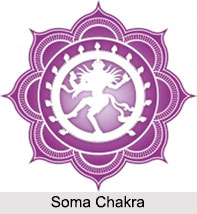
 Soma Chakra is also known as "Amria Chakra", which means "the Nectar of the Crescent Moon". This chakra is located within the Sahasrara Chakra and found just above the Ajna Chakra or the third eye. The Soma Chakra is not as well known and is veiled in the shadow of the Third Eye.
Soma Chakra
Soma Chakra is a minor chakra in the seventh chakra which is located above the third eye, in the centre of the forehead.
Introduction
Soma Chakra is also known as "Amria Chakra", which means "the Nectar of the Crescent Moon". This chakra is located within the Sahasrara Chakra and found just above the Ajna Chakra or the third eye. The Soma Chakra is not as well known and is veiled in the shadow of the Third Eye.Appearance of Soma Chakra
The general Soma Chakra is illuminated as a light blue-white lotus with 12 petals (sometimes 16), with a crescent silver. This moon is the source of nectar for the body, which is said to flow from Kamadhenu, the white cow-faced goddess.
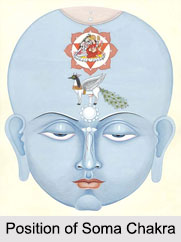 This chakra contains the A-Ka-Tha triangle, formed from the 3 Nadis. This is purported to contain the combined energies of the Godhead: Lord Brahma the creator, Lord Vishnu the preserver and Lord Shiva the destroyer.
This chakra contains the A-Ka-Tha triangle, formed from the 3 Nadis. This is purported to contain the combined energies of the Godhead: Lord Brahma the creator, Lord Vishnu the preserver and Lord Shiva the destroyer.Function of Soma Chakra
This energy center is concerned with a person"s connection to the angelic realms and his spiritual guidance. The proper function of this vortex is important to time management and the manifestation of a wholesome existence. If one is scattered and unable to manage lives within the hours of a day, it will have repercussions on all the other chakras, in particular the Visuddha Chakra, leading to imbalances of the thyroid. It is considered the creative center and the imbalanced Soma Chakra directly impacts the ability to co-create ones reality. Symptoms linked with imbalance of this energy centre are digestive difficulties, dryness of skin, stress related headaches, thyroid imbalances and dehydration of the body or drying up of one"s spirituality.
Activation of Soma Chakra
Soma Chakra is activated to experience the essence of healing by invoking the Divine Healer within one. Meditating on this chakra stops the downward flow of nectar through performance of Khechari Mudra. This brings immortality in the physical body so that the process of aging is stopped. Through the union of Shiva and Shakti one enjoys eternal bliss.
Exercises for Soma Chakra
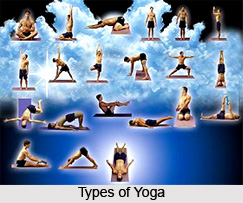
Yoga Asanas that activate the Soma Chakra and balance physical functions are Yoga Mudra, Shashankasana, Matsyasana, Vrikshasana, Sumeru Asana, Bhumi Pada Mastakasana and Supta Vajrasana.
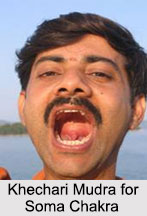 Exercises for Soma Chakra are performed and hence it is activated using asanas and mantra. The flow of soma is directed to wherever one desires to experience healing. Soma means healing nectar. This healing nectar is generated in one of the energy centres of the Chakra system of the bodies known as the Soma Chakra.
The following are the Yoga Asanas that activate the Soma Chakra and balance physical functions:
•Agnisara Kriya
•Ujjayi Pranayama with Khechari Mudra and Jalandhara Bandha
•Viparitakarani (Half Shoulderstand)
•Shirshasana (Headstand)
•Sarvangasana (Shoulderstand)
•Yoga Mudra
•Shashankasana (Hare)
•Matsyasana (Fish)
•Vrikshasana (Tree)
•Sumeru Asana (Mountain)
•Bhumi Pada Mastakasana (Head and Feet on the Earth)
•Supta Vajrasana (Back Bend sitting on heels)
In all these postures Ujjayi Pranayama and Khechari Mudra can be performed at the same time with concentration on the Soma Chakra. Viparitakarani Mudra is particularly effective when combined with the following breathing exercise; inhale through the nose and exhale through the mouth 15 times.
Another technique for activating the Soma Chakra is to allow 1-2 litres of lukewarm water flow over the Soma Chakra. This is best done in the morning with a jug, or under the shower. The water temperature should be about 39 degree Centigrade in winter and 35 degree Centigrade in summer. At the same time chant the "Gayatri Mantra" for five times:
"Om Bhur Bhuvah Svah Tat Savitur Varenyam Bhargo Devasya Dhimahi Dhiyo Yo Nah Prachodayat"
Brahmaghata for Soma Chakra
In India, one can sometimes see men who have allowed a thin strand of hair to grow at the back of the head which is then twisted and knotted. This is known as "Brahmaghata". It creates pressure on the scalp, similar to acupressure, stimulating nerves and glands and promoting activation of the Soma Chakra.
Those who lack energy, feel constantly tired or suffer from feelings of helplessness should tie a Brahmaghata and concentrate on the Soma Chakra. Within a few days the invigorating effect of the Chakra becomes obvious. This measure is also beneficial for headaches and improves vision. One can also daily massage the scalp in the region of the Soma Chakra with gentle, circular movements using sandalwood oil or paste, in the morning and evening.
Exercises for Soma Chakra are performed and hence it is activated using asanas and mantra. The flow of soma is directed to wherever one desires to experience healing. Soma means healing nectar. This healing nectar is generated in one of the energy centres of the Chakra system of the bodies known as the Soma Chakra.
The following are the Yoga Asanas that activate the Soma Chakra and balance physical functions:
•Agnisara Kriya
•Ujjayi Pranayama with Khechari Mudra and Jalandhara Bandha
•Viparitakarani (Half Shoulderstand)
•Shirshasana (Headstand)
•Sarvangasana (Shoulderstand)
•Yoga Mudra
•Shashankasana (Hare)
•Matsyasana (Fish)
•Vrikshasana (Tree)
•Sumeru Asana (Mountain)
•Bhumi Pada Mastakasana (Head and Feet on the Earth)
•Supta Vajrasana (Back Bend sitting on heels)
In all these postures Ujjayi Pranayama and Khechari Mudra can be performed at the same time with concentration on the Soma Chakra. Viparitakarani Mudra is particularly effective when combined with the following breathing exercise; inhale through the nose and exhale through the mouth 15 times.
Another technique for activating the Soma Chakra is to allow 1-2 litres of lukewarm water flow over the Soma Chakra. This is best done in the morning with a jug, or under the shower. The water temperature should be about 39 degree Centigrade in winter and 35 degree Centigrade in summer. At the same time chant the "Gayatri Mantra" for five times:
"Om Bhur Bhuvah Svah Tat Savitur Varenyam Bhargo Devasya Dhimahi Dhiyo Yo Nah Prachodayat"
Brahmaghata for Soma Chakra
In India, one can sometimes see men who have allowed a thin strand of hair to grow at the back of the head which is then twisted and knotted. This is known as "Brahmaghata". It creates pressure on the scalp, similar to acupressure, stimulating nerves and glands and promoting activation of the Soma Chakra.
Those who lack energy, feel constantly tired or suffer from feelings of helplessness should tie a Brahmaghata and concentrate on the Soma Chakra. Within a few days the invigorating effect of the Chakra becomes obvious. This measure is also beneficial for headaches and improves vision. One can also daily massage the scalp in the region of the Soma Chakra with gentle, circular movements using sandalwood oil or paste, in the morning and evening.
Recently updated articles in Yoga
Khanda Manda Yoga
Khanda Manda Yoga is a difficult form of yoga where the Yogi cuts off his own arms and legs with a sharp cleaver, that is axe-like knife, and throws t...
Kaivalya Pada
Kaivalya Pada, the fourth chapter of Patanjali Yoga Sutra denotes an absolute, indivisible state of existence of the Yogi. The Kaivalya Pada is someti...
Vibhuti Pada
Vibhuti is the Sanskrit term for “power” or “manifestation.” In this third chapter, Patanjali introduces the final three limbs of Aṣṭanga Yoga, collec...
Sadhana Pada
Sadhana Pada in Patanjali Yoga Sutra denotes the idea of practicing yoga that leads to spiritual illumination. Sadhana, the Sanskrit term for “practic...
Samadhi Pada
Samadhi Pada is the first chapter of Patanjali Yoga Sutra. In this chapter, the author explains the essence of yoga, the nature of samadhi, and the me...
Related articles in Yoga
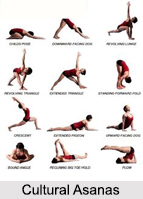
Cultural Asanas
Cultural Asanas refer to the daily physical exercise postures that train the body and mind in Yoga Practice.
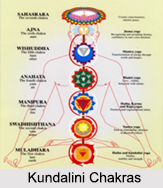
Kundalini Chakras
Kundalini Chakras are psychic energy centres or vortices, which connect between our psychic and physical energy systems.
Patanjali Yoga Sutras
Patanjali’s Yoga Sutras presents a foundational guide to the philosophy and practice of yoga. Through concise aphorisms, it outlines the nature of the...
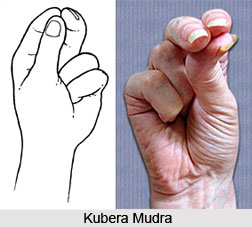
Kubera Mudra
Kubera Mudra, a form of Hatha Yoga, leads to the elevation of mental peace and physical relief by proper practice and cleanses frontal sinuses.